From Threads to Transistors: How the Jacquard Loom Built Modern Computing
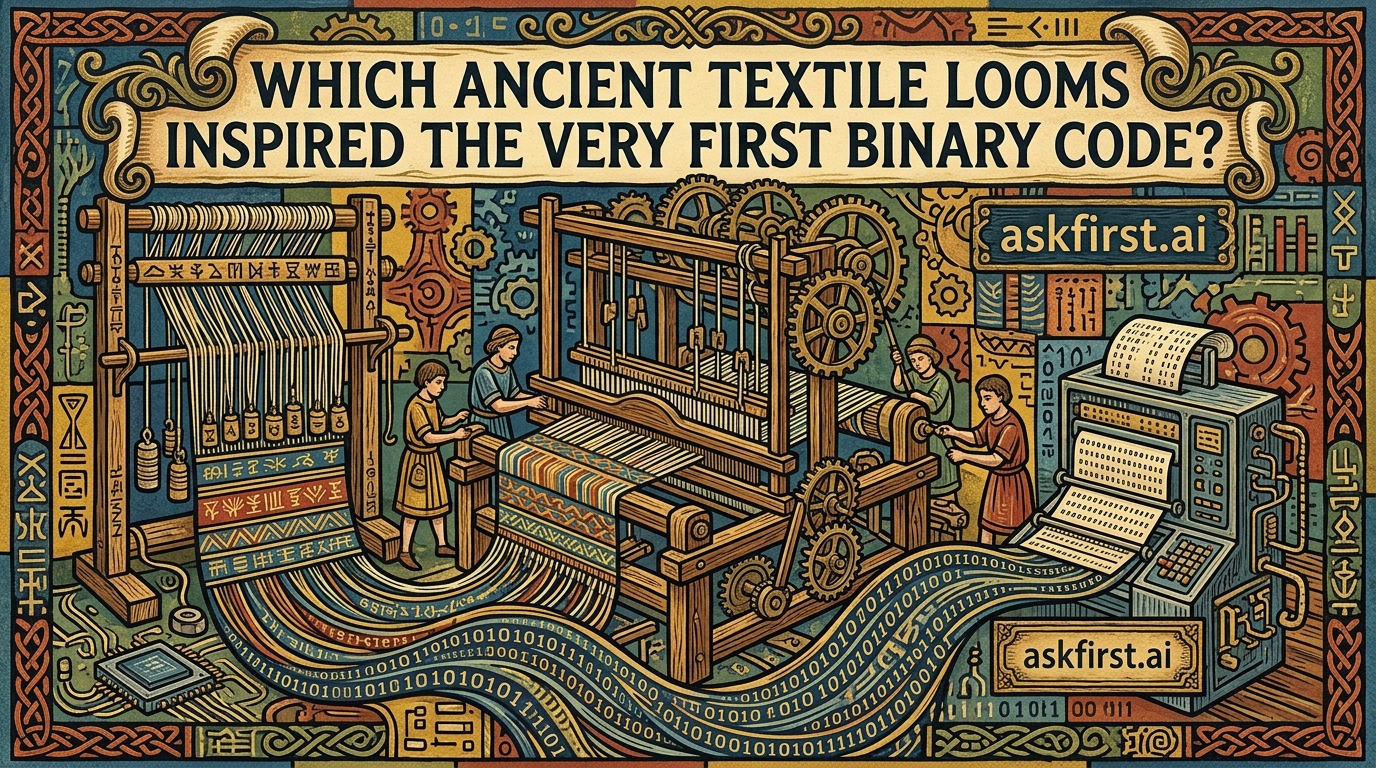
Many assume binary code began with the vacuum tubes of the 1940s, yet the intellectual foundations were laid in 1804. The invention that served as the primary bridge between artisanal craftsmanship and automated logic was the Jacquard Loom, developed by French weaver Joseph Marie Jacquard. This mechanism revolutionized the textile industry by utilizing a system of binary instruction that foreshadowed the modern computer processor by over a century.
The Mechanism of Punch Cards
The brilliance of the Jacquard Loom lay in its use of pasteboard punch cards. Each card featured a pattern of holes that dictated whether specific warp threads were raised or lowered during the weaving process. This was a physical manifestation of binary logic: a hole represented a "one" (active state, thread lifted) and the absence of a hole represented a "zero" (inactive state, thread depressed). By chaining these cards together, weavers could instruct the loom to execute incredibly complex, intricate designs without the need for constant manual recalibration. This shift from physical human labor to machine-read "software" instructions changed industrial manufacturing forever.
Influencing the Analytical Engine
The impact of this technology traveled far beyond the textile factory. In the 1830s, Charles Babbage, often credited as the father of the computer, sought a method to automate the complex calculations of his "Analytical Engine." Babbage was profoundly inspired by Jacquard’s punch cards, recognizing them as a universal method for storing instructions. He envisioned a system where his machine would "weave algebraic patterns just as the Jacquard loom weaves flowers and leaves." Alongside his colleague Ada Lovelace, who is widely regarded as the first computer programmer, Babbage incorporated the concept of punch-card inputs to manipulate data. Lovelace specifically noted the significance of this, realizing that the ability to process symbols according to rules meant that machines could compute much more than just simple arithmetic.
The Legacy of Binary Logic
This historical lineage confirms that the digital age is rooted in the physical repetition of textile patterns. While modern hardware has replaced paper cards with silicon chips and electrical gates, the fundamental logic remains identical to the loom's operation. When a computer runs a program today, it is effectively traversing a digital loom, firing threads of data through a series of "on" and "off" switches that mirror the exact binary flow of a 19th-century weaving machine. The evolution from a loom producing silk damask to a server processing global communications is a testament to the persistent power of binary abstraction. By viewing the loom as an early processor, one gains a clearer understanding of how the transition from mechanical automation to digital computation was not an accident, but a logical progression of industrial ingenuity that prioritized efficiency through standardized instructional code.