The Secret Chemistry Behind Cinema's Monochrome Roots
Many casual viewers assume that early filmmakers chose black and white visuals for artistic or stylistic reasons, much like a modern director might today. However, the reality is deeply rooted in the rigid chemical constraints of early 19th-century photography and chemical engineering. It was not a creative choice; it was a technological necessity driven by the limitations of silver halide sensitivity.
The Role of Silver Halides
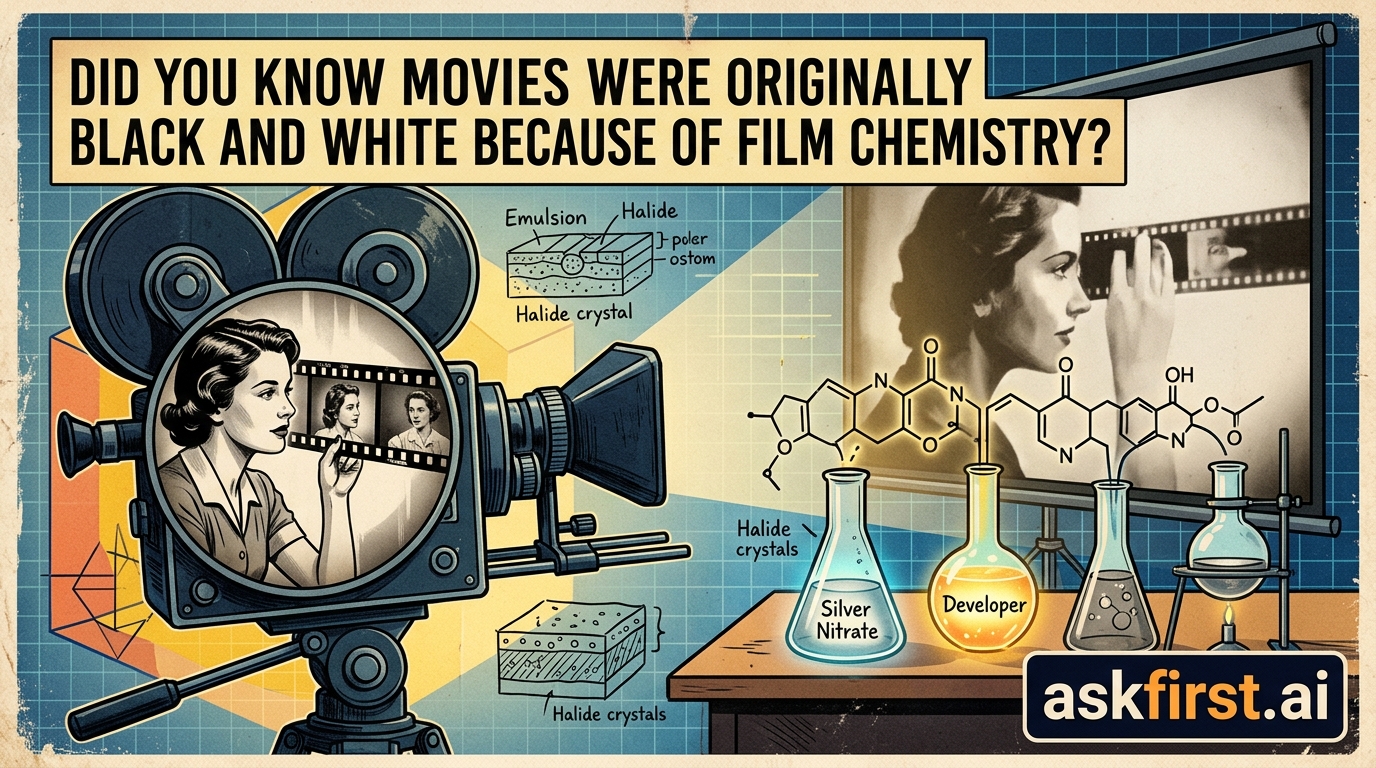
At the dawn of motion pictures, the standard medium was celluloid film coated with a gelatin emulsion containing silver halide crystals. These crystals possess a unique chemical property: when exposed to light, they undergo a reduction reaction that transforms them into metallic silver. This is the fundamental basis of traditional photography. Because these early emulsions were essentially "orthochromatic," they were primarily sensitive to blue and ultraviolet light but largely blind to longer wavelengths like green, yellow, and red. Consequently, vibrant landscapes appeared as muted, muddy grays, and the human eye could not accurately register colors on the film strip even if the film stock had the potential to hold them.
Technological Limitations and Constraints
Achieving full-spectrum sensitivity required adding complex chemical dyes to the emulsion, a process that was not perfected for commercial film until the mid-20th century. While additive processes like Kinemacolor or early Technicolor attempted to bridge this gap, they were notoriously fragile and expensive. Most productions relied on the reliability of the monochrome chemical reaction. The "black and white" look was actually the absence of a chemical solution to capture light across the visible spectrum simultaneously. Filmmakers had to carefully manage set designs, using high-contrast makeup and specific lighting rigs to ensure that actors stood out against their backgrounds, creating a distinct visual language based on shadows and highlights rather than hue.
The Evolution of Color
It took decades of advancements in organic chemistry to introduce "panchromatic" film, which expanded light sensitivity to the entire spectrum. Even after these chemical breakthroughs, the cost remained prohibitive. It wasn't until the refinement of the three-strip Technicolor process—which used prisms to split light into three separate black-and-white strips, each filtered for red, green, and blue—that color became a viable, albeit complex, alternative. This elaborate optical and chemical dance proves that cinema was, from its inception, a struggle to translate the physical world into a chemical recording. The iconic look of early films is therefore a lasting monument to the ingenious ways scientists and artists bypassed the limitations of early chemistry to tell stories that would eventually change the world forever. Understanding this history reveals that the classic aesthetic was born not from intention, but from the raw science of the light-sensitive surface.