Mastering Cartographic Distance: How Maps Represent the World
Maps are mathematical abstractions of the physical world, designed to translate vast three-dimensional landscapes onto two-dimensional planes. Because a flat surface cannot perfectly represent a spherical Earth, cartographers rely on specific tools and techniques to ensure distance remains measurable and meaningful.
1. The Role of Map Scales
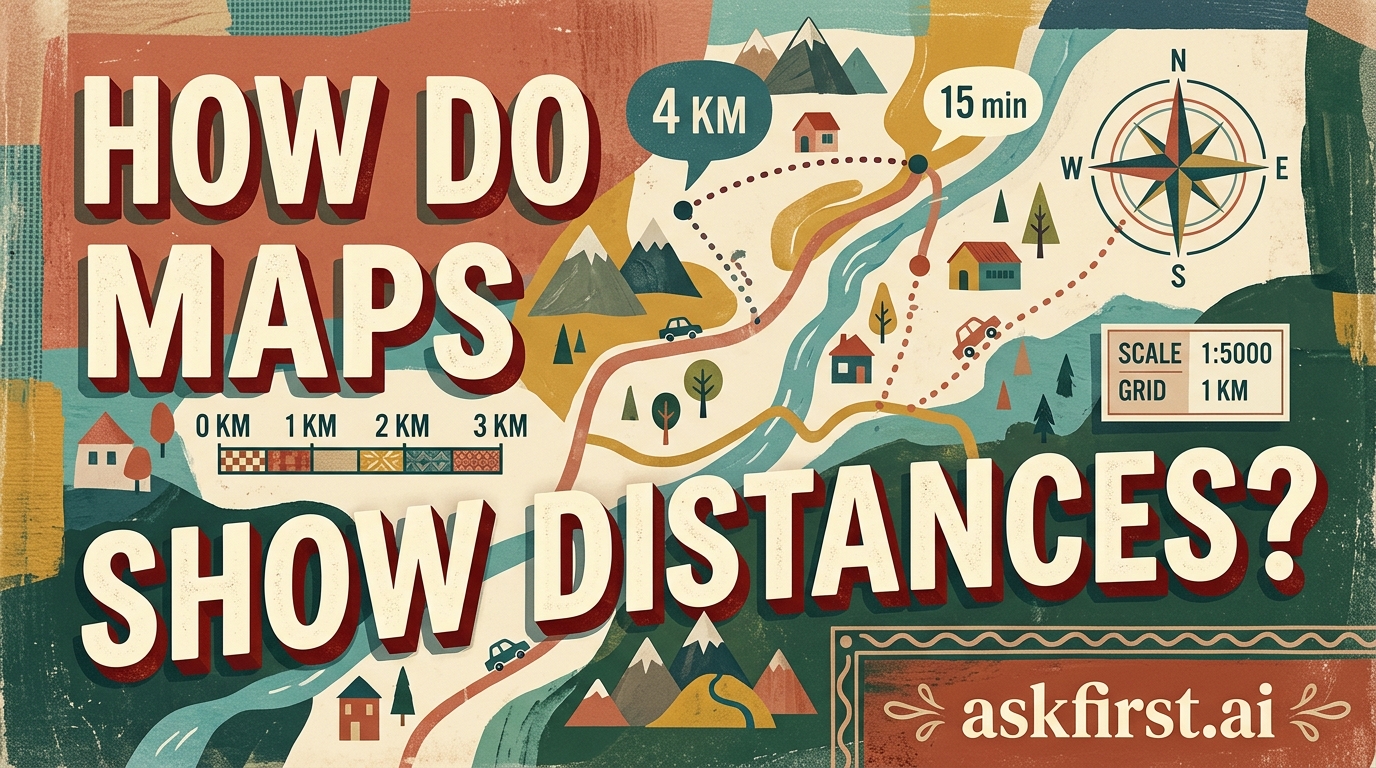
The fundamental mechanism for showing distance is the map scale. This is the ratio between a distance on the map and the corresponding distance on the ground. Scales are typically presented in three formats:
- Representative Fraction (RF): Written as a ratio (e.g., 1:50,000). This means one unit on the map equals 50,000 of the same units on the ground. It is unitless and universally understood.
- Verbal Scale: A written statement such as "one inch equals one mile." While intuitive, it becomes inaccurate if the map is resized or printed at a different scale.
- Graphic (Bar) Scale: A line marked in distances (miles or kilometers). This is the most reliable method because if the map is enlarged or shrunk, the scale bar changes proportionally, maintaining its accuracy.
2. Projection and Distortion
The challenge of cartography is the "Map Projection Problem." To flatten a sphere, some distortion is inevitable—either in shape, area, distance, or direction.
- Equidistant Projections: These specific projections are designed to preserve distance along certain lines (usually from the center point or along meridians). However, they cannot be equidistant in every direction simultaneously.
- The Mercator Trade-off: The famous Mercator projection preserves angles (useful for navigation) but drastically distorts distance and area as one moves toward the poles. Greenland appears larger than Africa, despite being significantly smaller.
3. Practical Guide: Measuring Distances
To determine distances on a physical map, users should follow these steps:
- Identify the Scale: Locate the legend or scale bar.
- Use a Measuring Tool: For straight lines, use a ruler to measure the distance and multiply by the scale factor.
- Handle Curvature: For winding roads or rivers, use a piece of string or a "map wheel" (opisometer). Lay the string along the path, then measure the string against the map’s graphic scale.
- Accounting for Elevation: Standard maps measure "horizontal distance." In mountainous terrain, the actual "slope distance" is greater. Advanced topographical maps use contour lines to estimate vertical gain, which must be factored in for accurate hiking or surveying estimates.
4. Digital Evolution and Future Trends
Modern digital cartography, such as Google Maps or GIS (Geographic Information Systems), has revolutionized distance measurement. These platforms use Geodesy—the science of measuring Earth’s geometry—to calculate "Great Circle" distances (the shortest path between two points on a sphere).
Pros and Cons of Modern Systems:
- Pros: Dynamic scaling, instant routing, and real-time adjustments for traffic or terrain.
- Cons: Over-reliance on GPS can lead to a loss of "spatial literacy." Furthermore, digital maps often hide the underlying projection distortions, making it difficult for users to intuitively grasp the true scale of the continents.
In summary, whether through a simple graphic bar or complex spherical geometry, maps translate the Earth's scale into a manageable format. Understanding the scale and the projection is the key to accurately navigating our world.