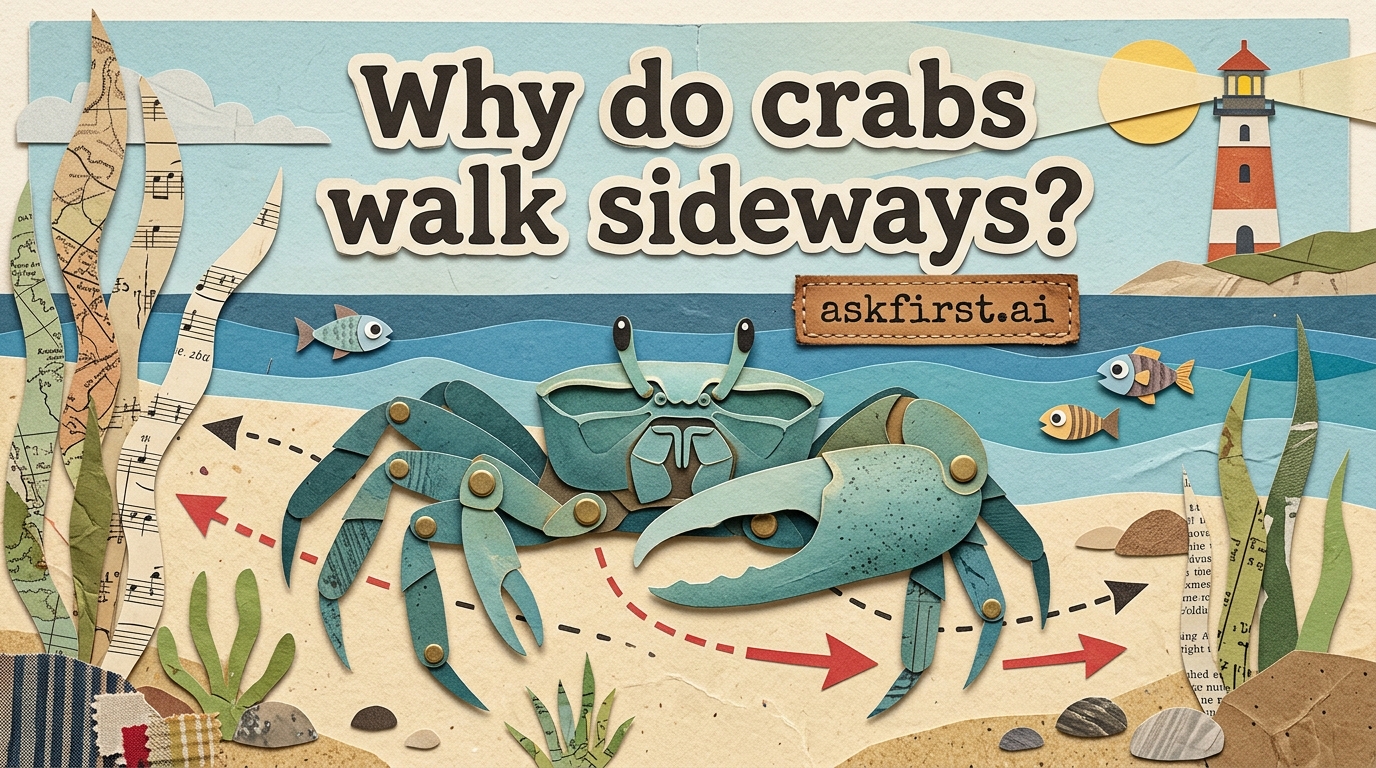
The Mechanics of Motion: Why Crabs Walk Sideways
The peculiar sideways gait of crabs is one of nature’s most fascinating examples of evolutionary optimization. While humans and most land-based mammals are built for forward-facing locomotion, the crab’s physiological design necessitates a lateral approach to movement. This behavior is not a choice, but a functional requirement dictated by their anatomy.
Anatomical Constraints: The Jointed Leg Structure
The primary reason for sideways movement lies in the structure of the crab’s legs. Most crabs possess jointed appendages that function like hinges. These joints are oriented in a way that allows them to bend primarily in one direction—outward and upward.
- The Hinge Mechanism: Because the joints on a crab’s legs are oriented horizontally, they cannot easily bend forward or backward in a way that would propel the body efficiently. Attempting to walk forward would require the legs to splay awkwardly, which is mechanically inefficient and energy-intensive.
- The Carapace Shape: Most crabs have a wide, flattened carapace (shell) that is broader than it is long. This wide body shape provides stability but physically limits the space available for the legs to move in a forward-facing stride.
Evolutionary Advantages
Why would evolution favor such a movement? The answer lies in survival and environment.
- Speed and Evasion: By moving sideways, crabs can move their legs in a rhythmic, coordinated fashion that allows for rapid acceleration. In the face of predators, the ability to "scuttle" sideways across rocky surfaces or sandy beaches provides a distinct advantage, allowing them to retreat into crevices or burrows quickly.
- Stability: Crabs often inhabit intertidal zones where wave action is high. The sideways gait keeps the crab’s center of gravity low and stable, preventing them from being flipped over by oncoming currents.
- Specialization: It is important to note that not all crabs walk sideways. Some species, such as the Raninidae (frog crabs) and certain spider crabs, are capable of moving forward. However, these species have evolved different body shapes—often longer or more streamlined—that accommodate forward motion.
Practical Observation: How They Navigate
If you observe a crab on the beach, you will notice that its eyes are mounted on stalks. This allows for a 360-degree field of vision. When a crab moves sideways, it is essentially keeping its eyes focused on the direction of travel or potential threats, ensuring it does not collide with obstacles while maintaining its lateral speed.
Pros and Cons of Lateral Locomotion
- Pros:
- Enhanced stability on uneven, rocky terrain.
- Rapid escape speed.
- Efficient navigation through narrow, horizontal crevices.
- Cons:
- Limited maneuverability in tight, vertical spaces.
- Higher energy expenditure for long-distance travel compared to forward-gait organisms.
Future Trends and Bio-robotics
The study of crab locomotion has become a cornerstone of biomimetic engineering. Robotics researchers are currently studying crab movement to design "search and rescue" robots capable of traversing disaster zones. By mimicking the crab’s lateral gait and multi-jointed leg structure, engineers are creating machines that can navigate rubble and debris where traditional wheeled or treaded robots fail. As of 2026, these "crab-bots" are being deployed in marine salvage operations, proving that the sideways walk is a masterclass in mechanical design.