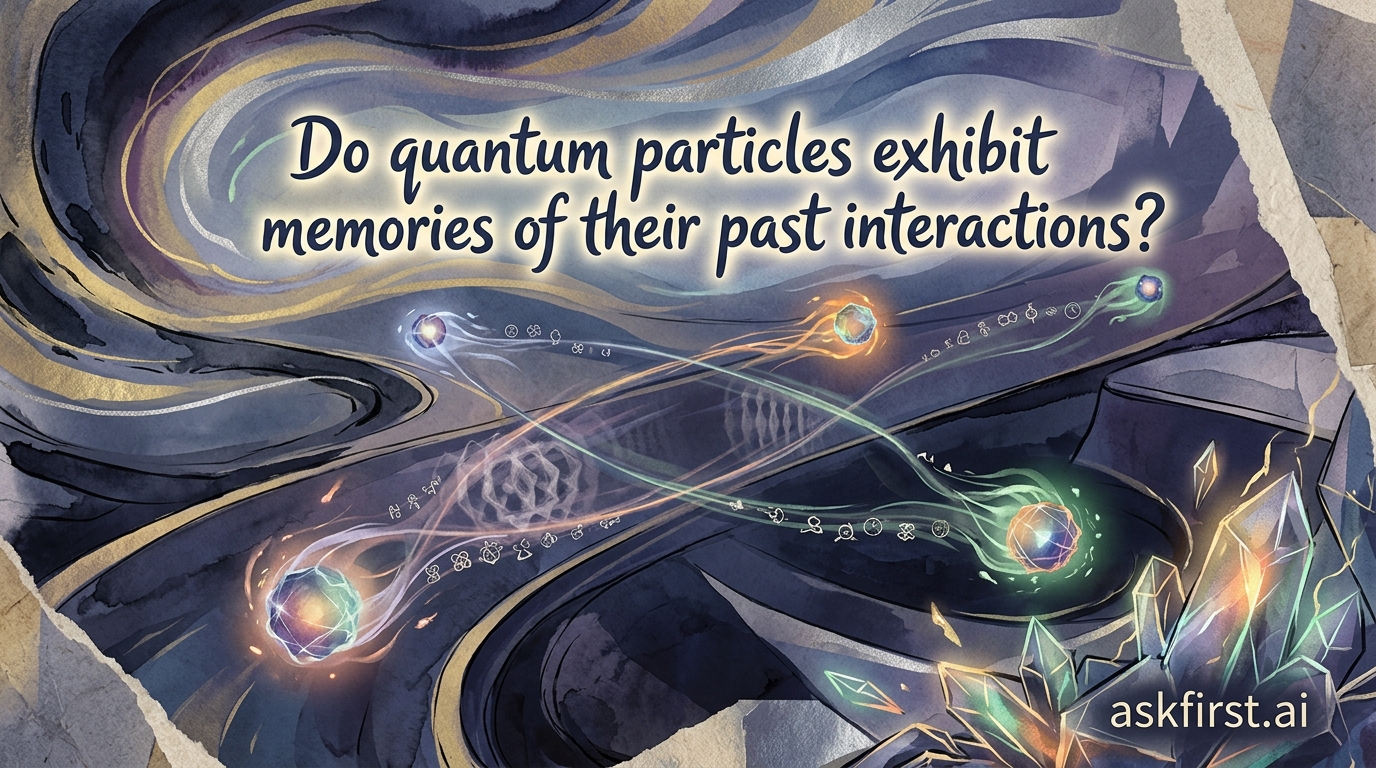
The Quantum Echo: Do Particles Retain Memories?
The concept of memory in the subatomic world challenges our traditional understanding of time and causality. In classical physics, an object’s state is determined entirely by its current position and momentum. However, in quantum mechanics, the behavior of particles often hints at a lingering influence of past interactions, a phenomenon that bridges the gap between quantum entanglement and temporal correlation.
The Role of Quantum Entanglement
At the core of this phenomenon lies entanglement, a state where two particles become linked such that the state of one instantly influences the other, regardless of distance. When particles interact, they often become entangled. This interaction establishes a persistent correlation. If these particles are separated, measurements performed on one particle reveal properties that are fundamentally tied to the prior interaction. This is not a biological memory, but rather a quantum correlation that preserves information about the initial entanglement event. It suggests that the history of the particles is encoded within their joint wave function.
Quantum Eraser Experiments and Causality
One of the most mind-bending examples involves the Delayed Choice Quantum Eraser experiment. In this setup, researchers observed that the choice to measure or 'erase' information about a particle’s path can seemingly retroactively affect the observed interference pattern. While this does not mean the past is literally changed, it highlights that the information regarding a particle's history is physically encoded in the system’s total wave function. If the information is preserved, the interference pattern disappears; if it is erased, the pattern reappears. This demonstrates that nature keeps a record of interactions at the quantum level.
Is It True Memory?
Physicists argue that this is not a 'memory' in the anthropomorphic sense. Instead, it is an expression of decoherence and information preservation. A particle does not 'remember' a specific event to contemplate it; rather, the physical system exists in a state that encompasses all prior interactions that have not been lost to the environment. The information remains encoded in the quantum system as long as isolation is maintained. Once the particle interacts with a macroscopic environment—a process known as decoherence—that record is dispersed, effectively 'forgetting' the past configuration.
Theoretical Implications for the Future
Research into quantum memory is the backbone of the nascent field of Quantum Computing. By engineering stable systems (such as trapped ions or superconducting circuits), scientists are learning to preserve these 'memories' for longer periods. If we can master the ability to hold onto the history of these interactions without interference, we unlock the potential for exponentially faster computation and secure communication. The quantum world is not merely a place of random chance; it is a profound repository of historical interactions defined by the mathematical laws of probability.