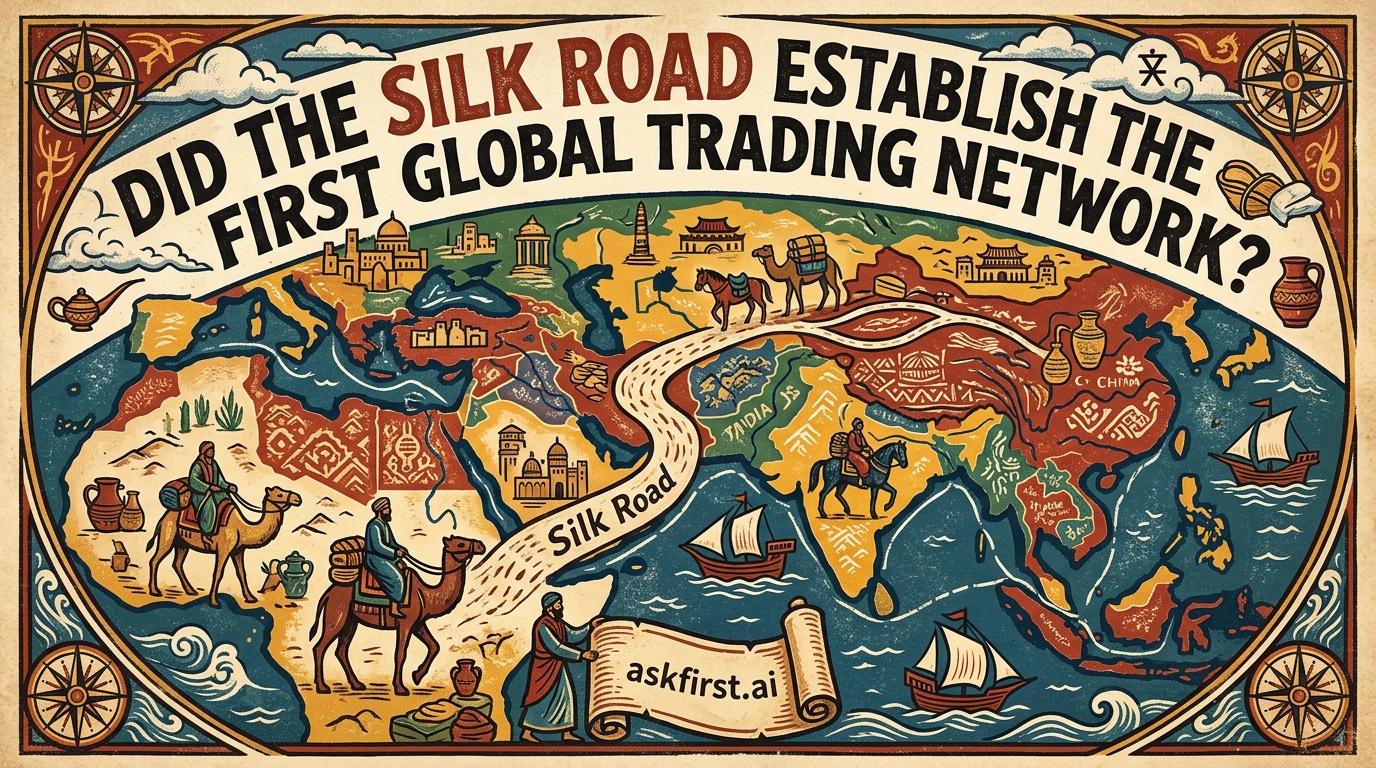
Unveiling the Silk Road: The World's First Global Network
Contrary to popular belief, the Silk Road was not a single paved highway, but a complex, shifting web of caravan routes that connected the East and West for centuries. While it certainly represented an unprecedented scale of transcontinental exchange, historians frequently debate whether it qualifies as the first truly global trading network. To understand its legacy, one must examine the depth and breadth of these ancient interactions.
The Scope of the Silk Road
Spanning from the Han Dynasty in China to the Mediterranean Sea, the Silk Road facilitated the movement of goods, technology, and ideologies. Commodities such as silk, porcelain, spices, and precious metals traveled thousands of miles through central Asian steppes, high mountain passes, and maritime lanes. This exchange did more than just move wealth; it served as a catalyst for the transmission of Buddhism, Islam, and Christianity, alongside revolutionary technologies like papermaking and gunpowder.
Challenging the "Global" Definition
Was it truly global? Technically, the Silk Road focused on the Afro-Eurasian landmass. It excluded the Americas, Australia, and sub-Saharan Africa from its primary loops. Therefore, in a strict geographical sense, it was a massive inter-regional network rather than a global one. Scholars argue that true globalization only emerged during the Age of Discovery in the 15th century when maritime routes finally linked all inhabited continents, including the Americas, into a singular commercial orbit.
The Precursor to Modern Systems
Despite the geographical limitations, the Silk Road functioned as the primary blueprint for globalization. It introduced the world to the concept of long-distance trade interdependency. When economic or political shifts occurred in China, their effects were eventually felt in the markets of Rome or the bazaars of Persia. This phenomenon, known as "trans-regional connectivity," created a proto-globalized mindset where the demand for foreign goods drove international relations and regional specialization.
The Architecture of Exchange
The network was sustained by three foundational elements:
- The Caravanserai System: These were the ancient equivalents of truck stops, providing security, food, and lodging for merchants, ensuring that trade could continue across hostile environments.
- Diplomatic Safekeeping: Powerful empires, including the Mongols, recognized the value of the routes and provided protections that allowed trade to flourish safely under their influence.
- Monetary Standardization: As trade volume grew, merchants developed sophisticated credit systems and promissory notes, reducing the dangers of carrying physical gold or silver.
Conclusion: A Legacy of Connectivity
While the Silk Road did not encompass the entire globe by modern definitions, it was undeniably the ancestor of our current interconnected world. It proved that distance was not a permanent barrier to progress, setting the stage for every trade agreement and logistics network that followed. By integrating diverse civilizations, it transformed local economies into parts of a greater, world-shaping system.