The Accidental Revolution: How Stage Magic Sparked Surgical Anesthesia
For centuries, surgery was synonymous with agony, and surgeons were judged by the speed of their blades rather than the precision of their technique. The transition to painless medicine did not emerge from within the sterilized walls of elite medical schools, but rather from the rowdy, smoke-filled exhibition halls of the 19th century. The discovery of modern anesthesia is a quintessential example of scientific advancement occurring at the intersection of popular entertainment and chemical experimentation.
The Era of Ether Frolics
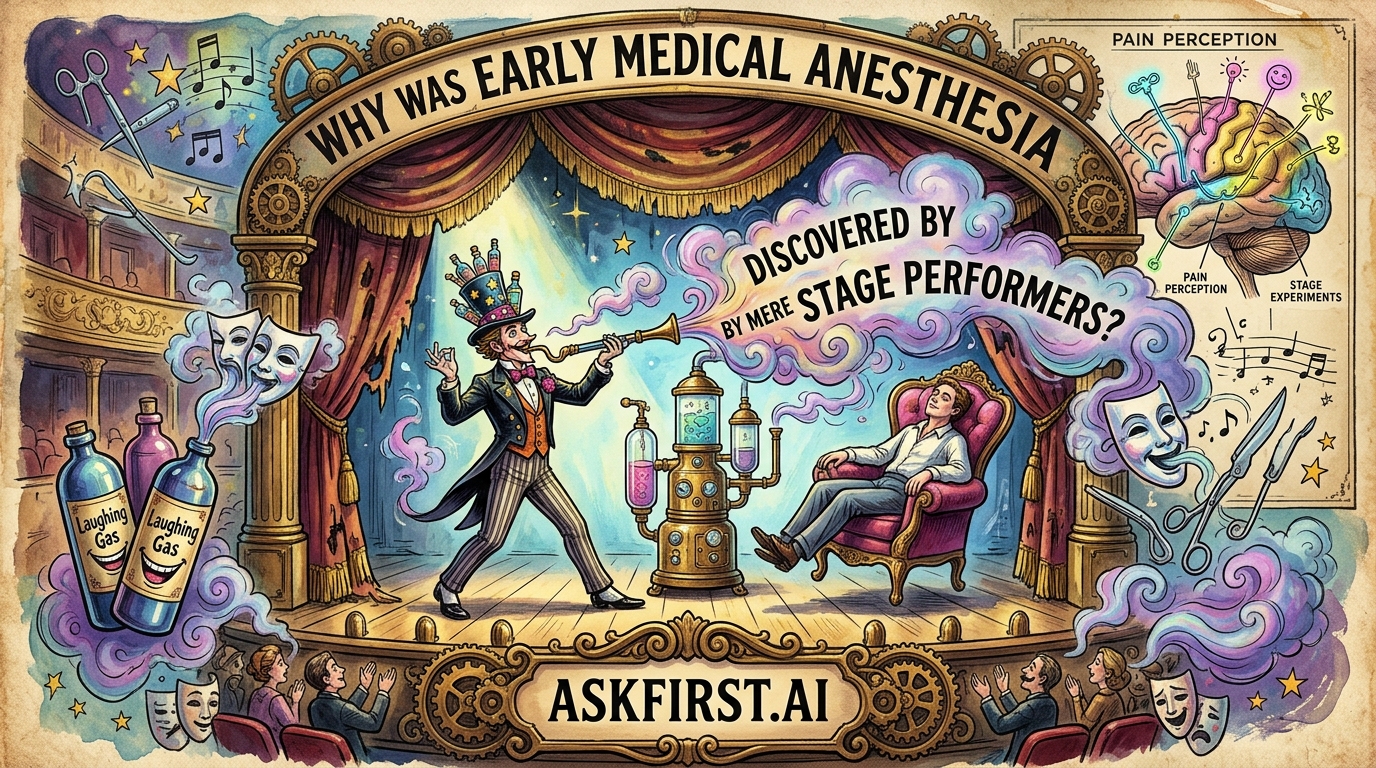
In the early 1800s, substances like nitrous oxide (laughing gas) and ether became the stars of traveling roadshows. Performers, often referred to as lecturers or showmen, would invite audience members onto the stage to inhale these vapors. The goal was purely amusement: participants would exhibit bizarre, often hilarious behavior, ranging from uncontrollable giggling to wild, uncoordinated dancing. These events, known as "ether frolics," turned chemistry into a public spectacle. It was in this chaotic environment that the true potential of these chemicals was inadvertently revealed.
The Power of Observation
While the medical establishment remained focused on anatomical studies and surgical speed, showmen observed a peculiar secondary effect: intoxication under these vapors rendered the subjects insensitive to physical injury. Audience members would frequently stumble, fall, or bang into furniture while under the influence, yet they appeared completely unfazed and oblivious to any pain. It was the keen, non-academic eye of individuals like Gardner Quincy Colton, a traveling lecturer, that bridged the gap between entertainment and clinical utility. Colton famously traveled across the United States demonstrating the effects of nitrous oxide to wide-eyed crowds.
Bridging the Gap to Clinical Medicine
Historians point to several key figures who translated stage findings into medicine:
- Gardner Quincy Colton: His public demonstrations of nitrous oxide caught the attention of Horace Wells, a dentist who realized the potential for painless tooth extractions.
- William T.G. Morton: A student of Wells who witnessed the limitations of nitrous oxide, Morton turned his attention to ether, which provided a more sustained period of unconsciousness.
- Crawford Long: Independently inspired by the recreational use of ether in social settings, he performed the first surgery using ether anesthesia in 1842.
Why Stage Performers?
The medical elite of the era were inherently conservative, viewing the surgical process as a trial of human fortitude. In contrast, stage performers had a vested interest in exploring the boundaries of human sensation for the sake of profit and audience engagement. Their willingness to experiment with volatile chemicals without the constraints of rigid academic paradigms allowed them to see what doctors had missed for centuries: that pain was not an inevitable requirement of healing.
Ultimately, the revolution of painless surgery was born from curiosity rather than clinical mandate. The legacy of these showmen reminds us that some of the greatest breakthroughs in human history arise from the margins, fueled by the audacity of those willing to look at the world differently.