The Science of Avian Waterproofing: How Feathers Defy Water
Feathers are marvels of biological engineering, balancing the need for lightweight flight with the necessity of thermoregulation and dryness. The natural waterproofing of birds is not a single mechanism but a sophisticated synergy of chemical secretions and intricate physical structures.
1. The Preen Gland: The Chemical Foundation
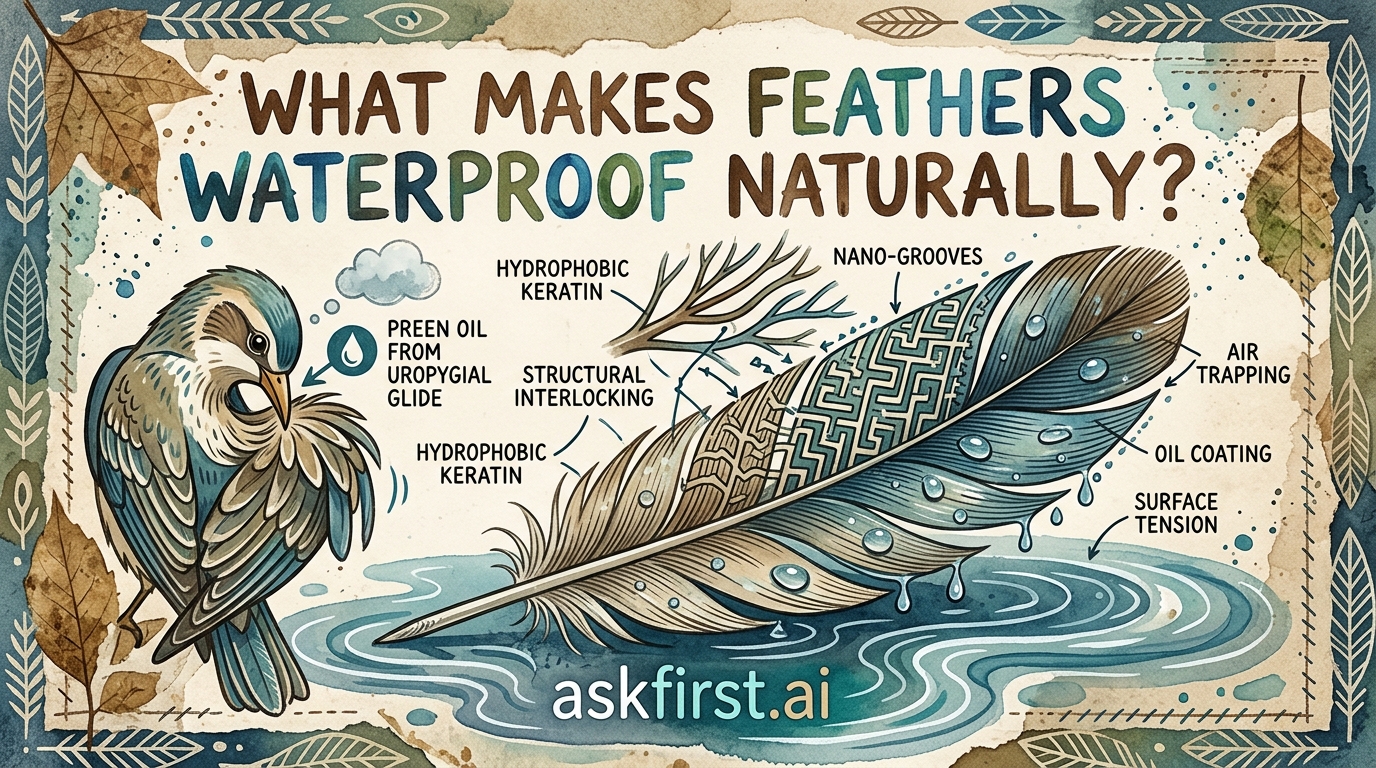
The primary source of avian waterproofing is the uropygial gland, commonly known as the preen gland. Located at the base of the tail, this gland secretes an oily, waxy substance containing a complex mixture of fatty acids, fats, and waxes.
- Application Process: Birds use their beaks to collect this oil and meticulously distribute it across their feathers through a process called "preening."
- Chemical Properties: These lipids are hydrophobic, meaning they repel water molecules. When applied, they form a thin, protective film over the feather’s keratin surface. This film prevents water from soaking into the feather’s core, forcing it to bead up and roll off.
2. Structural Hydrophobicity: The Micro-Architecture
Beyond chemical coatings, the physical structure of a feather—specifically its barbs and barbules—is essential for water resistance. This is often referred to as the "Lotus Effect."
- Interlocking Barbs: Feathers are composed of a central shaft (rachis) with barbs branching off. These barbs are lined with tiny hooks called barbicels. When a bird preens, these hooks interlock like a zipper, creating a continuous, smooth surface.
- Surface Tension: The microscopic geometry of these interlocking structures traps a layer of air against the feather. This "air-cushion" prevents water from penetrating the gaps between the barbs. Because the water cannot bridge the gap between the tiny fibers, it remains on the surface, unable to saturate the downy insulation underneath.
3. Maintenance and Practical Application
Waterproofing is not a permanent state; it requires constant maintenance. If a bird’s feathers become damaged or the oil is stripped away (for example, by oil spills or detergents), the bird loses its insulation.
Steps for Optimal Feather Health:
- Grooming: Birds spend a significant portion of their day preening to ensure the uropygial oil is evenly distributed.
- Molting: Old, worn-out feathers lose their structural integrity and ability to repel water. Molting allows birds to replace damaged feathers with fresh, hydrophobic ones.
- Bathing: Contrary to intuition, birds bathe in water to clean their feathers of dust and debris, which allows the preen oil to adhere more effectively to the keratin.
4. Pros and Cons of Avian Waterproofing
- Pros:
- Thermoregulation: Keeping the downy under-feathers dry is critical for maintaining body temperature in cold environments.
- Buoyancy: Trapped air bubbles within the feather structure increase buoyancy for aquatic species like ducks and penguins.
- Flight Efficiency: Dry feathers are lighter, ensuring that the bird’s weight remains constant during flight, even in rain.
- Cons:
- Energy Intensive: The constant need to preen and maintain the plumage is time-consuming and leaves birds vulnerable to predators.
Future Trends and Bio-mimicry
Engineers are currently studying avian feather structures to develop superhydrophobic synthetic materials. By mimicking the microscopic architecture of barbs, researchers hope to create self-cleaning, water-repellent coatings for textiles, medical devices, and marine vessels. This intersection of ornithology and material science continues to drive innovation in sustainable, non-toxic waterproofing solutions.