The Sonic Legacy: How Ancient Engineering Shapes Modern Sound
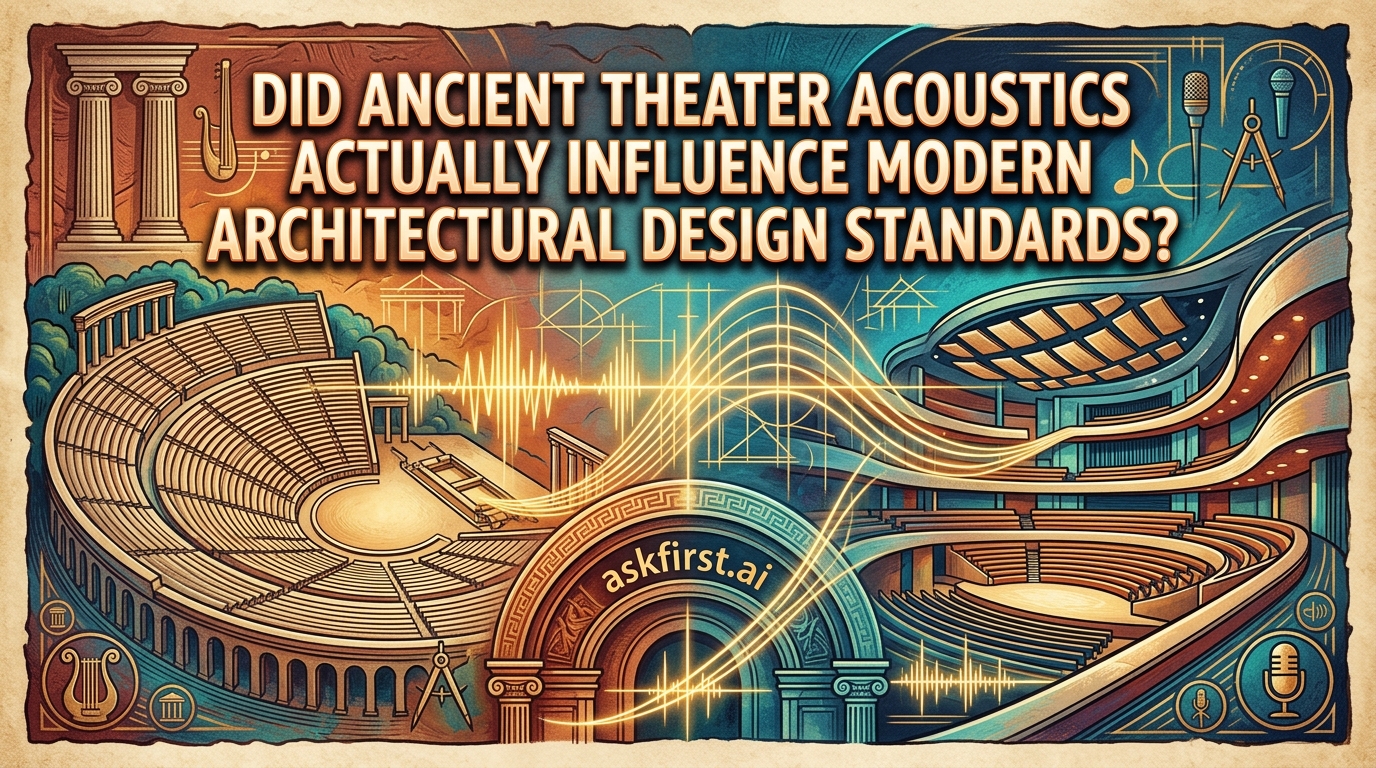
Ancient Greek theaters, such as the famous Epidaurus, are not merely relics of stone and stage. They stand as a testament to advanced empirical acoustics that continue to inform the structural blueprints of modern concert halls and arenas. The influence of these ancient spaces on current architectural standards is profound, moving far beyond aesthetic imitation to fundamental physical principles.
The Physics of the Greek Slope
The primary architectural secret of ancient theaters is the steep angle of the seating rake. Architects like Polykleitos the Younger discovered that this geometry served a dual purpose. By increasing the angle of the seats, they reduced the distance between the performer and the spectator, thereby lowering atmospheric absorption of sound. Furthermore, the hard stone surfaces acted as reflective barriers, while the soft, human-filled benches acted as diffusers. Modern stadium architects now utilize computer modeling to replicate these specific angles to optimize the 'direct-to-reverberant' sound ratio, ensuring that every seat receives high-fidelity audio without the need for electronic reinforcement.
Filtering Noise through Limestone
Recent scientific studies, such as those conducted by researchers at the Georgia Institute of Technology, uncovered a surprising acoustic filter in ancient Greek seating. The limestone benches were found to act as natural frequency filters. By reflecting high-frequency sounds—such as the sibilance in speech—toward the audience while suppressing low-frequency background noise like wind or crowd murmur, the design effectively boosted the intelligibility of the performers. This principle is a cornerstone in the design of modern lecture halls and multi-purpose performance spaces, where ambient noise control is paramount for clear communication.
The Diffusion of Sound
The ancient theater relied on the circular layout of the orchestra and the fan-shaped seating to distribute sound energy evenly. This geometry is directly mirrored in the 'Vineyard' or 'Fan' seating styles found in world-class concert halls like the Berlin Philharmonic. By avoiding parallel walls, which create unwanted standing waves and echo, modern architects replicate the ancient focus on irregular, non-parallel surfaces to promote sound diffusion. This approach ensures a warm, immersive auditory environment.
Legacy in Modern Standards
The integration of ancient acoustics into modern design is not an accident but a result of rigorous cross-disciplinary collaboration between acoustical engineers and architects. Contemporary standards for 'Reverberation Time' (RT60) and 'Speech Transmission Index' (STI) rely on the same geometric foundations established by the Greeks. By studying the successes of antiquity, engineers have learned to harness structural geometry to achieve acoustic clarity that sustains the emotional power of a live performance. In essence, while the tools have evolved from chisels to digital algorithms, the core laws of sound propagation remain the eternal legacy of ancient theater design.