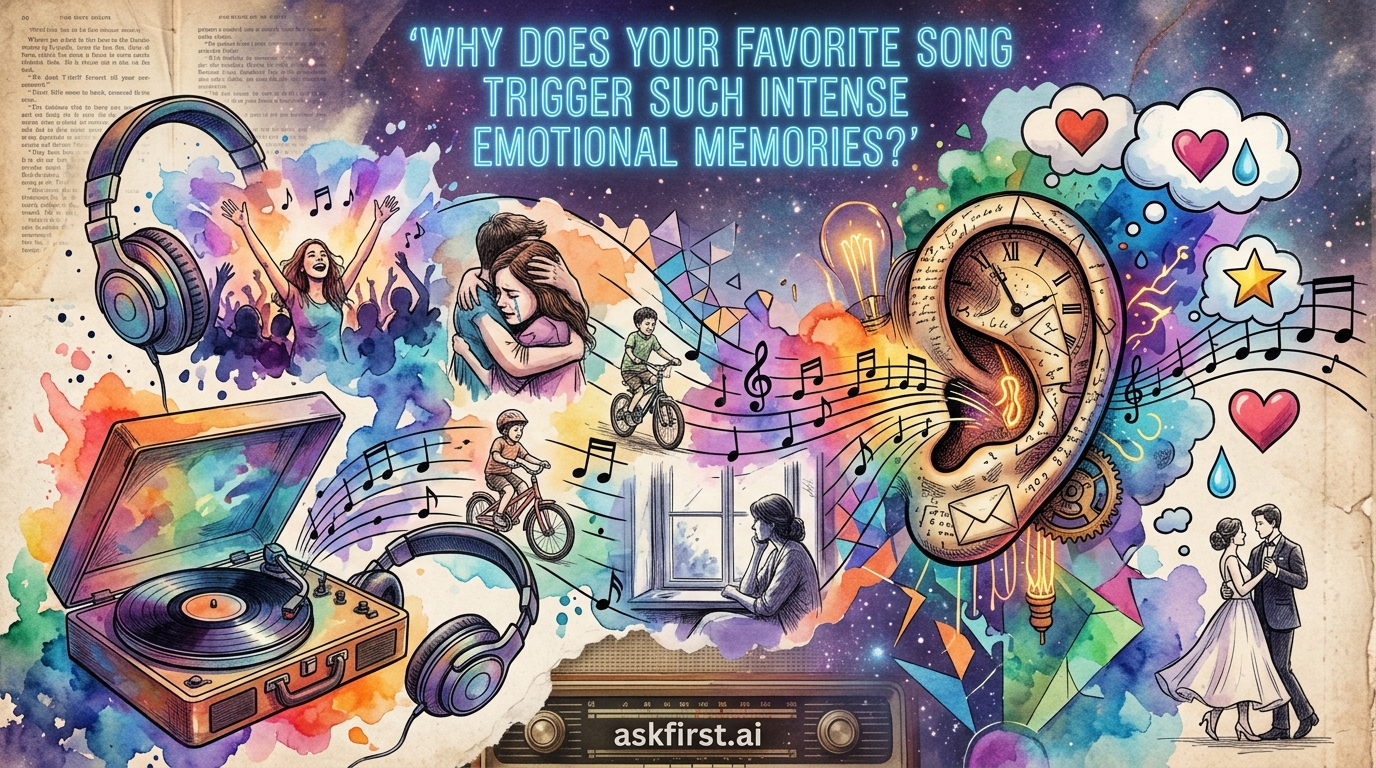
The Sonic Time Machine: Why Music Unlocks Deep Emotional Memories
Music possesses a unique, almost supernatural ability to transport individuals back to specific moments in their lives. This phenomenon, often described as a 'sonic time machine,' is deeply rooted in the complex architecture of the human brain. Unlike other sensory inputs, music activates widespread neural networks that link auditory processing with autobiographical memory, emotion, and motor coordination.
The Neurology of Musical Nostalgia
When a familiar song plays, the brain engages in a multi-region activation pattern. Key areas involved include:
- The Medial Prefrontal Cortex: This region is critically linked to both autobiographical memory and the self-identity, acting as a bridge between current experience and past life events.
- The Hippocampus: Essential for memory retrieval, this area ensures that the sound patterns are instantly associated with specific past contexts, such as a childhood summer or a significant life milestone.
- The Amygdala: As the emotional hub, the amygdala processes the affective tone of the music, triggering the release of dopamine—the brain's reward chemical—which explains why hearing a 'golden oldie' feels so inherently pleasurable.
The Reminiscence Bump and Neural Pruning
Psychological research, notably the work surrounding the 'Reminiscence Bump,' suggests that memories from adolescence and early adulthood are particularly vivid. During these developmental years, neural pathways are highly malleable. When music is paired with the heightened hormonal and emotional state of youth, the brain encodes these associations with extreme durability. The music essentially becomes a structural component of the identity being formed at that time, making the retrieval of those memories effortless and intense decades later.
Why Songs Are More Potent Than Words
While photographs and text provide visual or intellectual data, music operates on a rhythmic and harmonic level that mirrors human biological functions, such as heart rate and respiration. This 'entrainment' allows music to bypass analytical thought and trigger an immediate physiological response. Studies indicate that because the auditory cortex has direct, high-speed neural connections to the limbic system, music can bypass the 'middleman' of rational processing. This results in an emotional gut-reaction that occurs before the listener has time to consciously recall the memory itself.
Conclusion
This intricate dance between sound and biology transforms favorite songs into archival markers of the self. By anchoring ephemeral life experiences to stable rhythmic structures, the human brain ensures that no matter how much time passes, the sound of a few specific chords can instantly recreate the internal landscape of the past. It is not merely an act of remembering; it is a neurological re-experiencing of the emotional truth of one's own history.