The Musical Origins of Computational Logic: Debunking the Programming Myth
There exists a pervasive, romanticized belief that the very first computer program ever written was a piece of music, composed to make a machine "sing." While the story of machines making music is deeply intertwined with the history of technology, the reality of the first computer program is both more mathematical and surprisingly devoid of audible melody. To understand the genesis of computer programming, one must travel back to the mid-19th century and the collaboration between Charles Babbage and Ada Lovelace.
The Reality of the Analytical Engine
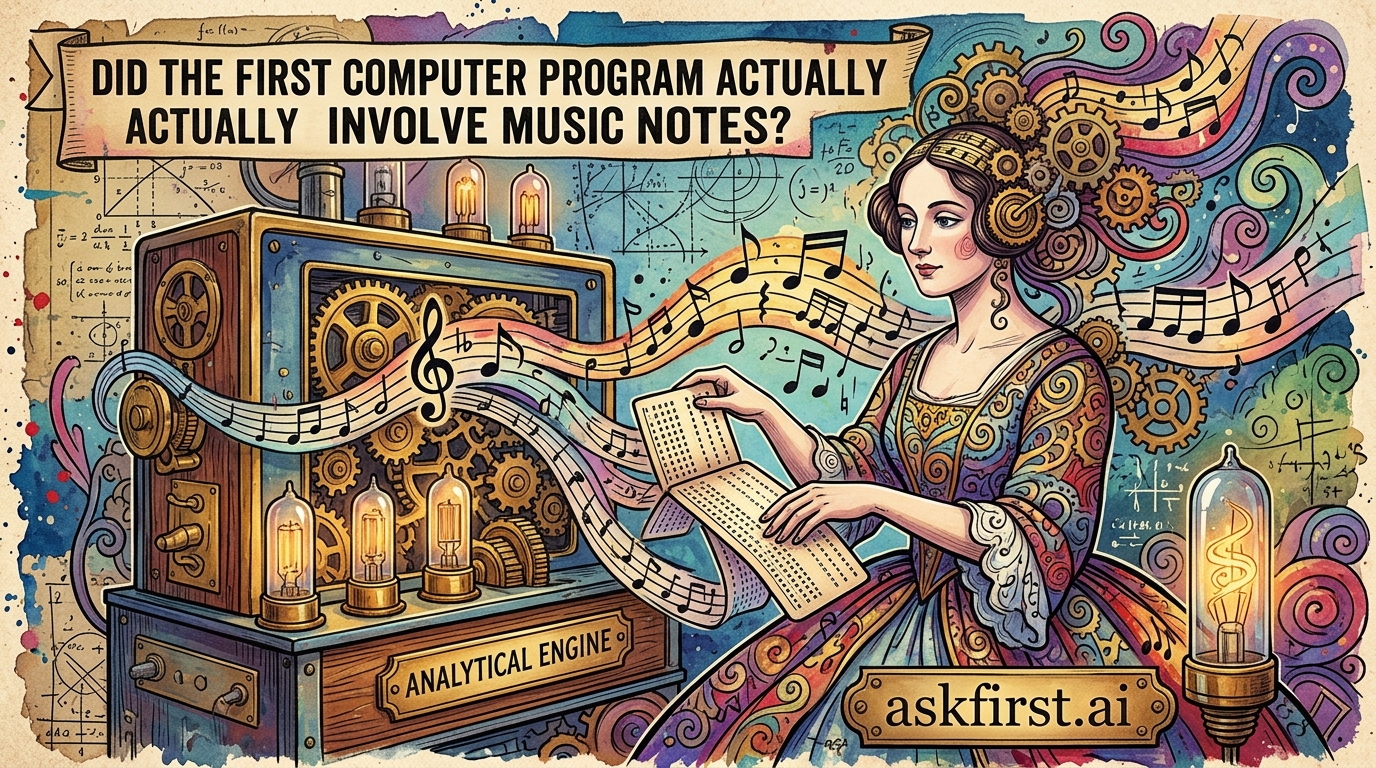
In the 1840s, Ada Lovelace worked on translations and notes regarding Babbage’s proposed Analytical Engine, a mechanical general-purpose computer. Her most famous contribution, "Note G," contained an algorithm designed to calculate Bernoulli numbers. This specific sequence of operations is widely recognized by historians and computer scientists as the first computer program. It was purely mathematical, focused on recursive calculation rather than artistic composition.
Lovelace herself recognized the potential for future machines to go beyond mere calculation. She noted in her writings that the engine might act upon things other than numbers, suggesting that if the fundamental relations of pitched sounds in the science of harmony were adaptable to such expression, the machine could compose elaborate and scientific pieces of music of any degree of complexity. However, this remained a visionary projection—a theoretical possibility—rather than the actual content of the first program.
Why the Confusion Persists
The myth likely stems from a conflation of Lovelace’s theoretical musings with actual later developments. Decades later, inventors such as Alan Turing and Christopher Strachey did indeed experiment with computer-generated music. In 1951, the Ferranti Mark 1 computer performed a version of the national anthem, which was a landmark moment in early human-computer interaction. Because these public demonstrations were sensational, they often overshadowed the dry, algebraic work of the 1840s in the public imagination.
Distinguishing Logic from Artistry
To appreciate the history of computing, one must distinguish between:
- Mathematical Programming: The foundational logic used to solve complex numerical problems, as seen in Lovelace's work on Bernoulli numbers.
- Algorithmic Creativity: The later application of these logical structures to manipulate frequencies and rhythms to create sound.
While music notes were not the subject of the first program, the mathematical structure of music—the very ratios and sequences that form scales—is deeply rooted in the same logic that drives computation. The transition from processing numbers to processing audio signals is a testament to the versatility of the stored-program architecture. Ada Lovelace successfully identified that hardware is a medium for information, regardless of whether that information represents a geometric series or a musical chord, cementing her status as the visionary pioneer of the computational age.