The Science of Elasticity: Why Rubber Stretches and Snaps Back
Rubber’s unique ability to stretch significantly and return to its original shape is a phenomenon defined by the science of polymers. Unlike rigid materials, rubber is an elastomer—a polymer with viscoelasticity—meaning it possesses both viscosity and elasticity. Its behavior is dictated by its molecular structure, specifically the arrangement and interaction of long-chain molecules.
The Molecular Architecture: Polymer Chains
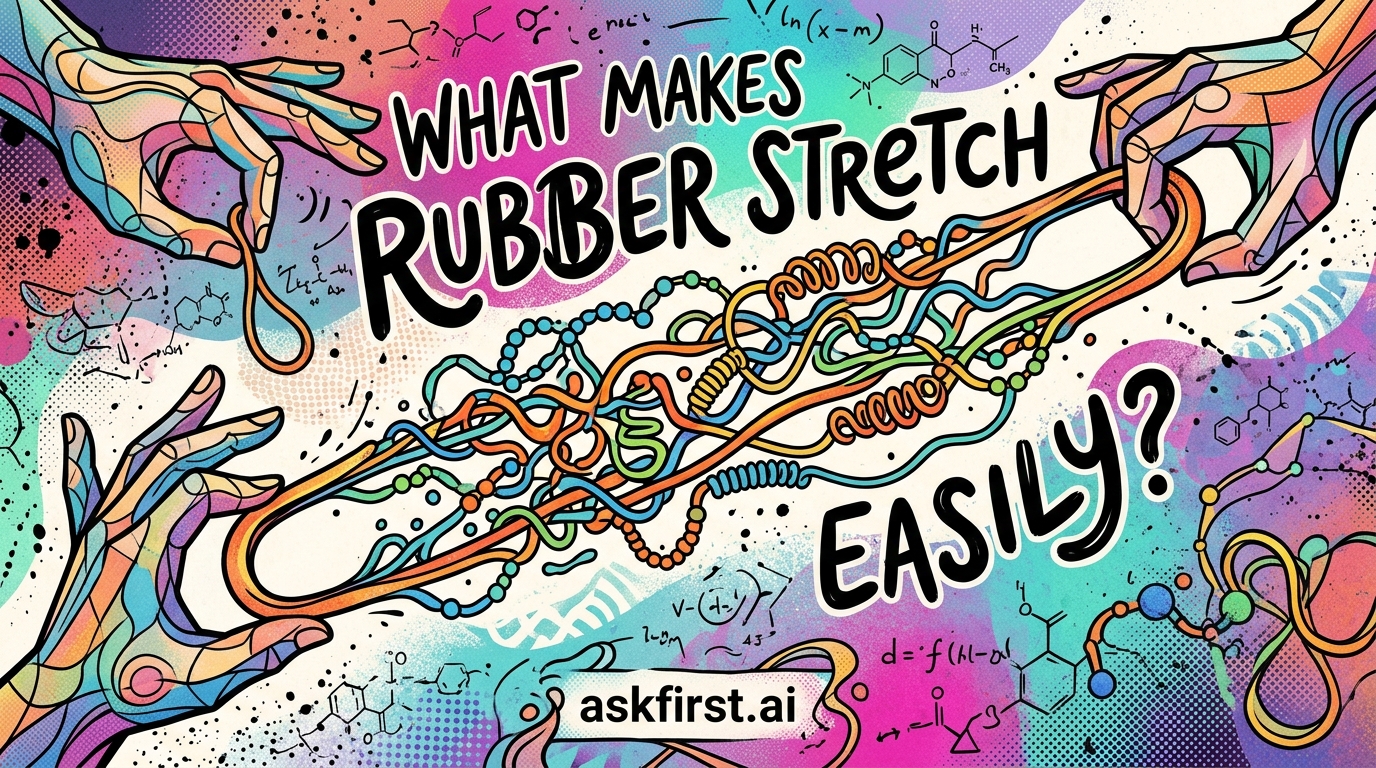
At the microscopic level, rubber consists of long, tangled chains of molecules called polymers (typically polyisoprene). In its natural state, these chains are coiled, twisted, and randomly oriented, much like a bowl of cooked spaghetti.
When you apply a stretching force to a piece of rubber, you are not stretching the actual chemical bonds between the atoms. Instead, you are uncoiling and straightening these tangled polymer chains. As the chains align in the direction of the tension, the material elongates. This process is physically easy because the individual chains are held together by relatively weak intermolecular forces rather than rigid, permanent lattice structures found in metals or ceramics.
The Role of Cross-Linking: Vulcanization
If rubber were just a collection of loose chains, it would deform permanently when stretched. To prevent this, rubber undergoes a process called vulcanization, discovered by Charles Goodyear in 1839.
- The Process: Sulfur is added to the rubber and heated. This creates chemical "bridges" or cross-links between the polymer chains.
- The Result: These cross-links act like anchors. When the rubber is stretched, the chains pull against these anchors. Once the external force is removed, the stored potential energy in these cross-linked chains causes them to snap back into their original, tangled, low-entropy configuration. Without vulcanization, rubber would remain sticky and lose its "memory" of its original shape.
Entropy: The Driving Force
Interestingly, the "snap back" effect is largely driven by entropy. In its relaxed state, the coiled, random shape of rubber molecules is the most statistically probable (highest entropy) state. When you stretch rubber, you force the molecules into a more ordered, less probable state. Nature prefers the high-entropy, disordered state, so the rubber naturally seeks to return to its coiled configuration as soon as the tension is released.
Practical Applications and Considerations
Rubber's elasticity makes it indispensable in modern engineering:
- Automotive: Tires must absorb road shocks and return to their shape after compression.
- Medical: Latex gloves provide a tight, conforming fit due to their high elongation ratio.
- Industrial: O-rings and seals rely on this material to maintain pressure in changing environments.
Pros: High flexibility, excellent energy absorption, and durability.
Cons: Rubber is susceptible to degradation from UV light, ozone, and extreme temperatures, which can break the cross-links (a process called "perishing"), leading to brittleness.
Future Trends
The industry is moving toward self-healing elastomers and sustainable biopolymers. Future materials aim to mimic natural rubber’s elasticity while increasing resistance to heat and chemical degradation, ensuring that the next generation of synthetic materials remains functional in increasingly harsh environments.