The History and Evolution of Electricity: From Static Sparks to Modern Power
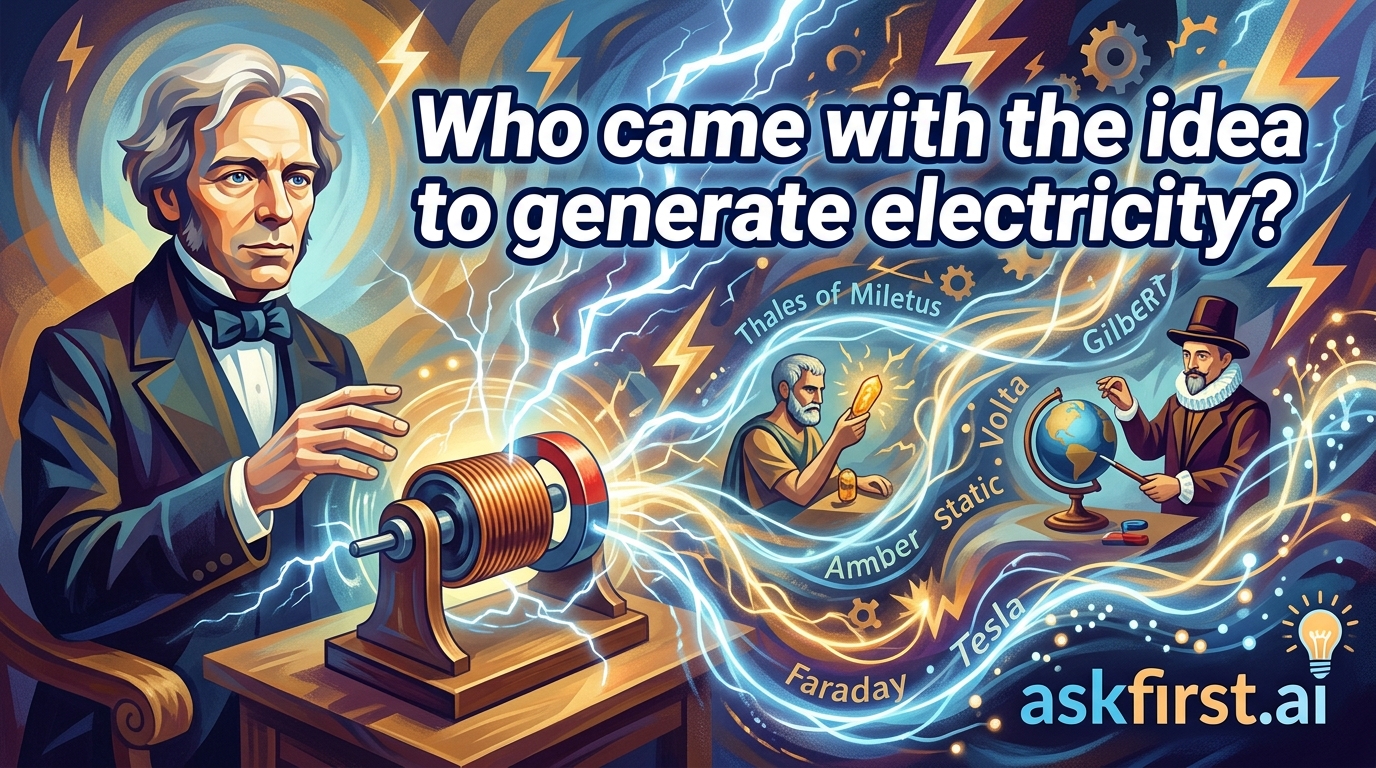
The quest to understand and generate electricity was not the work of a single inventor, but rather a multi-century collaborative effort involving philosophers, scientists, and engineers. While ancient cultures observed static electricity, the systematic generation of electrical power as we know it today emerged through a series of incremental breakthroughs.
Ancient Observations and Early Experiments
The term "electricity" is derived from the Greek word elektron (amber). As early as 600 BCE, Thales of Miletus observed that rubbing amber with fur created an attraction to light objects, a phenomenon we now call static electricity. However, it remained a mere curiosity for nearly two millennia. The true scientific exploration began in 1600 with William Gilbert, who coined the Latin term electricus to describe the force exerted by certain substances when rubbed.
The 18th Century: Harnessing the Spark
The 18th century served as the foundational era for electrical research:
- Benjamin Franklin (1752): His famous kite experiment proved that lightning and tiny electrical sparks were the same phenomenon, leading to the invention of the lightning rod.
- Luigi Galvani (1780s): He discovered "animal electricity" by observing that frog muscles twitched when struck by a spark, laying the groundwork for bio-electromagnetism.
- Alessandro Volta (1800): Volta invented the Voltaic Pile, the world's first true battery. By stacking alternating discs of zinc and copper separated by brine-soaked cardboard, he created the first source of continuous, steady electrical current, moving beyond the fleeting nature of static sparks.
The 19th Century: The Birth of the Generator
The leap from chemical batteries to industrial-scale generation occurred in the 1830s through the study of electromagnetism.
- Michael Faraday (1831): Often considered the "Father of Electricity," Faraday discovered electromagnetic induction. He demonstrated that moving a magnet through a coil of wire induced an electric current. This principle remains the basis for almost every modern power plant, from coal to wind turbines.
- Hippolyte Pixii (1832): Building on Faraday’s work, Pixii constructed the first practical dynamo (electric generator).
The War of Currents
By the late 1880s, the focus shifted to distribution.
- Thomas Edison: Promoted Direct Current (DC), establishing the first central power station in New York City (1882).
- Nikola Tesla and George Westinghouse: Championed Alternating Current (AC). AC proved superior because it could be stepped up to high voltages via transformers, allowing electricity to be transmitted over long distances with minimal loss. The adoption of AC solidified the modern power grid.
Pros, Cons, and Future Trends
Pros and Cons
- Pros: Electricity is a versatile energy carrier, powering everything from global infrastructure to medical technology. It is essential for modern economic development.
- Cons: Traditional generation methods (fossil fuels) contribute significantly to carbon emissions, and the infrastructure requires immense capital investment.
Future Trends
The future of generation is shifting toward decentralization and renewables. Solar photovoltaics and wind energy are replacing centralized steam turbines. Furthermore, research into Nuclear Fusion promises a future of near-limitless, clean energy, representing the ultimate evolution of the quest sparked by the simple rubbing of amber thousands of years ago.