How Deserts Form: The Science of Arid Landscapes
The Geomorphology of Aridity: How Deserts Form Over Time
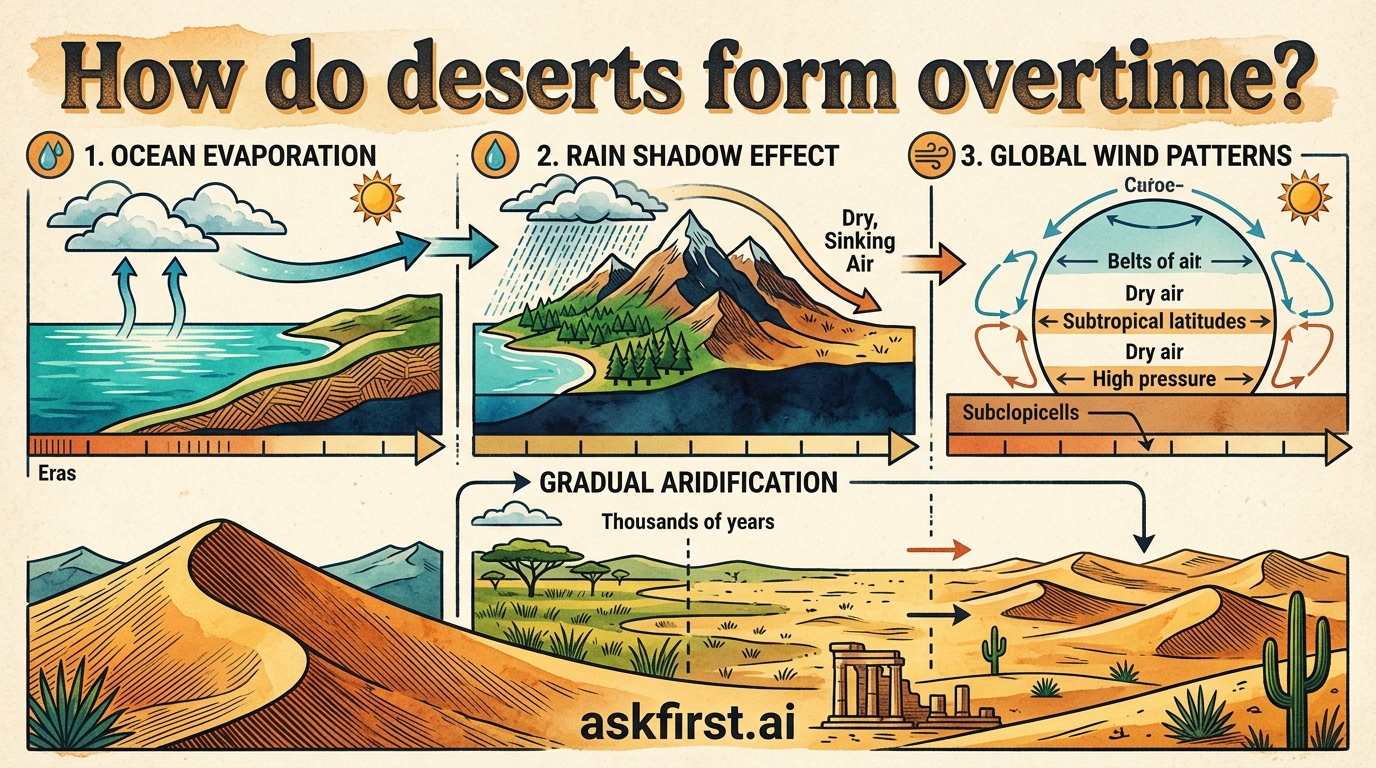
Deserts are defined not merely by heat, but by extreme aridity—regions receiving less than 250 millimeters (10 inches) of annual precipitation. The formation of a desert is a complex geological and meteorological process that occurs over thousands to millions of years, driven by atmospheric circulation, topography, and continental positioning.
1. Atmospheric Circulation: The Hadley Cell Mechanism
The primary driver of global desert formation is the Hadley Cell. At the equator, intense solar heating causes moist air to rise, creating low-pressure zones and heavy rainfall. As this air moves toward the poles, it cools and loses its moisture. By the time this air descends at approximately 30° North and South latitudes, it is extremely dry and warm. This creates high-pressure belts where air is compressed and heated, preventing cloud formation and suppressing rainfall. This mechanism is responsible for the formation of the Sahara, the Arabian, and the Kalahari deserts.
2. The Rain Shadow Effect (Orographic Lifting)
Topography plays a critical role in regional desertification. When moisture-laden air masses encounter mountain ranges, they are forced upward. As the air rises, it cools and sheds its moisture as precipitation on the windward side of the mountain. By the time the air reaches the leeward side, it is stripped of humidity. This creates a "rain shadow," a dry zone where deserts flourish. A classic example is the Sierra Nevada range in the United States, which creates the arid conditions of the Great Basin Desert.
3. Cold Ocean Currents and Coastal Deserts
Coastal deserts, such as the Atacama in Chile or the Namib in Africa, form due to cold ocean currents. These currents cool the air above the water, creating a stable atmosphere that prevents the formation of clouds or vertical air movement. Because the air is cold and dense, it cannot hold much moisture, leading to persistent aridity despite the proximity to the ocean. These areas often experience thick fog, which provides the only source of moisture for specialized flora and fauna.
4. Continental Interior and Distance
The "continentality" factor involves the distance of a region from oceanic moisture sources. In vast landmasses like Eurasia, air masses lose their moisture long before reaching the center of the continent. By the time winds reach the Gobi Desert, they are essentially bone-dry, resulting in extreme seasonal temperature fluctuations and minimal precipitation.
5. Pros, Cons, and Future Trends
- Pros: Deserts are vital carbon sinks, rich in mineral resources, and serve as optimal sites for solar energy harvesting due to high cloudless solar irradiance.
- Cons: Desertification—the process by which fertile land becomes desert due to climate change and over-farming—threatens global food security and biodiversity.
- Future Trends: Anthropogenic climate change is shifting atmospheric circulation patterns, potentially expanding existing desert boundaries. Scientists are currently focusing on "Great Green Wall" initiatives, attempting to halt the expansion of the Sahara through massive reforestation, signaling a shift toward active land management to combat natural desertification processes.