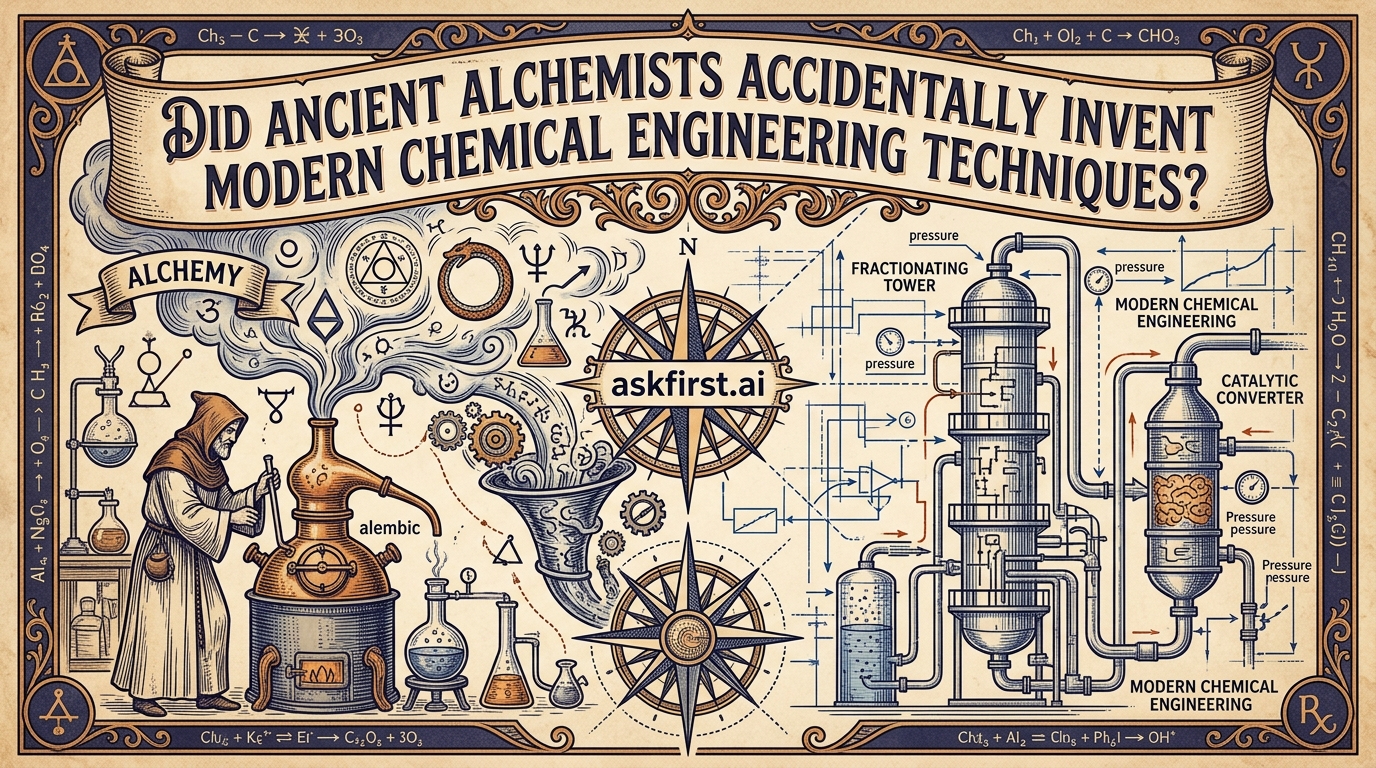
How Ancient Alchemists Accidentally Pioneered Chemical Engineering
The Hidden Legacy: Alchemical Foundations of Modern Engineering
While modern science often distances itself from the mystical reputation of alchemy, the historical reality is that ancient alchemists were the true pioneers of chemical engineering. Far from being merely practitioners of magic, these individuals developed foundational unit operations that remain the bedrock of chemical manufacturing today. Their pursuit of transmutation required rigorous experimentation, which unintentionally birthed a systematic approach to substance manipulation.
The Birth of Unit Operations
Modern chemical engineering relies on the concept of 'unit operations'—physical steps such as filtration, crystallization, distillation, and solvent extraction. These were not invented in the 20th century; they were perfected in alchemical laboratories across the Islamic Golden Age and Medieval Europe. Alchemists, such as Jabir ibn Hayyan (often cited as the father of chemistry), rigorously cataloged procedures for isolating substances from crude materials. His documentation of distillation and sublimation provided the necessary blueprint for scaling up lab reactions into industrial processes.
Key Historical Innovations
Several specific alchemical processes became the precursors to large-scale industrial engineering:
- Distillation Apparatus Design: The creation of the 'alembic' introduced the concept of controlled vapor condensation. This exact mechanism is still utilized in modern industrial solvent recovery units and petroleum refining.
- Temperature Regulation: Alchemists developed sophisticated heating systems, such as the athanor furnace, which allowed for constant heat maintenance. This was an early attempt at thermal process control, a fundamental principle in modern reactors.
- Solvent Extraction: By using various reagents to pull specific compounds from complex mixtures, alchemists established the methodology for modern separation science, which is vital in pharmaceutical and petrochemical industries.
From Transmutation to Industrialization
Though the goal—turning base metals into gold—remained elusive, the equipment designed to reach this goal was highly functional. The transition from alchemy to chemistry was not a total break but an evolution. When the Enlightenment shifted the focus from mystical transformation to empirical composition, researchers simply inherited a treasure trove of glassware, cooling methods, and purification techniques. These methods were effectively 'pressure-tested' by centuries of alchemical labor.
The Enduring Impact
Today, a chemical engineer managing a high-pressure reactor is following in the footsteps of those ancient practitioners who dared to heat, cool, and distill matter to unveil its secrets. The rigorous documentation standards established by early alchemists pushed the scientific community toward a systematic record of chemical changes. Consequently, modern industry thrives on these inherited techniques, proving that the foundation of our high-tech world is rooted in the pragmatic, albeit mysterious, trial-and-error methodology of the alchemical past. By refining their equipment and standardizing their processes, these ancient scholars unknowingly authored the first manual for industrial chemical engineering.