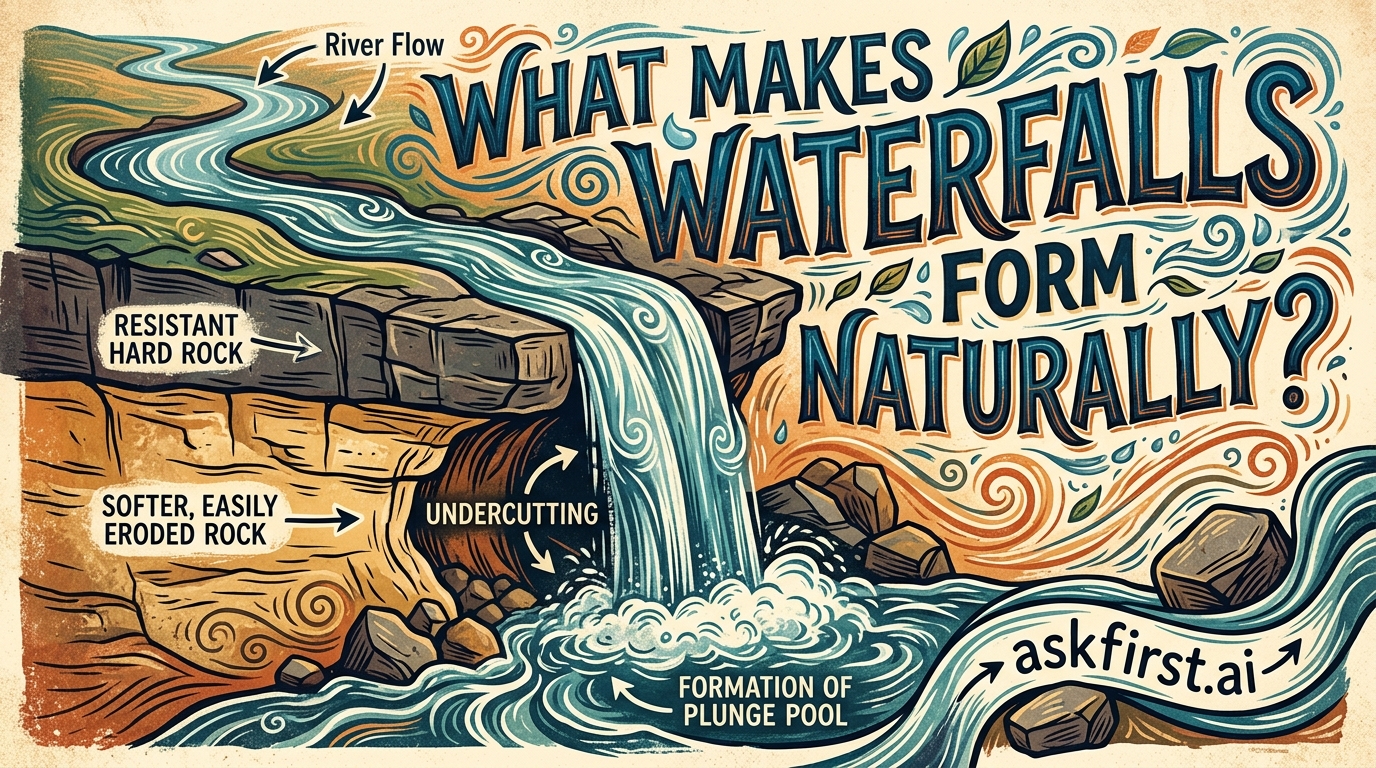
The Geological Genesis: How Waterfalls Form Naturally
Waterfalls are among nature’s most captivating geological features, representing a dramatic transition in a river’s longitudinal profile. Their formation is a complex process driven by erosion, tectonic activity, and variations in rock resistance.
The Core Mechanism: Differential Erosion
The primary catalyst for waterfall formation is differential erosion. This occurs when a river flows over an area containing layers of rock with varying degrees of hardness.
- Hard Rock Layers: Typically, a layer of resistant rock (such as igneous basalt or granite) sits atop a layer of softer, more easily eroded rock (such as sandstone or shale).
- The Undercutting Process: As the river flows, it erodes the softer rock at the base much faster than the resistant caprock. This process creates an overhang.
- Collapse and Retreat: Over time, the overhang loses structural support and collapses due to gravity. The debris from the collapse falls into the riverbed, creating a plunge pool. The force of the falling water and the swirling rocks within the plunge pool further erode the base, causing the waterfall to retreat upstream over thousands of years, often carving a deep gorge or canyon.
Secondary Drivers of Formation
While differential erosion is the most common cause, other geological phenomena contribute to the creation of these vertical drops:
- Tectonic Uplift: Rapid geological shifts can cause the earth's crust to rise, creating "knickpoints" in a river's path where the landscape drops suddenly.
- Glacial Processes: During the last ice age, massive glaciers deepened main valleys. When these glaciers retreated, smaller tributary valleys were left "hanging" high above the main valley floor. Water flowing from these hanging valleys now cascades down as waterfalls (e.g., Yosemite Falls).
- Volcanic Activity: Lava flows can create natural dams that obstruct river channels, forcing water to spill over the resulting basaltic cliffs.
Classification and Morphology
Waterfalls are categorized by their shape and the way water descends. Key classifications include:
- Plunge: Water descends vertically, losing contact with the rock face.
- Horsetail: Descending water maintains some contact with the cliff.
- Tiered/Multi-step: Water drops in a series of distinct steps or levels.
- Cataract: A large, powerful waterfall with a massive volume of water.
Pros, Cons, and Ecosystem Impact
Waterfalls are critical ecological hubs. They provide high levels of dissolved oxygen to downstream environments, supporting diverse aquatic life. However, they also serve as significant barriers to fish migration, leading to unique evolutionary pressures on species separated by these vertical obstacles.
The Future of Waterfalls
Climate change and human intervention pose significant risks. Hydroelectric dam construction often permanently alters the flow regimes of rivers, while changing precipitation patterns can turn perennial waterfalls into seasonal ones. As landscape evolution continues, waterfalls remain transient features; geologically speaking, they are constantly migrating upstream until the river eventually levels its gradient, signaling the end of the waterfall's life cycle. Understanding these processes allows geologists to map the history of Earth's crust and predict the future evolution of our river systems.