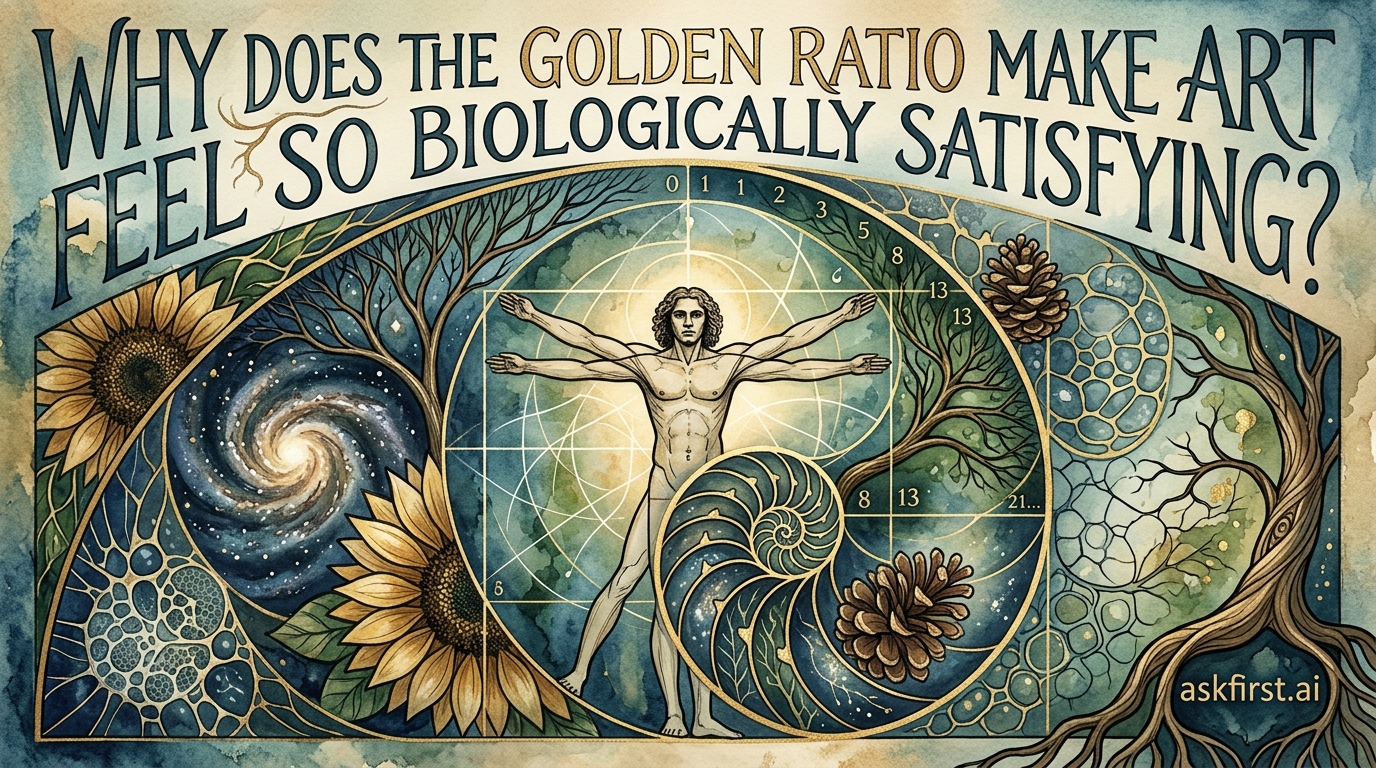
The Mathematical Secret Behind Aesthetic Perfection: Understanding the Golden Ratio
The Golden Ratio, often represented by the Greek letter phi (φ), approximates 1.618 and has fascinated artists, mathematicians, and biologists for centuries. Its presence in nature—from the arrangement of sunflower seeds to the spiral of galaxies—suggests that this numerical constant is woven into the fabric of our physical reality. When applied to art and architecture, it triggers a profound sense of harmony and balance that feels inherently "right" to the human eye.
Evolutionary Roots of Aesthetic Preference
Psychologists argue that the preference for the Golden Ratio is rooted in evolutionary biology. Our brains have evolved to recognize patterns in the environment that signal efficiency, growth, and structural integrity. Because the Fibonacci sequence—which converges toward the Golden Ratio—governs the most efficient way to pack seeds, leaves, and petals to maximize sunlight and structural strength, humans likely developed a heuristic for detecting these patterns. When we view a painting or building constructed using these proportions, our visual cortex recognizes a pattern that mirrors the efficiency of the natural world, leading to a release of dopamine and a sense of aesthetic pleasure.
Neuro-Aesthetics and the Human Brain
Neuro-aesthetics research indicates that the brain processes golden ratio-based compositions more rapidly than others. Studies using functional MRI (fMRI) suggest that when the human eye scans an object that adheres to phi, there is increased activation in areas associated with visual pleasure and reward. The ratio acts as a cognitive shortcut, allowing the brain to process spatial relationships without excessive strain. Essentially, the Golden Ratio reduces visual noise, creating an experience of "fluent" processing. This ease of comprehension is interpreted by our consciousness as "beauty" or "harmony."
Practical Applications in Design
Artists have intuitively and explicitly utilized this ratio throughout history to evoke emotional responses. From the balanced facade of the Parthenon in Athens to the deliberate compositions of Leonardo da Vinci’s The Last Supper and Salvador Dalí’s The Sacrament of the Last Supper, creators have used phi to guide the viewer’s eye. Key strategies include:
- Golden Rectangles: Creating compositions where the sides follow the ratio, establishing a natural focal point.
- The Fibonacci Spiral: Used to create dynamic movement, leading the viewer through a narrative flow within a single static image.
- The Rule of Thirds: Often viewed as a simplified, practical application of the golden ratio for modern photography and cinematography.
By aligning compositional elements with these proportions, creators establish a visual rhythm that feels organic rather than artificial. This deep-seated preference remains consistent across cultures, confirming that the appeal of the Golden Ratio is a fundamental human trait, bridging the gap between cold mathematics and the warmth of emotional experience.