The Digital Fabric: Does Reality Emerge From Mathematical Code?
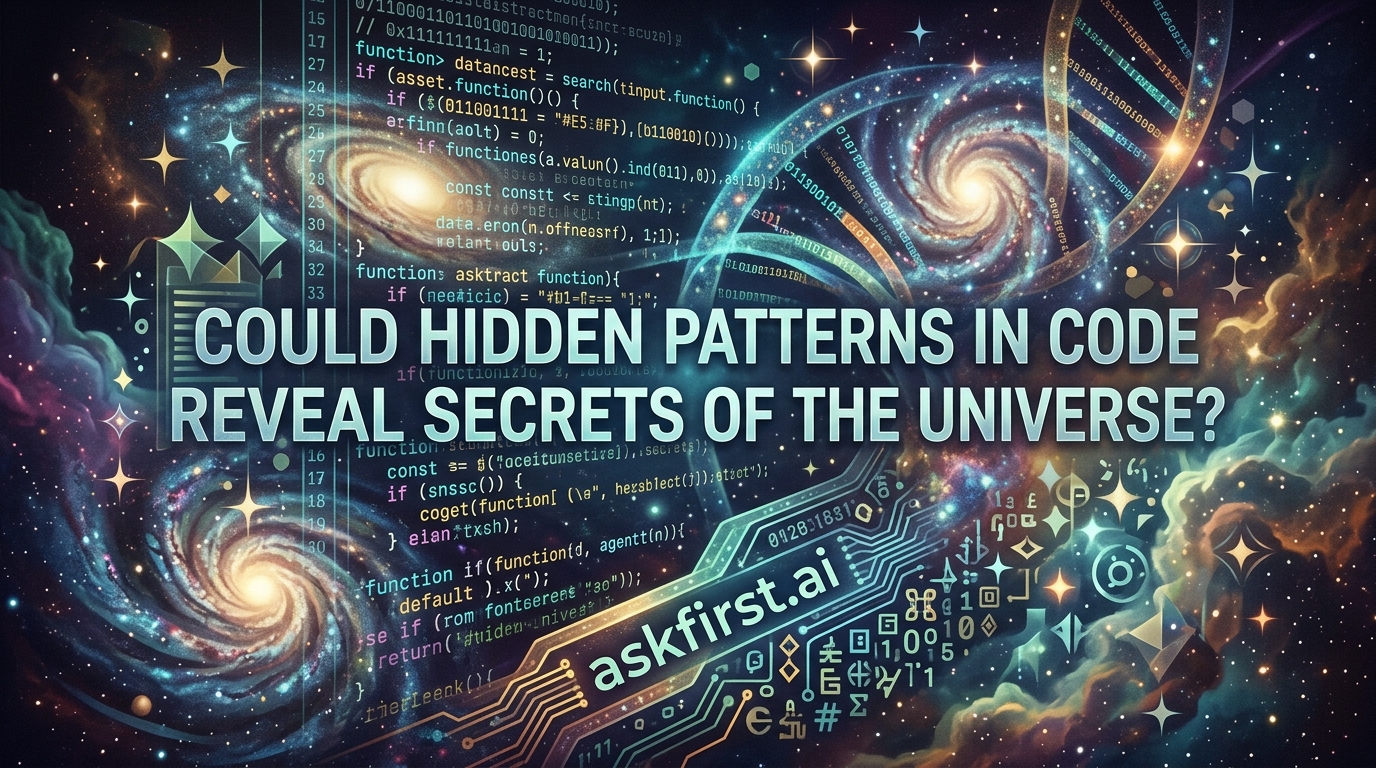
At the fundamental level of physical reality, there exists a striking hypothesis suggesting that our universe may not be made of "stuff" at all, but rather of information. This concept, often referred to as the Digital Physics paradigm, posits that the fundamental laws of nature are essentially algorithmic processes. If reality is computational, then the hidden patterns within code—whether observed in quantum wavefunctions or the distribution of prime numbers—could indeed be the blueprints of existence itself.
The Mathematical Skeleton of Reality
The idea that the universe operates on code stems from the uncanny effectiveness of mathematics in describing natural phenomena. From the Fibonacci sequences observed in biological spirals to the elegant symmetry of group theory in particle physics, the universe exhibits a structural coherence that mirrors computer programming. Theoretical physicist Edward Fredkin and digital pioneer Konrad Zuse have long argued that the universe is a cellular automaton—a vast grid of pixels or cells governed by simple, deterministic rules. In this view, what we perceive as mass, time, and gravity are simply emergent properties of underlying discrete calculations, much like the lifelike behaviors that emerge in Conway’s Game of Life.
The Quantum Information Frontier
Modern research into quantum entanglement provides compelling evidence for this computational architecture. The holographic principle, derived from studies of black holes, suggests that all the information contained within a three-dimensional volume can be encoded on a two-dimensional boundary. This implies that the "code" of the universe may be stored on a surface, with the reality we inhabit being a projection or an interface. Furthermore, the way quantum particles "communicate" instantaneously across distances suggests a non-local, networked system that functions remarkably like an optimized database or a shared quantum circuit.
Deciphering the Cosmic Source Code
If we live in an information-based reality, how do we reveal its secrets? The path involves identifying "glitches" or fundamental limits, such as the Planck length or the speed of light, which could be interpreted as the resolution limits of the cosmic machine. Just as a software engineer reverse-engineers a black-box system, physicists use mathematical modeling to identify constants that appear fixed across all observable space. If we can treat natural phenomena as data streams, we might eventually unlock the "source code" of the standard model, uncovering why the laws of physics are tuned so precisely for complexity.
Conclusion: A Universe of Logic
While the hypothesis remains philosophical and theoretical, it provides a bridge between classical physics and information theory. By viewing code as the primary substrate of reality, we gain a new perspective on why mathematics is so uniquely capable of predicting the behavior of the cosmos. Whether reality is a literal computer program or simply a system governed by logical recursion, the quest to understand these patterns continues to push the boundaries of human knowledge.