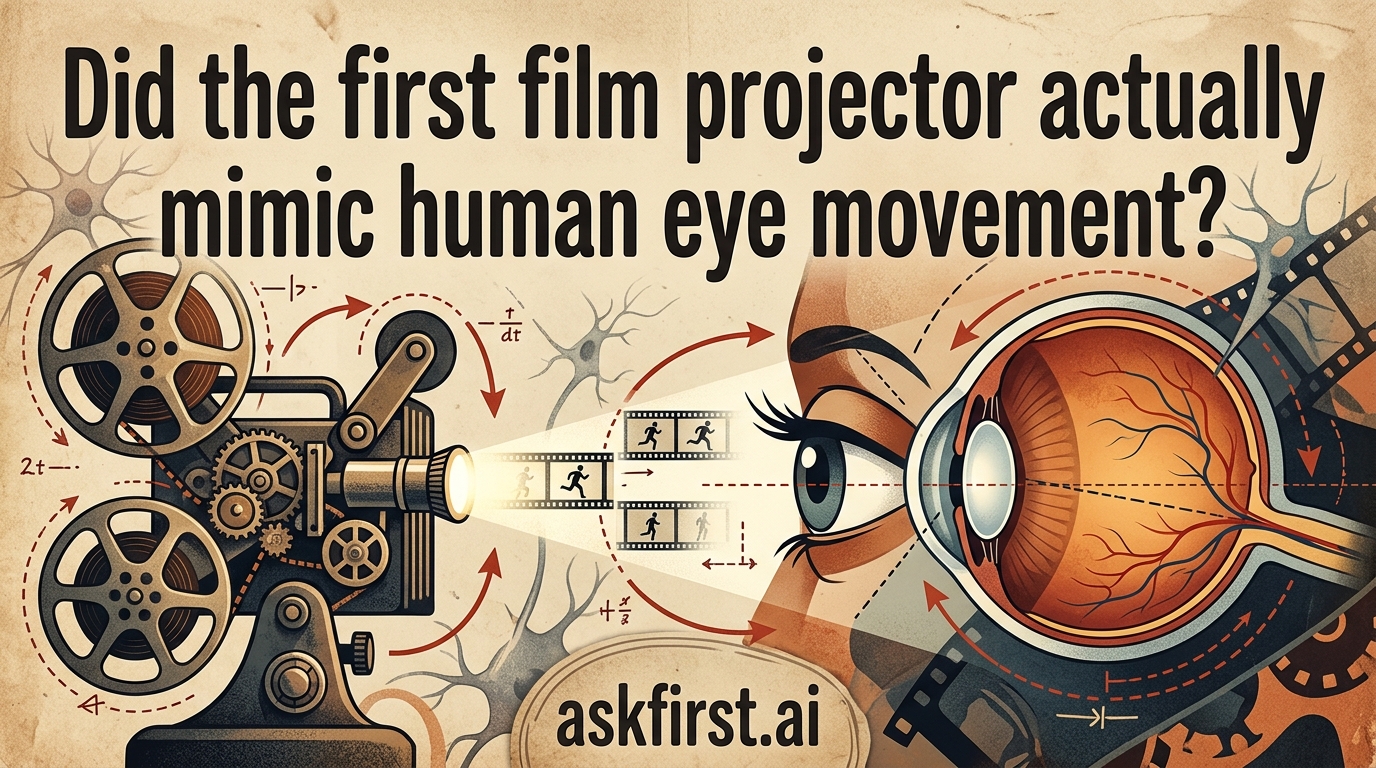
The Illusion of Motion: Did Early Cinema Mimic Human Vision?
There is a common, persistent myth that the first film projectors were designed specifically to mimic the physical mechanics of human eye movement. While the invention of cinema is deeply rooted in the biological study of human sight, the reality is that early projectors did not replicate the erratic, jittery motions of human eyeballs. Instead, they relied on a sophisticated understanding of a psychological phenomenon known as the persistence of vision and the phi phenomenon.
The Physiology of Vision
Human vision does not work like a fluid camera lens. The eyes utilize "saccades," or rapid, jumping movements from one point of fixation to another, and the brain performs incredible processing to stitch these disjointed snapshots into a coherent visual field. If a projector actually mimicked this mechanism, the audience would experience extreme motion sickness. Instead, early inventors like the Lumière brothers, Thomas Edison, and William Dickson focused on how to exploit the lag in our visual system.
Persistence of Vision and the Phi Phenomenon
Early cinema pioneers discovered that by rapidly displaying a sequence of static images—typically at a rate of 16 to 24 frames per second—the human brain perceives these distinct frames as a singular, moving image. This is the persistence of vision, a theory (though now partially debated by modern cognitive science in favor of the phi phenomenon) which suggests that the retina retains an image for a split second after the stimulus is removed. The projector utilizes a mechanical shutter to interrupt the light beam exactly when the film strip moves to the next frame. This "dark period" is crucial; without it, the motion would appear as a blurry smear.
The Mechanical Innovation
The "mimicry" people often attribute to early projectors is actually a mechanical breakthrough called the Maltese cross mechanism (or Geneva drive). This device converts continuous rotary motion into intermittent motion, allowing the film to pause perfectly behind the lens for a fraction of a second before jumping to the next frame.
- The Goal: To eliminate the blur and create a seamless illusion of fluid motion.
- The Fact: The mechanism does not mirror the eye, but rather forces the eye to interpret rapid, frozen intervals as a continuous reality.
Conclusion
The invention of the film projector remains a triumph of physics and engineering, not biology. While the machine accounts for the limitations of human perception, it never sought to recreate the biological "jumpy" movement of the human eye. Rather, it serves as an elegant bridge between static art and the psychological construction of continuous motion within the human mind.