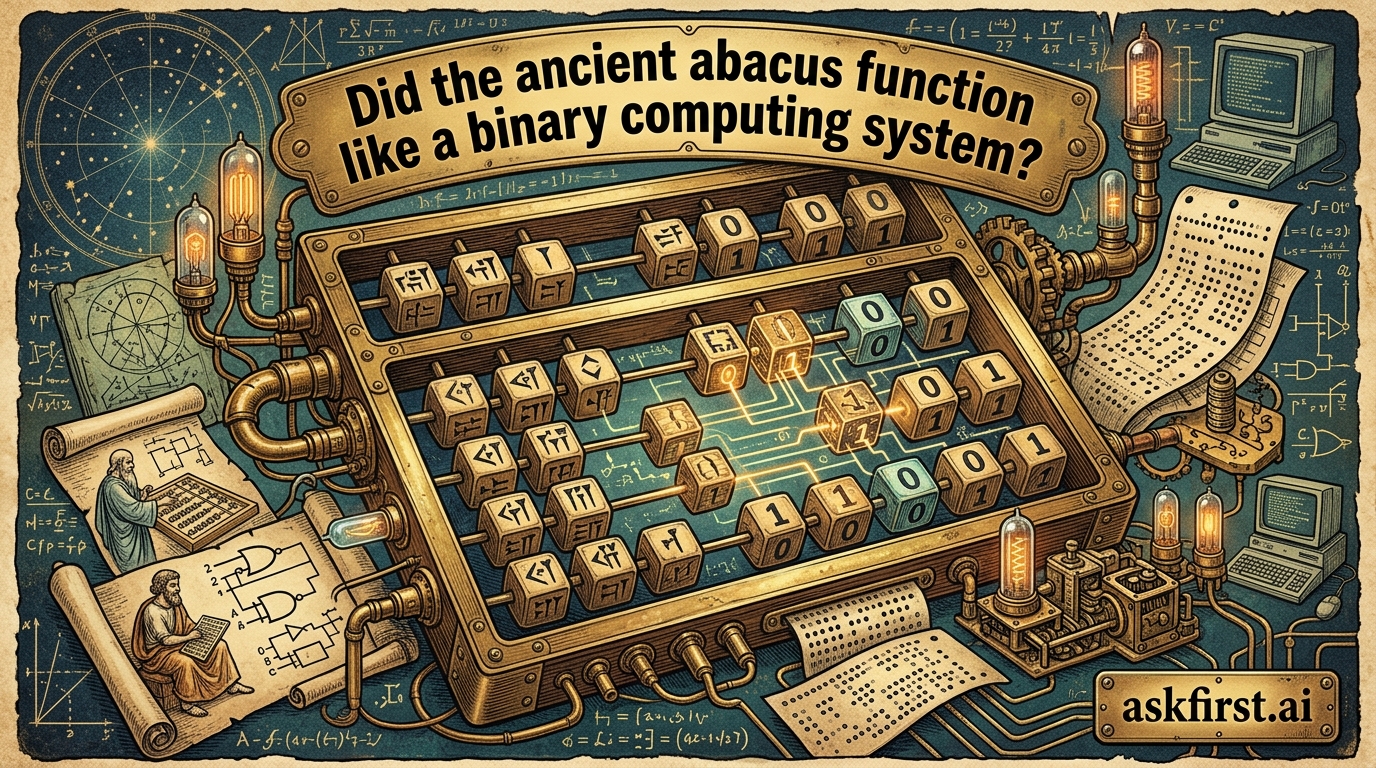
Beyond Beads: Decoding the Binary Nature of Ancient Abaci
Many modern observers assume the abacus is a primitive tool for simple addition, but this perspective overlooks the sophisticated logic embedded within its mechanical design. To address the question of whether an abacus functions like a binary system, one must distinguish between the standard decimal representation and the underlying logic gates that facilitate computation. While the abacus is fundamentally a base-10 (decimal) machine, its physical operation mimics the fundamental principles of binary logic, serving as a conceptual precursor to modern Boolean arithmetic.
The Logic of Bead Movement
At the most basic level, an abacus relies on the binary state of a bead: a bead is either "active" (pushed toward the counting line) or "inactive" (pushed away). This simple "on-off" state is the physical manifestation of a single bit of information. In a standard suanpan or soroban, the beads act as mechanical switches that represent discrete numerical values. When a user moves a bead, they are effectively executing a logic operation—performing an addition or subtraction through a physical manipulation of state. This transition between binary states allows for complex calculations, effectively replicating the shifting of bits found in contemporary processor architecture.
Decimal vs. Binary Architecture
It is essential to clarify that the traditional abacus is not inherently binary in its numbering system; it is a decimal device. In a base-2 (binary) system, every position represents a power of two, which is how modern computers interpret data. Conversely, the abacus uses position-based decimal notation. For instance, in the classic Chinese suanpan, two beads in the upper deck represent "fives" and five beads in the lower deck represent "ones." This structure allows the user to represent any decimal digit from zero to nine using only seven beads per column. While this is not "binary math" in the sense of power-of-two scaling, the physical manipulation of the hardware is remarkably similar to the logic gate operations of a central processing unit.
The Ancestor of Computing
Historically, the abacus bridges the gap between human manual calculation and algorithmic automation. Some scholars, such as Kai Krause, have suggested that the logic flow of an abacus user is structurally analogous to computer algorithms. When performing complex multiplication or division on an abacus, the operator follows a series of predefined steps—essentially "programming" the tool with every move. This procedural adherence ensures that the calculation is performed with absolute precision, provided the operator maintains the logical flow. By turning abstract numbers into tangible, binary-state bead positions, the ancient world created a hardware-based solution for cognitive labor that mirrors the structural simplicity of modern computational design.