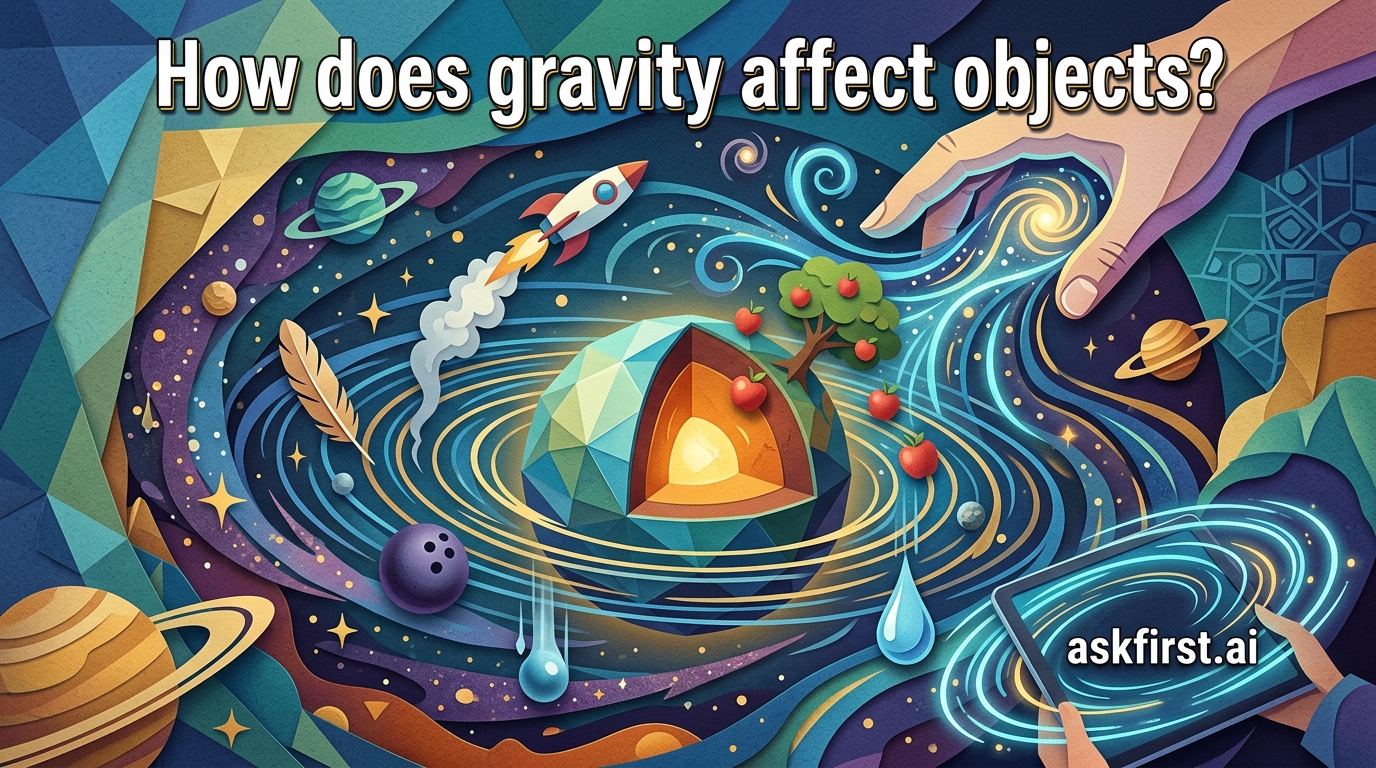
The Mechanics and Manifestations of Gravity
Gravity is one of the four fundamental forces of nature, acting as the universal glue that governs the motion of celestial bodies and the behavior of objects on Earth. Defined as a natural phenomenon by which all things with mass or energy are brought toward one another, gravity dictates the structure of the universe.
1. Theoretical Foundations: From Newton to Einstein
- Newtonian Mechanics: Sir Isaac Newton’s Law of Universal Gravitation (1687) posited that every point mass attracts every other point mass with a force directly proportional to the product of their masses and inversely proportional to the square of the distance between them. This explained why objects fall to Earth and why planets orbit the Sun.
- General Relativity: In 1915, Albert Einstein revolutionized this concept. He proposed that gravity is not a traditional "force" but a curvature of spacetime caused by mass and energy. Massive objects, like stars and planets, warp the fabric of spacetime, and other objects follow these "geodesic" paths, appearing to be pulled toward the center of mass.
2. How Gravity Affects Objects on Earth
On a terrestrial scale, gravity manifests as weight. Weight is the force exerted on an object due to the gravitational pull of the planet.
- Acceleration: Near the surface of Earth, gravity causes objects to accelerate at approximately 9.8 m/s². Regardless of mass, in a vacuum, all objects fall at the same rate—a principle famously demonstrated by Galileo.
- Structural Stress: Gravity exerts constant pressure on objects. For biological organisms, it necessitates muscular and skeletal systems to counteract downward force. For architecture, it requires materials with high compressive strength to prevent structural collapse.
- Fluid Dynamics: Gravity dictates the movement of liquids, driving convection currents, tides, and the flow of water from higher elevations to lower basins.
3. Practical Applications and Effects
- Orbital Mechanics: Gravity allows for satellites and the Moon to remain in orbit. By balancing forward velocity with gravitational pull, objects maintain a "free-fall" trajectory around a planet.
- Time Dilation: According to General Relativity, gravity affects the passage of time. Clocks closer to a massive body (where gravity is stronger) tick slightly slower than clocks further away. This is accounted for in GPS satellite synchronization.
- Gravitational Lensing: On a cosmic scale, the gravity of massive galaxies bends light from objects behind them, acting as a magnifying lens for astronomers.
4. Pros and Cons of Gravitational Influence
- Pros: It keeps the atmosphere bound to Earth, allows for the formation of stars and planets, and enables the stability of solar systems. It provides the necessary pressure for nuclear fusion in stars.
- Cons: It poses significant challenges for space exploration, requiring massive fuel consumption to achieve "escape velocity." It also contributes to long-term health issues in humans, such as bone density loss and cardiovascular changes during prolonged exposure to microgravity.
5. Future Trends and Research
Current research focuses on reconciling General Relativity with Quantum Mechanics through the search for the graviton, a hypothetical elementary particle that mediates the force of gravity. Understanding gravity at a quantum level remains the "Holy Grail" of modern physics, potentially unlocking new methods for energy production and interstellar propulsion.