The Physics of Reflection: How Mirrors Work
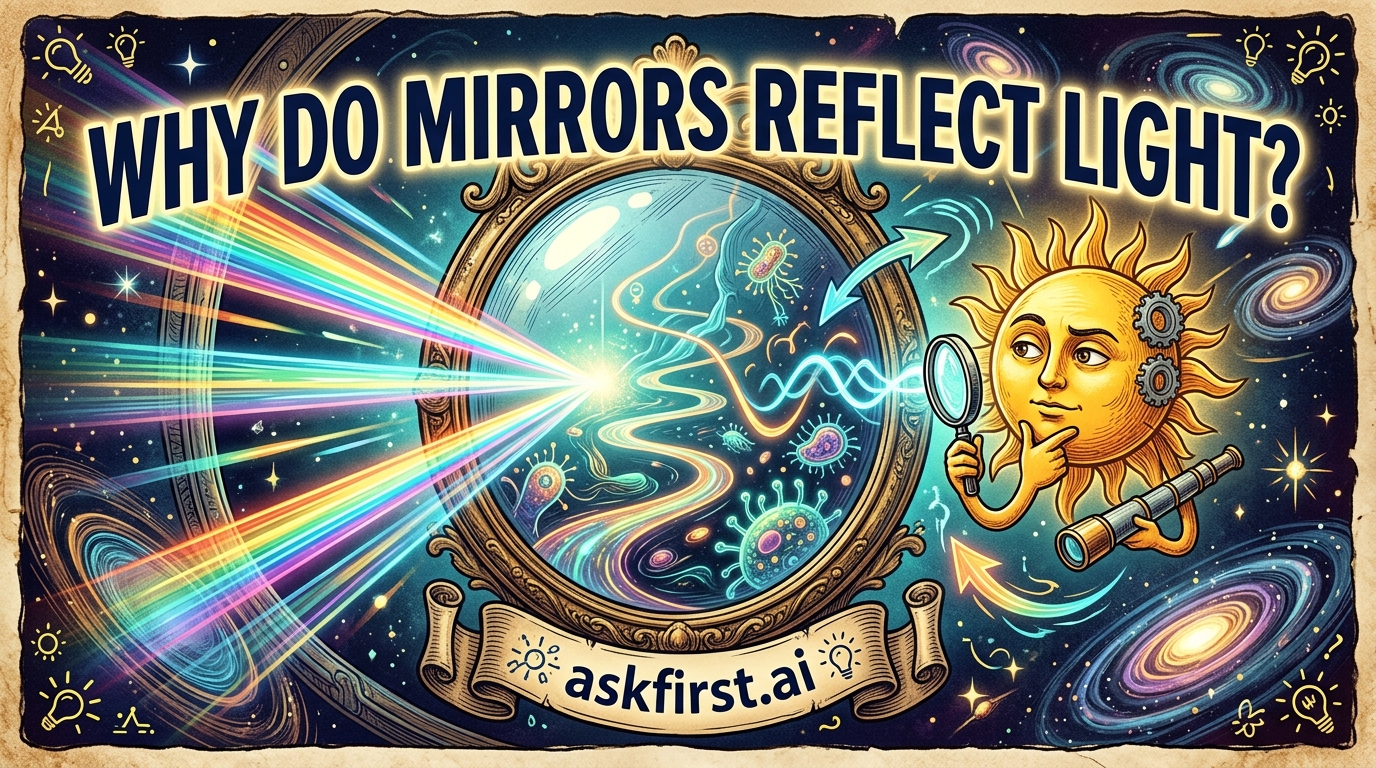
At its core, a mirror is an object that reflects light in a way that preserves much of its original quality. While almost any surface reflects some light, mirrors are engineered to reflect the vast majority of incident light, resulting in a clear, coherent image.
1. The Atomic Mechanism: Specular vs. Diffuse Reflection
The reason mirrors function as they do relies on the interaction between photons and electrons. When light hits a surface, two primary types of reflection occur:
- Specular Reflection: This occurs on smooth, polished surfaces like glass mirrors. Light rays bounce off at the same angle they hit (the angle of incidence equals the angle of reflection), preserving the image's spatial information.
- Diffuse Reflection: This occurs on rough surfaces (like paper or wood). The microscopic irregularities cause light rays to scatter in many directions, preventing a clear image from forming.
In a mirror, the surface is smooth relative to the wavelength of visible light. This ensures that the light rays remain organized, allowing our eyes and brains to interpret the reflected light as a coherent "virtual image."
2. Composition and Construction
Modern mirrors are not simply polished metal; they are complex optical devices. A standard household mirror is composed of three distinct layers:
- The Substrate (Glass): The front layer is typically high-quality, transparent glass. Its primary function is to provide a smooth, flat surface and to protect the reflective layer from oxidation and scratching.
- The Reflective Layer: Behind the glass is a thin, uniform coating of metal—usually silver or aluminum. Silver is preferred for high-end mirrors because it reflects almost 99% of visible light, whereas aluminum is cheaper and more durable for mass-market products.
- The Protective Backing: To prevent the metal from corroding or peeling, a layer of paint or sealant is applied to the rear. This protects the reflective surface from environmental moisture and air.
3. The Quantum Perspective
From a quantum mechanics standpoint, reflection is an interaction between photons and the electrons within the metal coating. Metals have a "sea" of free-moving electrons. When light strikes these electrons, they oscillate at the same frequency as the incoming light. These oscillating electrons then emit their own electromagnetic waves, which sum together to form the reflected beam. Because the metal is so dense with free electrons, the light cannot penetrate deep into the material, forcing it to bounce back.
4. Pros, Cons, and Practical Applications
- Pros: Mirrors are essential for navigation (rear-view mirrors), medical diagnostics (dentistry), scientific research (telescopes), and architecture (expanding small spaces).
- Cons: Mirrors can be fragile; silvering can degrade over time due to humidity, leading to "black spots."
- Future Trends: We are seeing the rise of dielectric mirrors—mirrors made of stacked thin layers of transparent materials instead of metal. These allow for near-perfect reflection for specific wavelengths, which is vital for laser technology and high-precision fiber optics.
Summary
Mirrors operate by combining a perfectly smooth surface with a dense, conductive metal backing. By preventing diffuse scattering and utilizing the free electrons of metallic coatings, mirrors allow us to manipulate light paths with extreme precision. Whether in a bathroom or a space telescope, the fundamental principle remains: the preservation of the angle and intensity of light.