The Melodic Advantage: Why Music Outperforms Data in Human Memory
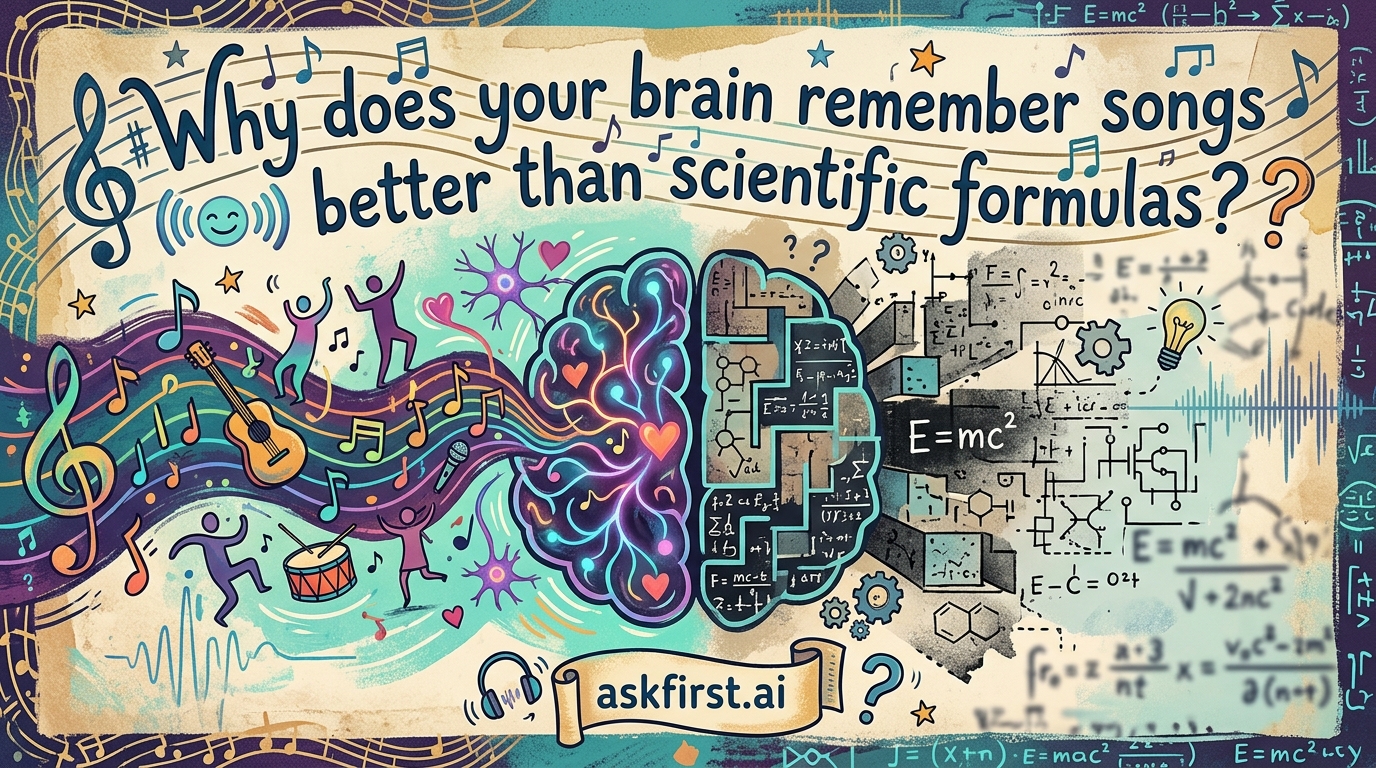
Human memory operates through complex associative networks, and music serves as a unique cognitive catalyst. While abstract data like mathematical formulas often feel burdensome to retain, melodies embed themselves deeply into our long-term storage. This phenomenon is rooted in the way the brain processes emotional, rhythmic, and linguistic information simultaneously.
The Power of Encoding via Multimodal Processing
Scientific formulas are typically symbolic and require effortful, logical processing in the prefrontal cortex. In contrast, songs utilize multimodal encoding. When a brain listens to music, it engages the auditory cortex, the limbic system (responsible for emotion), and the motor cortex (responsible for rhythm). By stimulating these diverse regions, the brain creates a richer "neural map" of the information. According to the Dual-Coding Theory proposed by Allan Paivio, information is remembered more effectively when processed through both verbal and non-verbal channels. Melodies act as a mnemonic anchor that holds the lyrics in place.
Emotional Resonance and The Amygdala
Music possesses a profound capacity to trigger emotional responses, which is the primary driver of memory consolidation. The amygdala, often called the brain's emotional center, is closely linked to the hippocampus, the organ responsible for forming new memories. When a song evokes an emotional response, the amygdala releases neurotransmitters that effectively "tag" the memory as significant. Scientific formulas lack this natural emotional stimulus, making them "cold" data points that the brain finds less urgent to prioritize for long-term storage.
The Mnemonic Structure of Rhythm and Rhyme
Patterns are the language of the human brain. Music relies on predictable structures, rhymes, and intervals. This structural predictability acts as an organizational framework. When a person learns a scientific formula, they must rely on pure rote memorization of arbitrary symbols. When learning a song, the rhythm provides a scaffold. If a fragment of the melody is recalled, the brain automatically fills in the subsequent lyrical data because the pattern completion mechanism is activated. This is why jingles are used in advertising; the cognitive load of retrieving information is drastically reduced through rhythm.
Overcoming the "Cognitive Load" Barrier
Logical formulas often exceed working memory capacity because they lack narrative or auditory flow. Cognitive load theory suggests that our ability to process information is finite. By wrapping facts in musicality, the information is chunked into patterns that the brain manages with far greater efficiency. Effectively, music converts raw, isolated data into an integrated sensory experience that bypasses the limitations of standard rote memorization techniques. Ultimately, the brain is biologically predisposed to favor patterns and emotions over sterile, symbolic abstractions.