The Glass Giants: How Vacuum Tubes Sparked the Digital Revolution
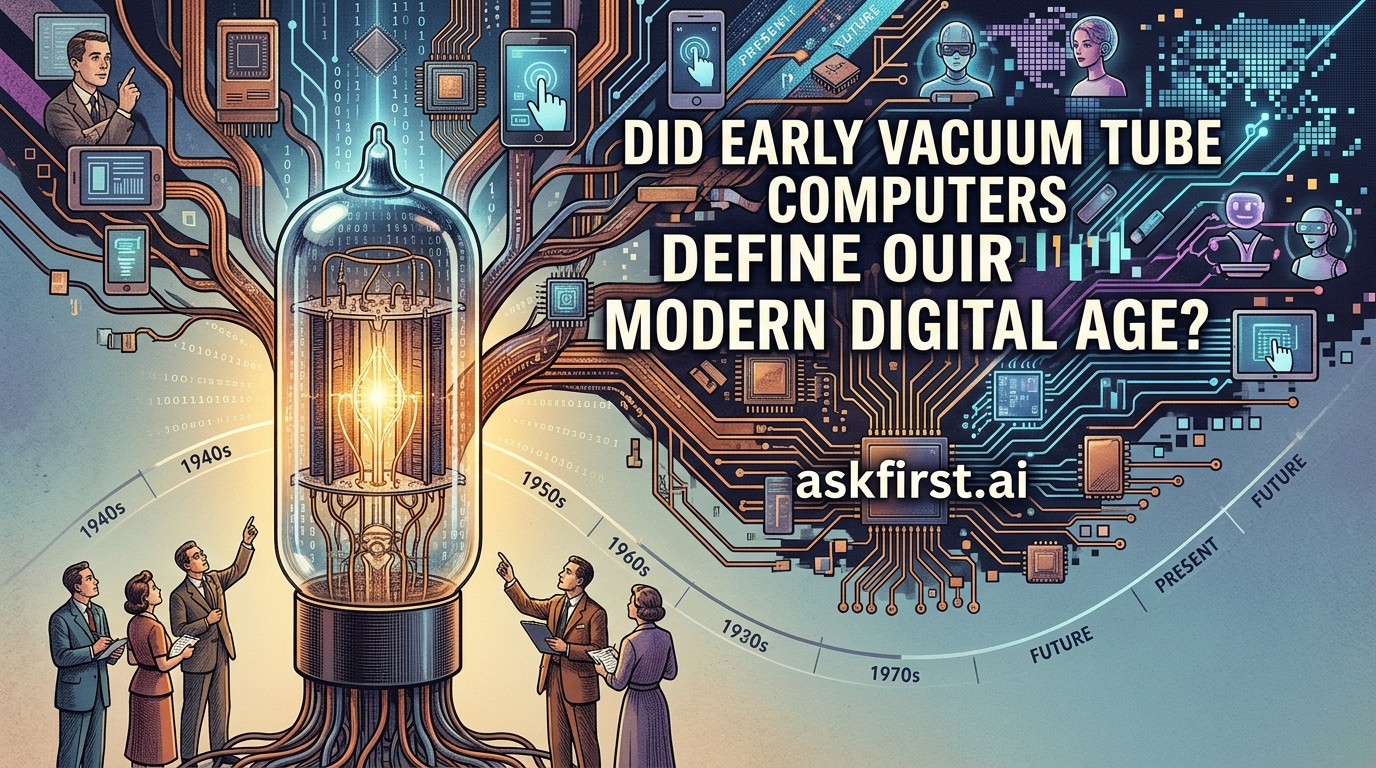
To understand the digital landscape of the 21st century, one must look back at the room-sized behemoths of the 1940s and 1950s. The invention and refinement of the vacuum tube—a glass-enclosed device that controls electric current—served as the fundamental building block for the first electronic general-purpose computers, such as the ENIAC (Electronic Numerical Integrator and Computer). These machines were not merely early prototypes; they were the essential architects of our modern logic.
Breaking the Mechanical Barrier
Before vacuum tubes, calculation was largely the domain of mechanical gears or electromechanical relays. These systems were slow, prone to wear, and physically limited by their moving parts. Vacuum tubes, by contrast, operated at the speed of electrons. This transition allowed for the birth of high-speed binary switching—a concept that remains the backbone of every microprocessor currently in existence. By using vacuum tubes to represent the states of 0 and 1, engineers successfully moved computation from the physical realm into the realm of pure electricity.
The Architecture of Logic
Beyond mere speed, these machines defined the structure of modern computation. The Von Neumann architecture, which describes a computer design with a shared memory for programs and data, was developed in conjunction with these early systems. This architectural shift allowed for reconfigurable computers that did not need to be physically rewired for every new task. This concept is the reason modern laptops and smartphones can switch from a calculator to a word processor with a single click.
- Scalability: By proving that electronic circuits could perform complex calculations, these machines provided the proof of concept that led to miniaturization.
- Language: The software paradigm, including the development of the first assemblers, originated as researchers tried to communicate with these fragile glass titans.
- Reliability: While vacuum tubes were notoriously prone to burning out, their failures drove engineers to develop better circuit redundancy and, eventually, the solid-state transistor.
The Transition to Transistors
While vacuum tubes were ultimately replaced by transistors—which were smaller, faster, and cooler—the logic gates, binary mathematics, and architectural philosophies established during the vacuum tube era did not change. The transition to the transistor was a technological evolution, not a revolution of logic. If one traces the lineage of a modern silicon chip, the blueprint connects directly back to the vacuum-based circuits of the mid-20th century.
In conclusion, these early computers defined the digital age not by their hardware, but by establishing the binary language and system logic that governs our lives today. They transformed the abstract mathematics of the early 20th century into the tangible reality of the information era, proving that electricity could be tamed to think.