The Biomechanics of Kangaroo Locomotion
Kangaroos, the iconic macropods of Australia, have evolved a unique mode of locomotion: bipedal hopping. This energy-efficient movement is a masterpiece of evolutionary engineering, allowing these marsupials to traverse vast distances across the arid Australian landscape while conserving precious caloric energy.
The Physics of Elastic Energy Storage
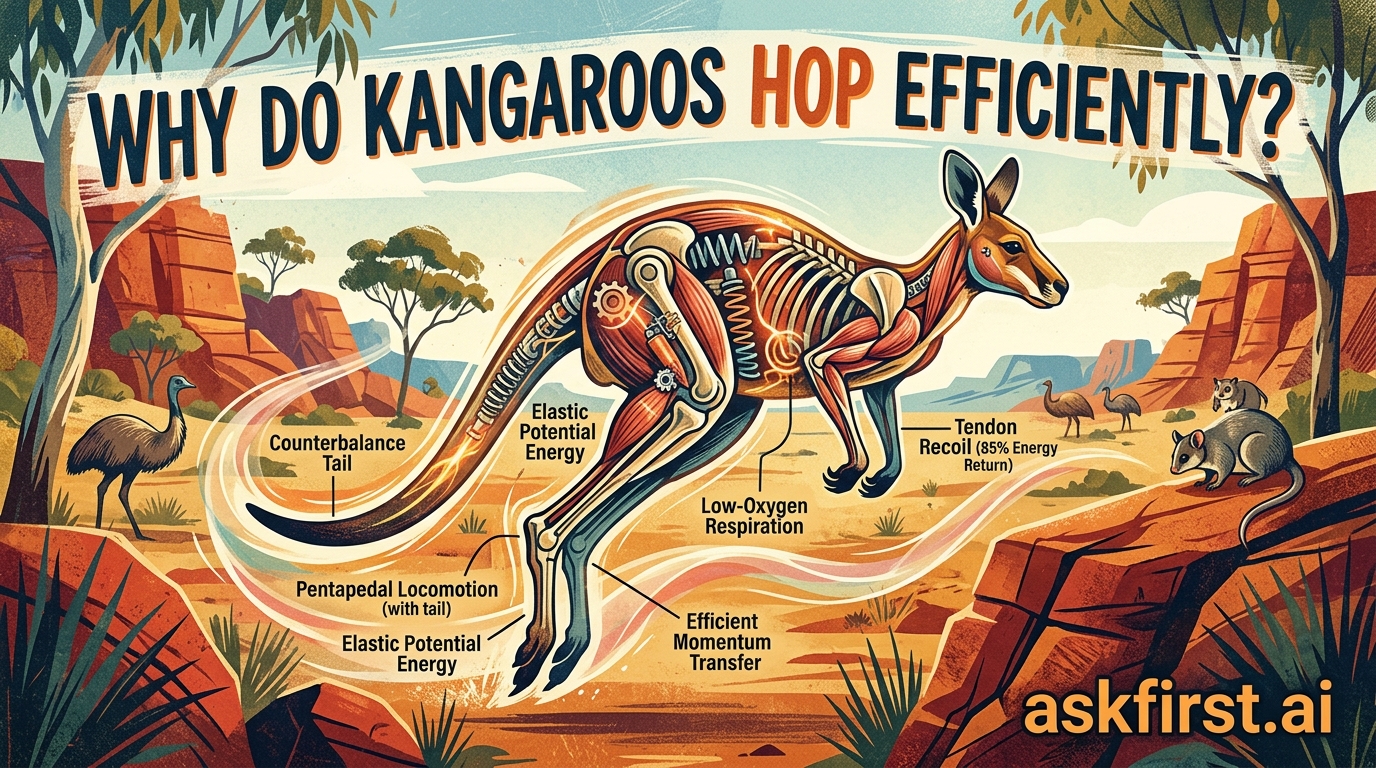
The primary reason for the kangaroo’s efficiency is elastic energy storage. Unlike human running, which relies heavily on active muscle contraction, hopping utilizes the kangaroo’s massive, thick tendons—specifically the Achilles tendon—like a biological spring.
- The Loading Phase: As the kangaroo lands, its body weight stretches these elastic tendons.
- Energy Storage: The kinetic energy of the landing is stored as potential elastic energy within the stretched tissues.
- The Recoil Phase: During the liftoff phase, this stored energy is released, propelling the animal forward without the need for significant additional muscle effort.
Research indicates that as a kangaroo increases its speed, the energy cost of hopping actually decreases. At high speeds, the "spring" effect becomes so efficient that the kangaroo can travel at over 40 km/h with minimal metabolic cost compared to a quadrupedal mammal of similar size.
Anatomical Adaptations
The kangaroo’s body is hyper-specialized for this high-speed, high-efficiency movement:
- The Tail as a Counterbalance: The heavy, muscular tail acts as a dynamic counterbalance. It prevents the animal from tipping over during the flight phase and provides stability during sharp turns.
- The Pentapedal Gait: While hopping is efficient for speed, kangaroos also use a "pentapedal" (five-footed) movement at slow speeds. They use their tail as a fifth limb, shifting weight onto it while moving their hind legs forward. This is a deliberate, low-energy mode used for grazing.
- Specialized Feet: The central digit of the foot is highly elongated, acting as a lever arm. The metatarsals are long, providing a robust frame for the powerful tendons to attach, maximizing the mechanical advantage of the jump.
Evolutionary Context and Statistics
Kangaroos (family Macropodidae) evolved approximately 20 million years ago. As the Australian continent became increasingly arid, the ability to travel long distances between sparse food sources became a critical survival trait.
- Efficiency Metric: Studies by the University of New South Wales suggest that at cruising speeds, kangaroos are roughly 30% to 50% more efficient than mammals of equal mass using traditional quadrupedal gaits.
- Speed: A Red Kangaroo (Osphranter rufus) can reach top speeds of approximately 60–70 km/h in short bursts, though they maintain a steady, highly efficient pace of 20–25 km/h for hours.
Pros and Cons of Hopping
- Pros: Exceptional energy efficiency over long distances; ability to navigate rough terrain; high speed for predator avoidance.
- Cons: Inability to move hind legs independently, preventing the kangaroo from walking backward; high energy cost at very slow speeds (which is why they employ the tail-assisted pentapedal gait); vulnerability in enclosed, dense spaces where jumping is restricted.
Future Trends in Biomechanics
The kangaroo’s locomotion is currently a subject of intense study in the field of soft robotics. Engineers are attempting to replicate the "tendon-spring" mechanism to create more efficient, all-terrain robotic legs. By mimicking the kangaroo’s passive energy return, researchers hope to build robots that can traverse uneven ground with the same grace and efficiency observed in the wild.