The Visionary Architect: Ada Lovelace and the Dawn of AI
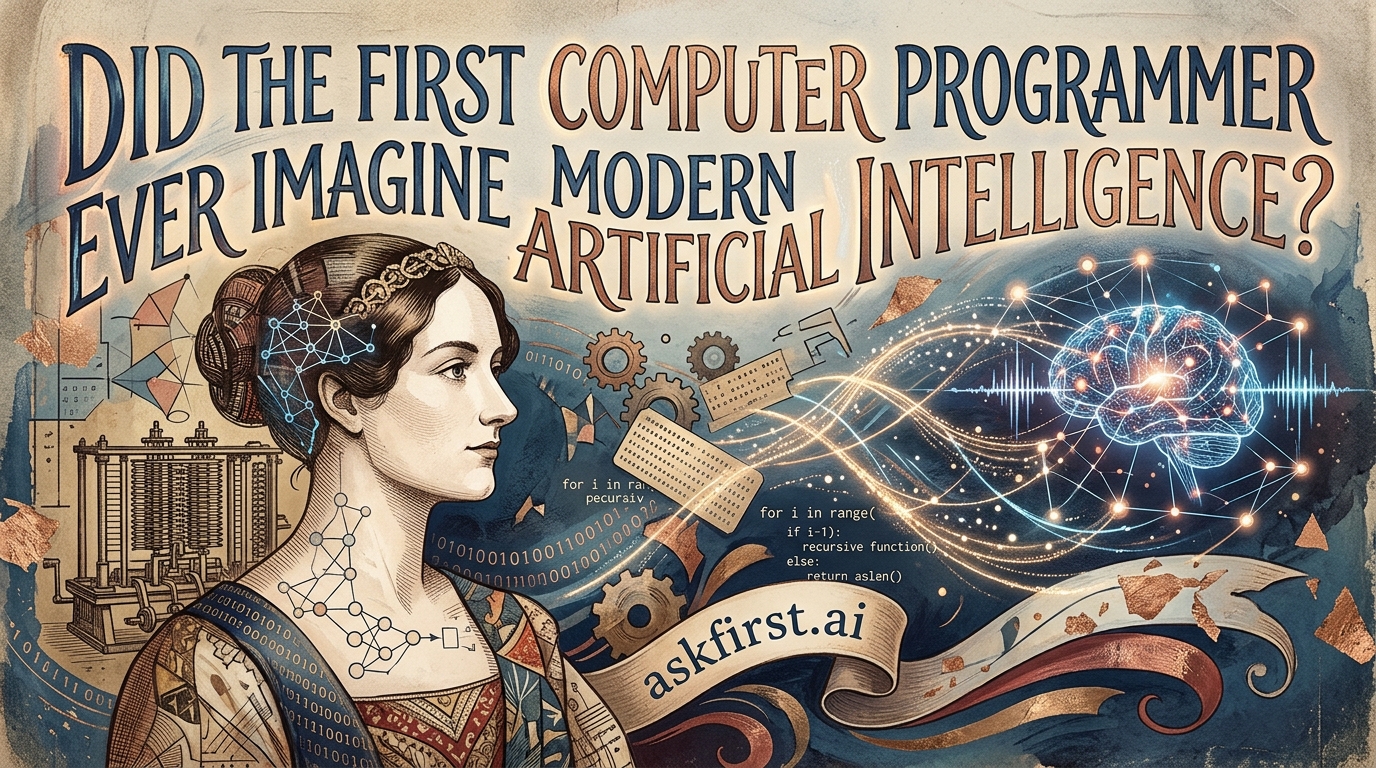
In the annals of computing history, Ada Lovelace stands as a titan of foresight. Often heralded as the world's first computer programmer for her work on Charles Babbage’s Analytical Engine in the mid-1840s, Lovelace did not merely see a machine that calculated numbers. She envisioned a device that could manipulate symbols according to rules, fundamentally altering how humanity interacts with logic and creation.
The Concept of Analytical Engines
Lovelace recognized that the Analytical Engine was not restricted to arithmetic. She posited that if the fundamental relations of pitched sounds in the science of harmony were susceptible to such expression and adaptation, the engine might compose elaborate and scientific pieces of music of any degree of complexity or extent. This breakthrough idea moved computing from simple calculation into the realm of general-purpose processing.
Lovelace’s Warning: The Limits of Machine Intelligence
Interestingly, while she saw the potential for machines to process logic, she notably addressed what would become known as the "Lovelace Objection" regarding Artificial Intelligence. In her Notes on the Analytical Engine, she argued that the machine has no pretensions whatever to originate anything. She asserted that the machine can only do whatever we know how to order it to perform. This viewpoint served as a foundational boundary in computer science for over a century: the distinction between human creativity and mechanical execution.
Was This Modern AI?
While Lovelace did not specifically use the term "artificial intelligence"—which was coined over a century later by John McCarthy in 1956—she was the first to articulate the transition from a specialized calculator to a universal machine. Her work anticipated the following pillars of modern AI:
- Algorithmic Thinking: The ability to encode complex, non-numeric processes into machine-executable steps.
- Symbolic Manipulation: Recognizing that numbers could represent objects, sounds, or concepts beyond mere quantity.
- Computational Creativity: The hypothesis that creative output, such as art or music, could be generated via computational rules.
The Verdict
Did she imagine modern AI? The answer is nuanced. Lovelace did not foresee neural networks, machine learning, or self-learning algorithms as they exist today. However, she pioneered the intellectual framework necessary for such advancements. She identified the logical limits of machines while simultaneously perceiving that their utility was bounded only by human imagination. Her legacy is the realization that a machine governed by a sophisticated program is limited to the instructions it follows, yet the breadth of those instructions can encompass the entirety of human knowledge. She provided the essential bridge between pure mathematics and the digital cognitive revolution that defines our current era.