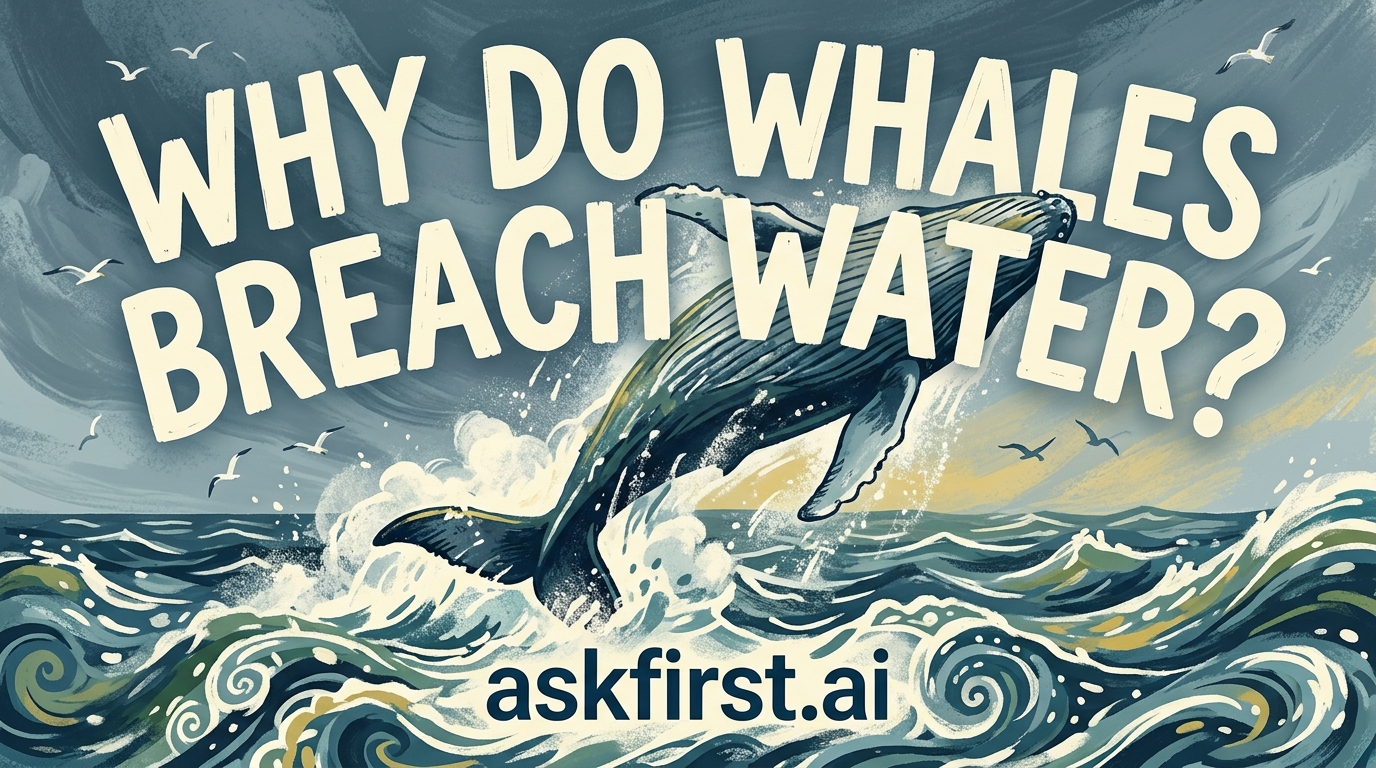
The Phenomenon of Whale Breaching: An Ethological Overview
Whale breaching—the spectacular behavior where a whale propels a significant portion of its body out of the water and crashes back down—is one of the most iconic displays in the natural world. While often interpreted by observers as a sign of joy, marine biologists suggest that this high-energy behavior serves several complex biological, social, and physical functions.
1. Primary Theories for Breaching
Scientific consensus suggests that breaching is not a single-purpose act but rather a multi-faceted behavior. The primary hypotheses include:
- Acoustic Signaling and Communication: Whales live in an environment where sound travels four times faster than in air. A breach creates a massive, low-frequency sound that can travel for miles. This may serve as a long-distance signal to other pods, potentially indicating the presence of food, the desire to congregate, or a warning of territorial boundaries.
- Parasite Removal: Large cetaceans, particularly humpback whales (Megaptera novaeangliae), often carry significant loads of barnacles and whale lice. The violent impact of hitting the water surface may help dislodge these external parasites or dead skin, providing relief and improving hydrodynamics.
- Social Display and Intimidation: In the context of mating, males often breach more frequently than females. This is likely an indicator of physical fitness and strength, used to assert dominance over rivals or to attract potential mates. It functions as a visual and auditory "showing off" of vigor.
- Physical Play and Development: Calves are frequently observed breaching. This is likely a form of practice for coordination, social bonding, and muscle development. It allows young whales to experiment with their motor skills in a low-risk environment.
2. The Mechanics of the Breach
To lift a multi-ton body out of the water, a whale must generate massive kinetic energy. The process typically involves:
- Acceleration: The whale swims vertically or at a steep angle toward the surface, utilizing its powerful tail fluke.
- The Launch: As the whale breaks the surface, the momentum carries the bulk of its body into the air.
- The Twist: Most species rotate mid-air to land on their side or back, which serves to minimize the impact force compared to landing flat on the belly.
- The Splash: The resulting cavitation and displacement of water create the characteristic "white water" explosion.
3. Pros and Cons of the Behavior
Advantages:
- Social Cohesion: Reinforces bonds within a pod.
- Information Exchange: Allows whales to communicate presence without needing close proximity.
- Hygiene: Offers a method for cleaning the skin surface.
Disadvantages:
- Energy Expenditure: Breaching is incredibly calorie-intensive. For migrating whales that are fasting, excessive breaching can deplete precious fat reserves.
- Predator Exposure: The noise and visual splash can potentially alert predators (like orcas) or draw unwanted attention to the pod.
4. Future Trends in Research
Current marine research is increasingly using bio-logging tags (suction-cup sensors) to monitor the heart rate and acceleration of whales during a breach. By correlating these physical metrics with environmental factors, scientists hope to determine if breaching increases during specific ecological events, such as changes in ocean temperature or shifts in prey migration patterns. As we observe these giants in 2026, the study of breaching continues to bridge the gap between animal behaviorism and marine ecology, reminding us of the complexity inherent in the lives of cetaceans.