The Enigma of Disembodied Consciousness: Beyond the Biological Neural Network
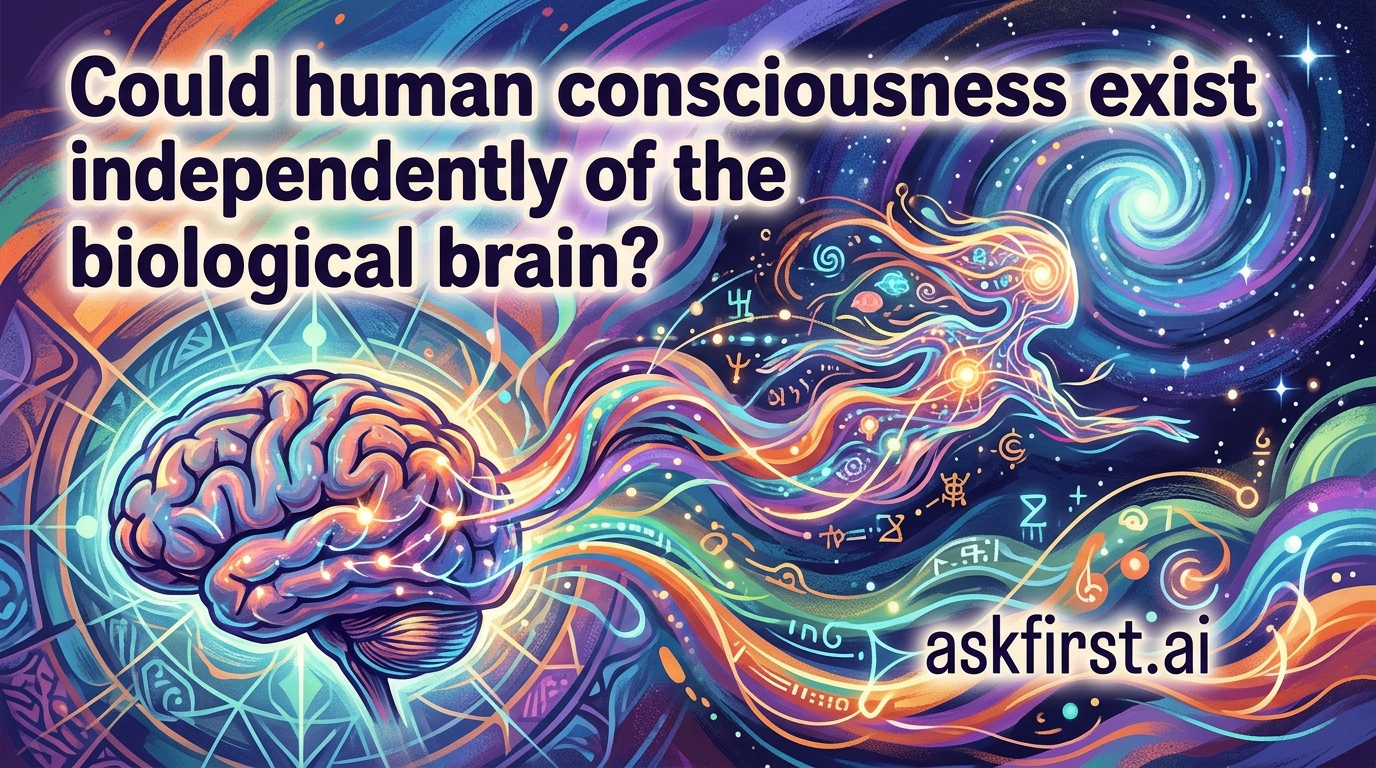
The relationship between the human mind and the physical brain remains one of the most profound mysteries in modern science. While mainstream neuroscience identifies the brain as the generator of consciousness, a growing body of research in quantum biology and philosophy of mind invites us to consider alternative paradigms where consciousness might exist independently of biological substrate.
The Neuro-Centric Paradigm
For centuries, the materialist perspective has dominated Western thought, positing that consciousness is an "emergent property" of complex neural computations. This view suggests that when neurons fire in specific patterns, subjective experience follows. Under this framework, consciousness is akin to software running on hardware; if the hardware is destroyed, the software ceases to exist. Proponents of this view point to brain injuries or pharmacological interventions as evidence that personality and awareness are inextricably linked to physical neural integrity.
Challenging Materialism: The Transmission Hypothesis
Alternative theories, such as the "Transmission Hypothesis" popularized by philosophers like William James and Henri Bergson, argue that the brain does not produce consciousness, but rather filters or receives it. According to this view, the brain acts as a radio receiver. A radio does not create the music it plays; it simply tunes into a broadcast. If the radio is damaged, the music may sound distorted or stop playing, yet the transmission itself remains unaffected. This perspective allows for the theoretical possibility that consciousness is a fundamental feature of the universe—an intrinsic property rather than an accidental byproduct of biology.
Quantum Biology and Potential Pathways
In the realm of quantum physics, theories like the Orch-OR (Orchestrated Objective Reduction) model, proposed by physicist Roger Penrose and anesthesiologist Stuart Hameroff, suggest that consciousness arises from quantum vibrations within microtubules inside neurons. If consciousness is linked to quantum processes, which operate independently of classical space-time limitations, the potential for non-local awareness becomes a subject of intense academic inquiry. While speculative, these models provide a mathematical basis for how consciousness could potentially operate beyond the traditional boundaries of organic matter.
Future Implications
Technological advancements in artificial intelligence and brain-computer interfaces are forcing humanity to redefine consciousness. As we attempt to map every neural synapse, we encounter the "Hard Problem of Consciousness," famously coined by David Chalmers: why and how does physical matter give rise to subjective experience? This enduring mystery suggests that our current tools may be insufficient to measure the full extent of awareness. Whether consciousness is an internal output of a biological machine or an external force interacting with the physical world, the inquiry into its nature remains the final frontier of human knowledge.