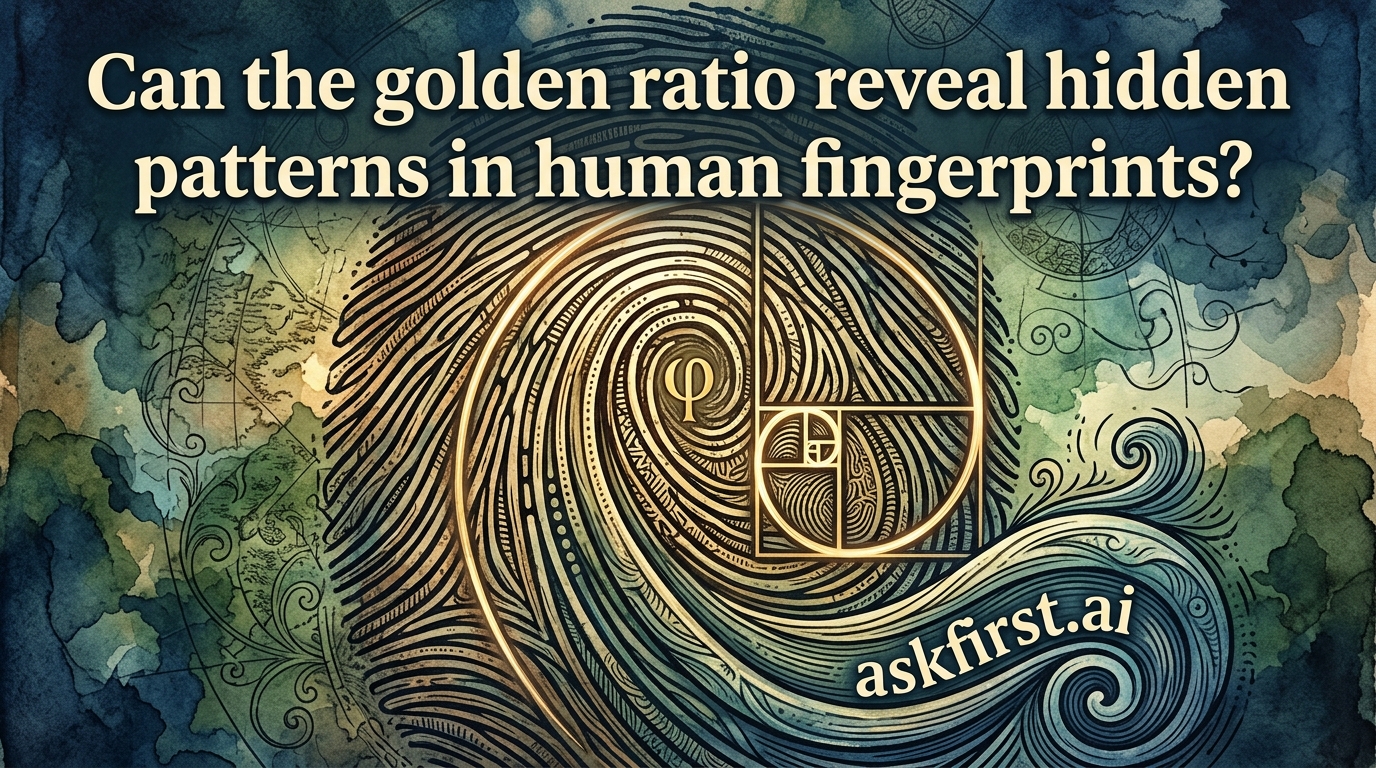
The Golden Ratio: Decoding Hidden Fingerprint Patterns
The Intersection of the Golden Ratio and Dermatoglyphics
The question of whether the Golden Ratio ($\phi \approx 1.618$)—a mathematical constant representing the proportion where the ratio of the sum of two quantities to the larger quantity is equal to the ratio of the larger quantity to the smaller—governs the complex topography of human fingerprints is a subject of ongoing debate in biometrics, mathematics, and developmental biology.
1. The Nature of Fingerprints (Dermatoglyphics)
Fingerprints, or dermatoglyphic patterns, are formed during the first trimester of fetal development. They are dictated by a combination of genetic factors and stochastic environmental variables within the womb, such as amniotic fluid pressure, the rate of fetal growth, and the precise timing of volar pad regression. These patterns are categorized into three primary types: loops, whorls, and arches.
2. The Golden Ratio in Biological Morphogenesis
The Golden Ratio is pervasive in nature, appearing in phyllotaxis (the arrangement of leaves on a stem), the spiral of nautilus shells, and the structure of galaxies. This occurs because $\phi$ minimizes the potential energy and maximizes space-filling efficiency in growing systems.
In the context of fingerprints, researchers have investigated whether the logarithmic spiral—a geometric progression often linked to the Golden Ratio—underlies the formation of whorl patterns. Studies using fractal geometry have shown that fingerprint ridges often follow self-similar patterns. When the curvature of a whorl is analyzed, the expansion rate of the ridge lines sometimes approximates the growth factor found in the Golden Spiral.
3. Scientific Consensus and Limitations
While the Golden Ratio appears in many biological structures, its application to fingerprints is not a universal law.
- Stochasticity: Unlike a sunflower seed arrangement, which is driven by rigid biological signaling (auxin distribution), fingerprint formation is highly chaotic.
- Variability: Forensic databases containing billions of prints demonstrate that while some whorls exhibit proportions close to 1.618, the vast majority of human prints (especially loops and arches) do not adhere to this ratio.
- Mathematical Coincidence: Critics argue that because logarithmic spirals are common in nature, finding them in fingerprints is a matter of mathematical probability rather than a deterministic "blueprinting" process.
4. Practical Implications and Biometrics
In modern biometrics, fingerprint identification relies on minutiae points—the specific locations where ridge lines end or bifurcate. These systems do not rely on the Golden Ratio for authentication. Instead, they use algorithms based on:
- Global Pattern Matching: Classifying the overall flow of ridges.
- Local Feature Extraction: Mapping the spatial coordinates of ridge endings.
5. Future Trends and Research
The future of dermatoglyphics lies in Epigenetics. Researchers are exploring whether the "hidden patterns" in fingerprints are better explained by Turing patterns—reaction-diffusion systems where chemical inhibitors and activators create complex, stable periodic structures. While the Golden Ratio may be a byproduct of these chemical waves, it is likely one of many geometric outcomes rather than the singular governing principle.
In conclusion, while the Golden Ratio can be superimposed onto specific whorl patterns, it does not reveal a hidden, universal structural code for human fingerprints. Fingerprints remain a testament to the interplay between genetic potential and the chaotic, beautiful unpredictability of individual development.