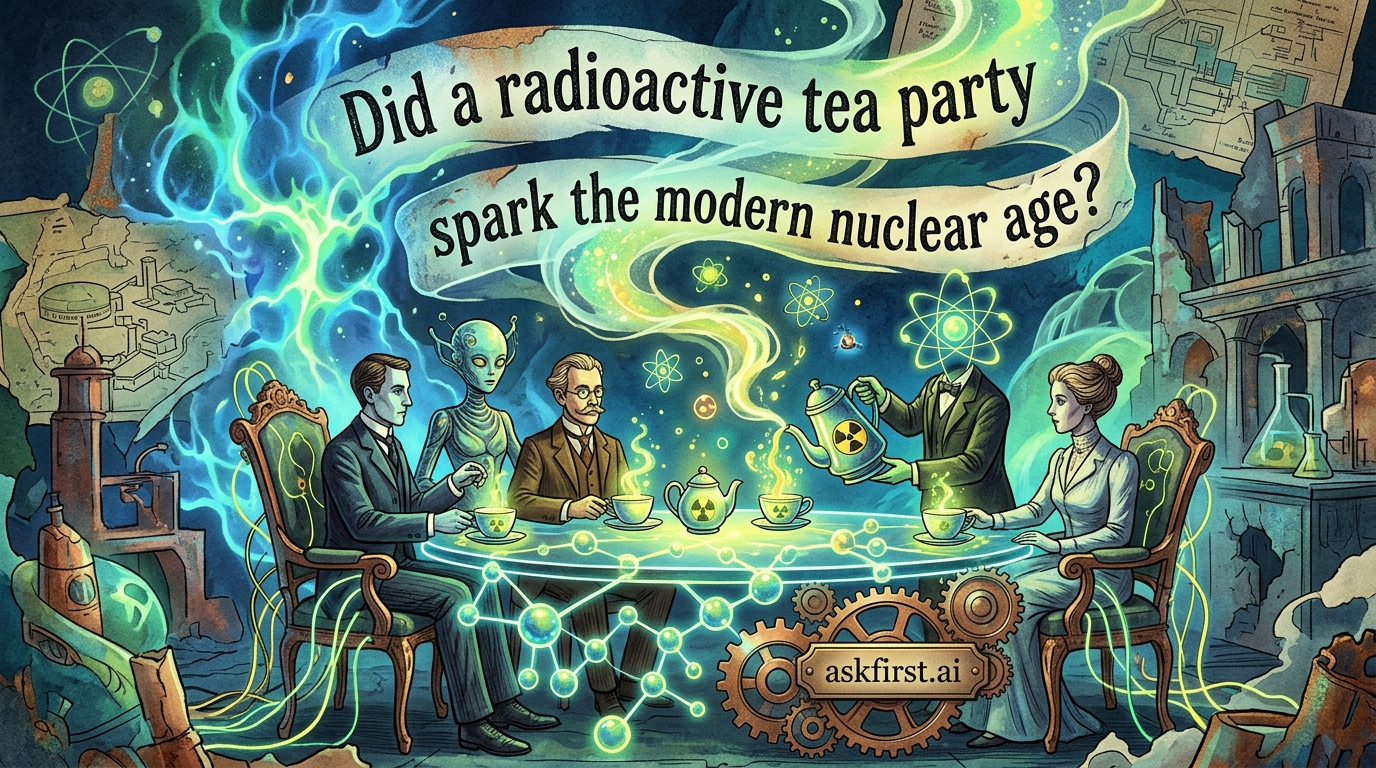
The Radioactive Tea Party: Myth, Reality, and the Dawn of the Nuclear Age
The phrase "radioactive tea party" is often used as a colorful, albeit metaphorical, descriptor for the early 20th-century obsession with radioactivity. While no single social gathering of tea-drinking scientists literally "sparked" the nuclear age, the era between 1895 and 1945 was defined by a culture of scientific curiosity that treated lethal radioactive materials with the same casual fascination one might reserve for a novel parlor trick.
Historical Context: The Radium Craze
Following Henri Becquerel’s 1896 discovery of radioactivity and the Curies’ isolation of radium in 1898, the world entered a period of "radium mania." In the early 1900s, radioactivity was perceived not as a threat, but as a miraculous health tonic.
- Radithor: The most infamous example of this era was Radithor, a patent medicine consisting of radium dissolved in water. Its most prominent victim, industrialist Eben Byers, died a gruesome death in 1932 after consuming nearly 1,400 bottles.
- Consumer Products: Radium was added to everything from toothpaste and cosmetics to chocolates and heating pads. The belief was that ionizing radiation stimulated the body’s cells, promoting vitality.
The Scientific Shift: From Curiosity to Weaponization
The transition from these "radioactive tea parties" to the reality of nuclear weaponry occurred through rigorous, often dangerous experimentation.
- The Neutron Discovery (1932): James Chadwick’s discovery of the neutron allowed scientists to probe the atomic nucleus without the repulsion caused by positive electrical charges.
- Nuclear Fission (1938): Otto Hahn and Fritz Strassmann discovered that uranium atoms could be split, releasing immense energy. Lise Meitner provided the theoretical explanation, proving that the mass lost during fission was converted into energy ($E=mc^2$).
- The Manhattan Project: The theoretical potential realized in the late 1930s was transformed into a military industrial complex during World War II. The "tea party" atmosphere of early academic labs vanished, replaced by the intense, secretive, and high-stakes environment of Los Alamos.
Pros, Cons, and Ethical Implications
The nuclear age brought a dual legacy that defines modern geopolitics and energy policy.
- Pros:
- Energy Density: Nuclear power provides a high-efficiency alternative to fossil fuels with zero carbon emissions during operation.
- Medical Advances: Radiotherapy and diagnostic imaging (PET scans) revolutionized oncology.
- Cons:
- Proliferation: The technology used for energy can be diverted for weapons, creating existential risks.
- Waste Management: The long-term storage of radioactive waste remains an unresolved environmental and political challenge.
Future Trends
The future of nuclear technology is shifting toward Small Modular Reactors (SMRs) and Nuclear Fusion. Fusion, the process that powers the sun, promises near-limitless energy without the long-lived radioactive waste associated with current fission reactors. As of 2026, international collaborations like ITER continue to push the boundaries of plasma containment, aiming to make fusion a viable component of the global energy grid.
Conclusion
The "radioactive tea party" serves as a cautionary tale of human hubris. It reminds us that our initial ignorance of the fundamental forces of nature led to both widespread suffering and the most potent technology in human history. Today, the nuclear age is no longer a parlor game; it is a mature, complex, and vital pillar of modern science that requires constant vigilance and ethical oversight.