The Psychology of the Norman Door: Why We Fail at Doors
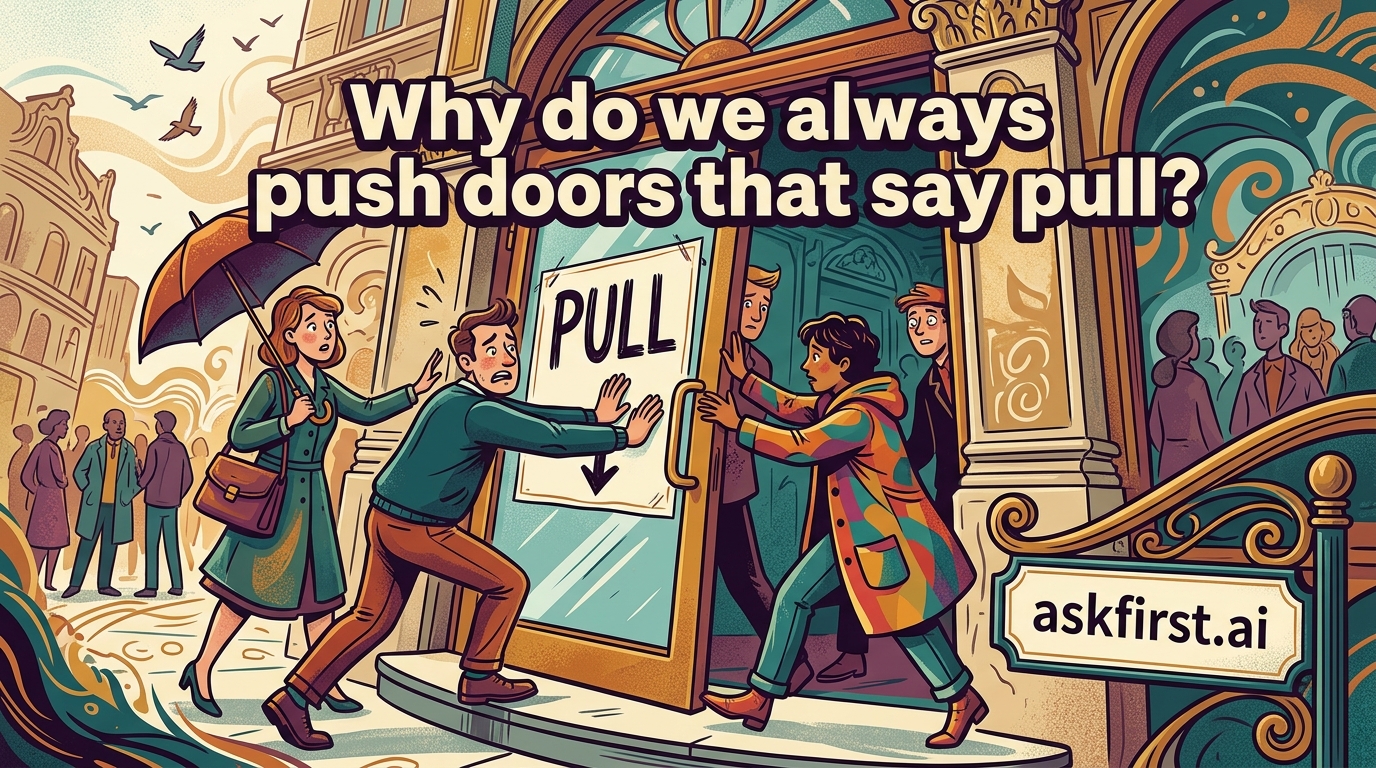
Human interaction with doors is a classic study in behavioral psychology and design, famously popularized by Don Norman in his seminal work, The Design of Everyday Things. The tendency to push a door labeled "pull" is rarely a lapse in intelligence, but rather a failure of intuitive design. When an object’s form suggests an action that contradicts its function, the phenomenon is referred to as a "Norman Door."
The Role of Affordances
Affordances are properties of an object that show how it can be used. A flat plate on a door is an "affordance" for pushing; it invites the palm to press against it. Conversely, a vertical handle is an affordance for pulling. When a designer installs a flat metal plate on a door that is meant to be pulled, they are creating a visual lie. The human brain processes these environmental cues in milliseconds, subconsciously deciding to push before the conscious mind has a chance to read the sign.
The Cognitive Load and Mapping
Humans rely on mental models to navigate the world. We build expectations based on past experiences; if every door in a specific building has a flat plate, we develop a heuristic that all doors operate by pushing. When we encounter a pull door, this cognitive shortcut forces a conflict. We do not stop to analyze the hardware; we rely on muscle memory. This automatic behavior is efficient for survival, but in the realm of poor industrial design, it creates a friction point known as "gulf of execution." This is the gap between the user’s goal (entering the building) and the action required to achieve it.
The Impact of Signage
Signs are often treated as a "patch" for bad design. If a door requires a label to explain how to operate it, the design has already failed. Expert designers emphasize that good design speaks for itself. In many public settings, the "pull" sign is small, obscured, or placed at eye level, which is far from the hardware the user is actually looking at. Because the eyes are fixed on the handle or the door frame, the instructional text is effectively invisible to the peripheral vision.
Conclusion: Design for Intuition
To bridge this gap, modern architecture increasingly emphasizes "nudge theory." By matching hardware to the required motion—such as replacing push-plates with ergonomic handles for pulling or vertical bars for pushing—architects can eliminate the need for signage entirely. When objects are designed to be self-explanatory, user error vanishes. Next time the urge to push a pull door arises, recognize it as a testament to the power of environmental suggestion rather than a personal oversight. The fault lies in the hardware, not the human.