The Quantum Resonance of Aesthetic Experience: Why Art Feels Alive
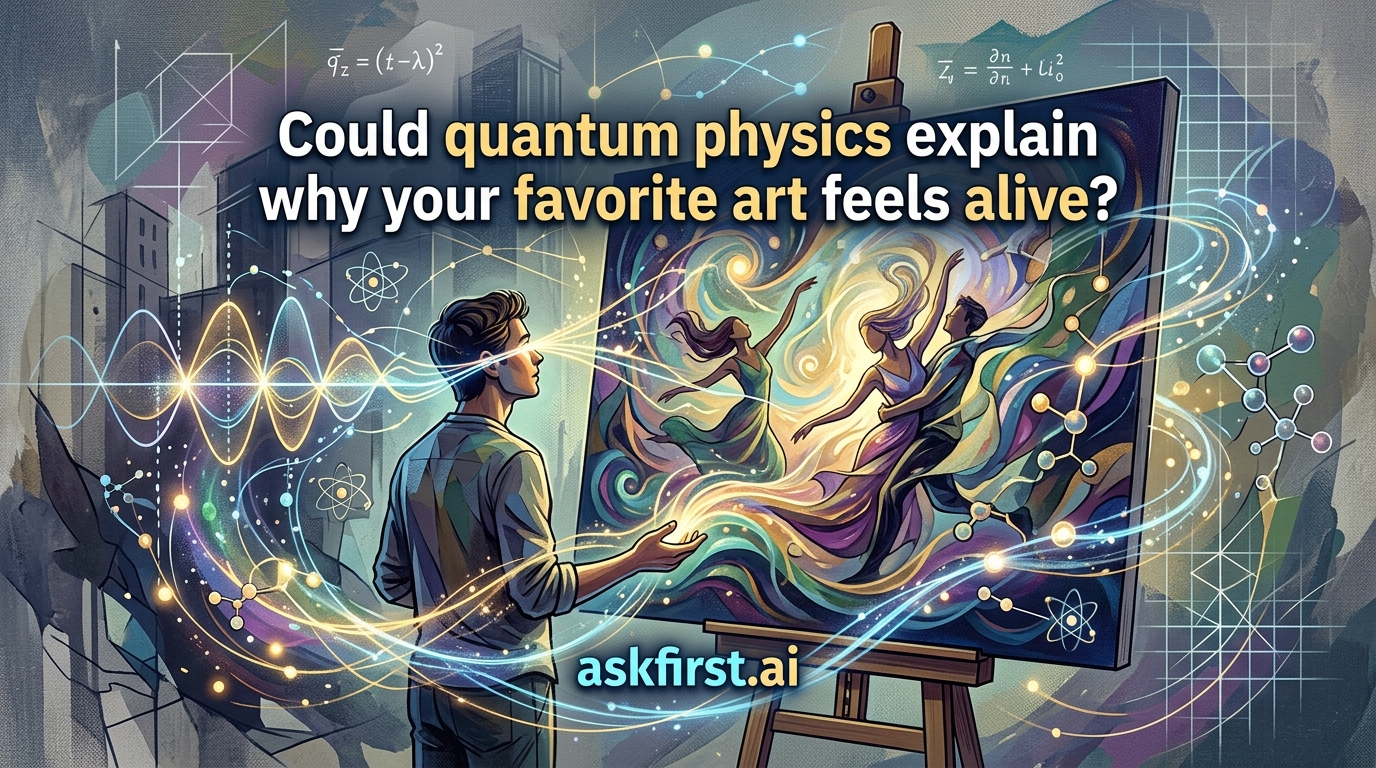
When standing before a masterpiece, the sensation that the work is breathing or watching back is a common human experience. While traditionally relegated to the realm of psychology or neuroaesthetics, some theorists suggest that the interface between consciousness and reality—rooted in quantum mechanics—might provide a framework for this phenomenon. The idea that art possesses a "vibrational quality" resonates with the principle of entanglement and the observer effect.
The Observer Effect and Art Perception
At the core of quantum theory lies the observer effect: the act of observing a system fundamentally changes its state. In art, the viewer is not a passive recipient but an active participant. When engaging with a profound piece of art, the neural patterns of the viewer interact with the visual information provided by the canvas. This creates a feedback loop that collapses the infinite possibilities of how a work might be interpreted into a singular, lived reality. This "collapse" creates a moment of subjective intimacy, which the brain interprets as the object having its own vitality.
Resonance and Quantum Coherence
Quantum coherence describes how particles can exist in a state where they share a single wave function. Some thinkers propose that deep aesthetic appreciation involves a form of macroscopic coherence between the viewer and the art object. When an artist imbues a work with intense focus and emotional depth, the structural order of the composition may act as a physical template.
- Patterns of Geometry: The use of fractals and golden ratios in art mimics the natural structures found at the quantum level.
- Information Density: High-quality art serves as an information-rich field, forcing the brain to process layers of meaning simultaneously.
This high level of density creates a "resonant field" where the viewer feels the art is "alive" because it is stimulating brain activity in a way that mimics the organic patterns of neural firing. The art is not merely light reflecting off a surface; it is a catalyst for coherent mental states.
The Mystery of Non-Local Connection
Beyond mere visual perception, some enthusiasts point to non-locality—the principle that objects can be connected across space without direct contact. While science currently lacks a verified mechanism for quantum effects in the wet, warm brain, the sense of "feeling" the artist's intent across time and space echoes the qualities of non-local entanglement. The viewer feels a sudden, profound shift in their own state, a "quantum leap" in awareness, which is attributed to the presence of the artwork. This creates a bridge between the creator's past internal state and the viewer's current consciousness, effectively blurring the lines between the inanimate object and the living experience of being human.