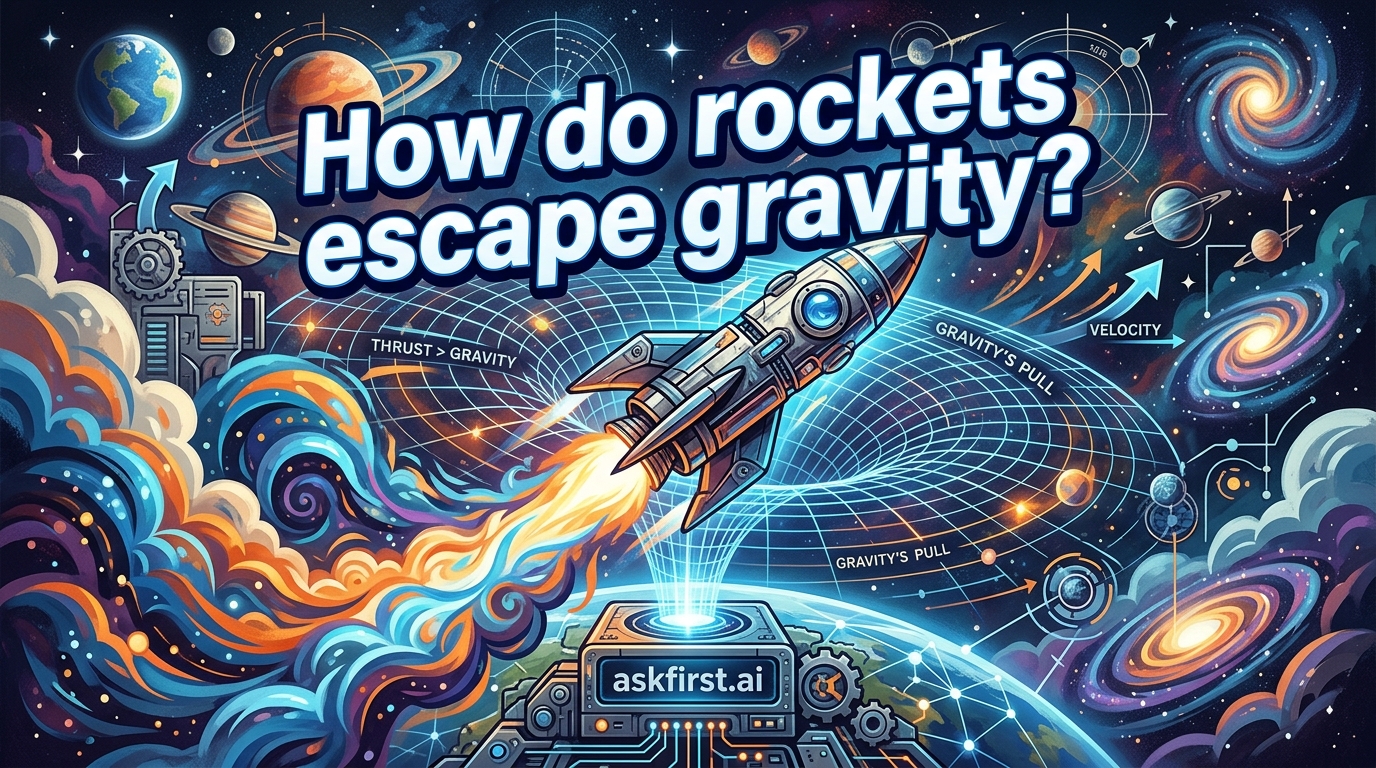
The Physics of Rocket Propulsion: Escaping Earth’s Gravity
To escape Earth’s gravitational pull, a rocket must achieve escape velocity, which is approximately 11.186 kilometers per second (or 40,270 km/h). This feat is governed by fundamental principles of physics, specifically Isaac Newton’s laws of motion and the Tsiolkovsky rocket equation.
1. The Core Principle: Newton’s Third Law
Rockets operate on the principle of action and reaction. By burning chemical propellants, a rocket engine creates high-pressure gas that is expelled at extreme speeds through a nozzle. According to Newton’s Third Law, for every action, there is an equal and opposite reaction. As the exhaust gases are pushed downward, the rocket experiences an upward force known as thrust.
2. The Tsiolkovsky Rocket Equation
The ability of a rocket to reach space is defined by the Tsiolkovsky rocket equation:
$$\Delta v = v_e \ln \frac{m_0}{m_f}$$
- $\Delta v$ (Delta-v): The total change in velocity required.
- $v_e$: Effective exhaust velocity.
- $m_0$: Initial total mass (rocket + propellant).
- $m_f$: Final mass (dry mass after propellant is spent).
This equation highlights the "tyranny of the rocket equation": to increase payload, one must add more fuel, but adding fuel increases the mass, which in turn requires even more fuel to lift. This is why multi-stage rockets are essential.
3. Practical Implementation: Multi-Stage Rockets
Because the Earth's atmosphere is dense and the planet’s gravity is strong, carrying the "dead weight" of empty fuel tanks is inefficient. Engineers utilize staging:
- Stage 1: Provides the massive initial thrust needed to clear the dense lower atmosphere. Once empty, this stage is jettisoned to reduce mass.
- Upper Stages: These ignite in the vacuum of space, where they are much more efficient since they no longer have to push against atmospheric drag or carry the weight of the massive first stage.
4. Overcoming Atmospheric Drag and Gravity Losses
A rocket does not just fight gravity; it fights aerodynamic drag. The rocket is designed with an aerodynamic fairing to minimize air resistance. Furthermore, rockets perform a gravity turn, a maneuver where the rocket tilts slightly after launch. This serves two purposes: it uses gravity to help steer the rocket into a horizontal trajectory, which is necessary to achieve the lateral velocity required for orbital insertion.
5. Pros, Cons, and Future Trends
- Pros: Chemical rockets are currently the only proven method for delivering heavy payloads into orbit.
- Cons: High cost, extreme environmental impact due to fuel combustion, and the massive amount of propellant required.
- Future Trends:
- Reusable Rockets: Companies like SpaceX are revolutionizing the industry by landing booster stages, significantly reducing the cost per kilogram.
- Nuclear Thermal Propulsion: Offers higher efficiency than chemical rockets for deep-space travel.
- Space Elevators: A theoretical, non-rocket method using a cable anchored to Earth to lift payloads into orbit, potentially eliminating the need for massive fuel consumption.
In summary, escaping gravity is a brutal battle against mass and atmospheric resistance, managed through the precise control of chemical energy and the strategic shedding of inert components.