The Memory Paradox: Why Trivia Stays and To-Dos Fade
It is a common human experience: the ability to recall the specific lyrics to a song from a decade ago or a random movie quote with crystalline clarity, while simultaneously forgetting to pick up dry cleaning or finish a critical project task. This phenomenon is not a failure of intelligence but a feature of how the biological architecture of memory operates.
The Encoding Priority of Novelty
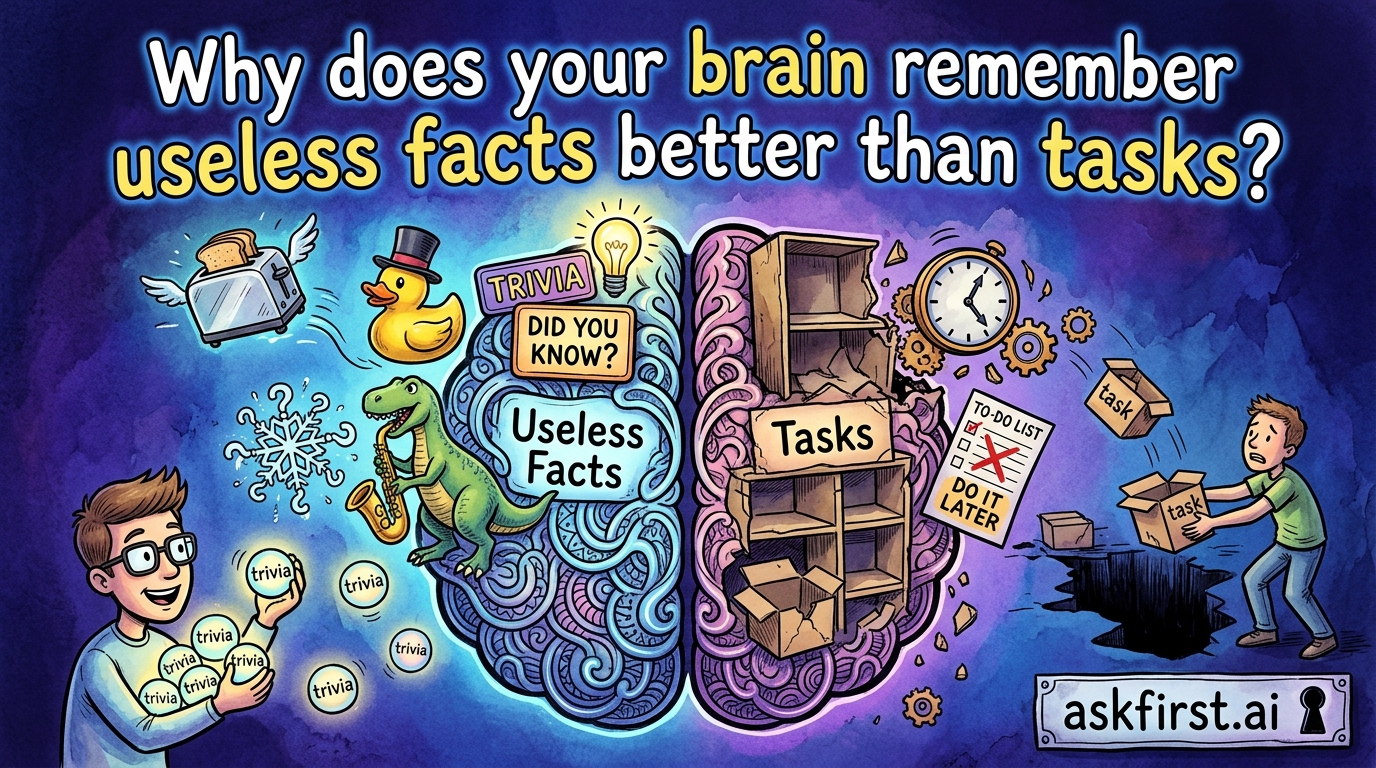
The brain functions as a sophisticated filter designed for survival, not for productivity. It prioritizes information based on emotional resonance and novelty rather than utility. In evolutionary terms, a "useless" fact—such as the specific color of a predator’s eyes or the location of a fruit-bearing tree—held life-altering significance. When the brain encounters high-novelty information, the amygdala signals the hippocampus to prioritize storage. Conversely, routine tasks often lack this emotional "tag," leading the brain to label them as low-priority "maintenance" data, which is subsequently deprioritized or purged to make room for new sensory input.
The Zeigarnik Effect and Cognitive Load
A critical psychological concept, the Zeigarnik Effect, states that people remember uncompleted or interrupted tasks better than completed ones. However, this is distinct from long-term storage. When a task is viewed as a "to-do," it occupies the brain’s limited working memory—a volatile, high-pressure workspace. Once the brain finishes the task, or decides the task is repetitive, it clears the working memory to prevent cognitive overload. In contrast, trivia is often stored in semantic memory, which is associated with long-term knowledge networks. Once a piece of trivia is integrated into the brain's existing web of knowledge, it becomes remarkably stable and easy to retrieve.
Why Tasks Disappear
Tasks often fall into the category of "prospective memory," which requires remembering to perform an action at a future time. This is significantly more resource-intensive than retrieving past information. Factors that cause task loss include:
- Context Dependency: A task is often tied to a specific environment. If the environment changes, the associative cue for the task is lost.
- Automation: Once a task becomes routine, it is offloaded to the basal ganglia, which governs habits. The conscious mind then disengages, making the task feel as though it was "forgotten" when, in reality, the brain simply stopped tracking it consciously.
- Attention Economy: The brain treats daily chores as background noise. Since they lack the "surprise" element of interesting facts, they are not encoded with the same neural vigor.
Ultimately, the brain is an expert at trivia because it treats life as an infinite encyclopedia. To improve task retention, experts suggest externalizing memory through systems like checklists, as the brain is evolved for synthesis and pattern recognition, not for acting as a static calendar.