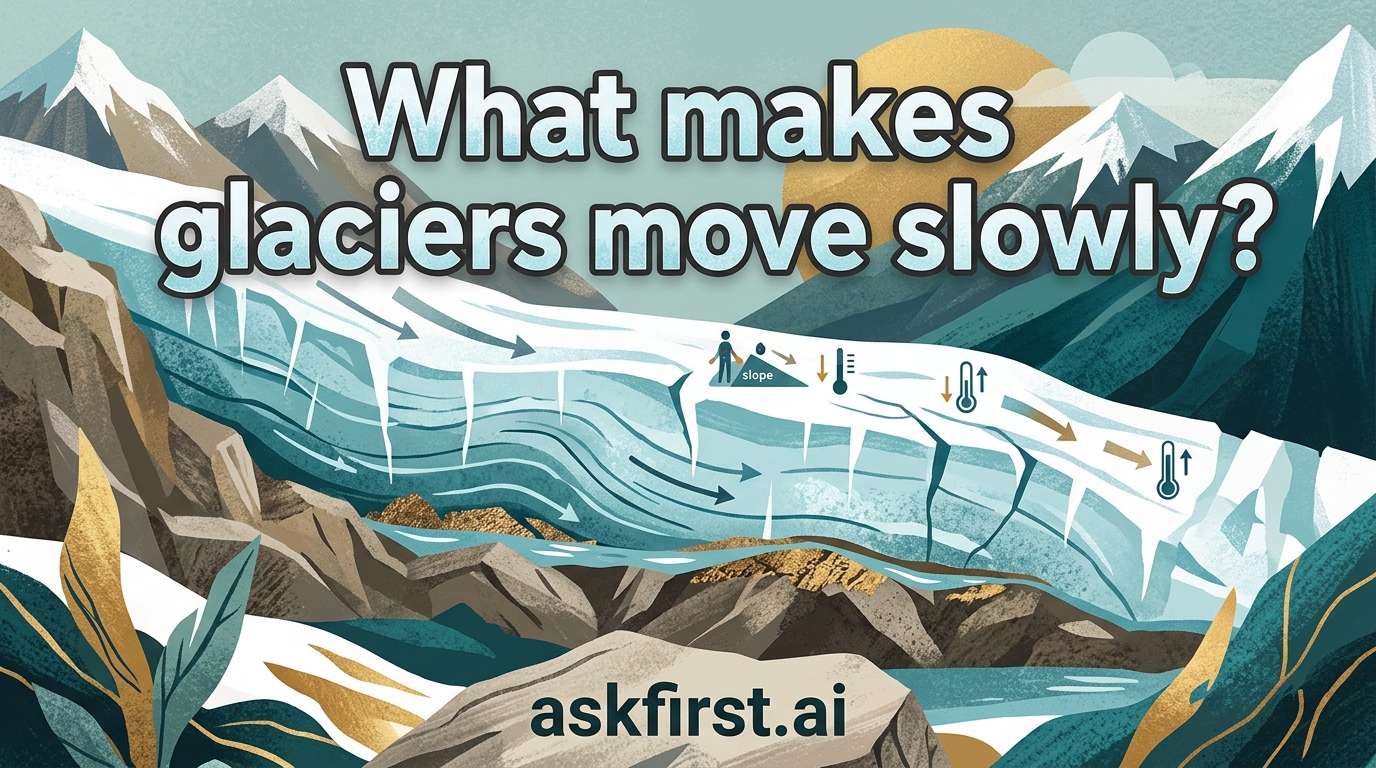
The Mechanics of Glacial Movement: An Exhaustive Overview
Glaciers are massive, perennial accumulations of crystalline ice, snow, rock, sediment, and liquid water that originate on land and move downslope under the influence of their own weight and gravity. Far from being static, glaciers are dynamic systems that flow like extremely viscous fluids. Their movement is a complex interplay of thermodynamics, pressure, and friction.
1. The Physics of Internal Deformation
The primary mechanism behind glacial movement is internal deformation, also known as creep. Glacial ice behaves as a plastic material. When a glacier reaches a critical thickness (typically around 30 to 50 meters), the pressure at the base becomes immense. Under this pressure, the ice crystals begin to reorganize:
- Basal Slip: The ice crystals align themselves in layers, allowing them to slide past one another.
- Plastic Flow: Because ice is a crystalline solid, individual grains can deform and re-orient under stress. As the glacier thickens, the weight of the overlying ice forces the bottom layers to deform, causing the entire mass to "flow" downhill.
2. Basal Sliding and Lubrication
Not all movement occurs through internal deformation. Many glaciers, particularly "temperate" glaciers, move via basal sliding. This is facilitated by three critical factors:
- Pressure Melting: The immense weight of the glacier lowers the melting point of ice. This creates a thin film of liquid water at the interface between the bedrock and the glacier, which acts as a lubricant, dramatically increasing the velocity of the glacier.
- Subglacial Hydrology: Meltwater from the surface often travels through deep cracks called moulins to the glacier bed. This pressurized water system can lift the glacier slightly, reducing friction and allowing it to "glide" over the landscape.
- Deforming Bed: In some regions, glaciers move over soft, water-saturated sediments. The movement of the glacier occurs as these sediments themselves deform or flow, effectively acting like a conveyor belt beneath the ice.
3. Key Factors Influencing Velocity
The speed at which a glacier moves is not uniform. It is dictated by several variables:
- Slope Gradient: Steeper terrain increases gravitational pull, accelerating movement.
- Ice Thickness: Thicker ice exerts more pressure, leading to faster internal deformation.
- Temperature: Warmer ice is more "plastic" and deformable than ice at very low temperatures.
- Friction: The roughness of the underlying bedrock acts as a brake. Glaciers move faster in the center and near the surface, where friction from the valley walls and floor is minimized.
4. Pros, Cons, and Environmental Impacts
Glaciers are essential components of the Earth's hydrological cycle.
- Pros: They act as massive freshwater reservoirs, regulating downstream water supply for agriculture and ecosystems.
- Cons: Rapid glacial retreat, driven by anthropogenic climate change, poses significant risks, including sea-level rise and the formation of unstable glacial lakes that can burst, causing catastrophic flooding.
5. Future Trends and Observation
Modern glaciology utilizes satellite imagery (such as InSAR) to monitor movement. Data indicates that many glaciers are accelerating due to increased surface meltwater reaching the bed. As global temperatures rise, the delicate balance of glacial flow is being disrupted, leading to thinning and potentially the eventual disappearance of smaller glaciers, fundamentally altering the topography and water security of mountainous regions worldwide.