The Dynamics of Wind: Global and Regional Atmospheric Motion
Wind is the large-scale movement of air in the atmosphere. At its core, wind is nature’s way of attempting to equalize atmospheric imbalances caused by the uneven heating of the Earth's surface. This phenomenon is a complex interplay of thermodynamics, fluid dynamics, and planetary rotation.
1. The Fundamental Drivers: Pressure and Temperature
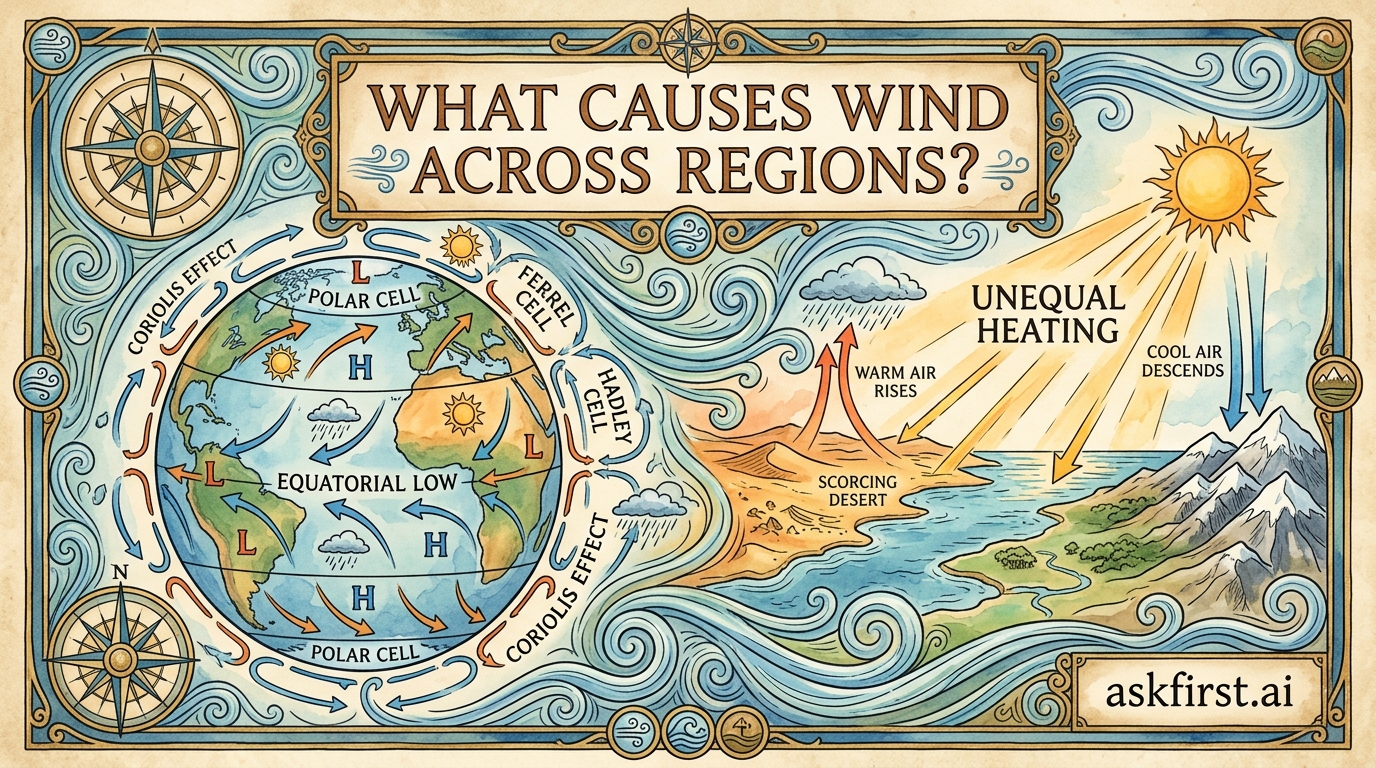
The primary cause of all wind is the Pressure Gradient Force (PGF). Air naturally moves from areas of high atmospheric pressure to areas of low atmospheric pressure.
- Solar Radiation: The sun heats the Earth’s surface unevenly due to its spherical shape and axial tilt. The equator receives direct, intense solar energy, while the poles receive slanted, diffuse energy.
- Thermal Expansion: As air warms, its molecules spread out, becoming less dense and rising, creating a low-pressure zone. Conversely, cold air is dense and sinks, creating a high-pressure zone.
- The Gradient: The greater the difference in pressure over a specific distance, the faster the air moves to balance it, resulting in stronger winds.
2. The Influence of Earth’s Rotation: The Coriolis Effect
If the Earth were stationary, wind would simply flow in straight lines from poles to equator. However, the Coriolis Effect—a result of the Earth’s rotation—deflects moving air.
- Northern Hemisphere: Wind is deflected to the right of its intended path.
- Southern Hemisphere: Wind is deflected to the left.
This force is responsible for the rotation of cyclonic storms and the formation of global wind belts like the Trade Winds and the Westerlies.
3. Regional and Local Wind Systems
Beyond global circulation, regional winds are shaped by local geography and surface characteristics:
- Sea and Land Breezes: During the day, land heats faster than water. Warm air rises over land, drawing cool air in from the sea (sea breeze). At night, the land cools faster, reversing the flow (land breeze).
- Mountain and Valley Breezes: During the day, sunlight warms mountain slopes, causing air to rise (valley breeze). At night, dense, cold air sinks down the slopes into the valley (mountain breeze).
- Katabatic Winds: These are gravity-driven winds, such as the Mistral in France, where dense, cold air spills down from high elevations to lower plains.
4. Friction and Surface Roughness
Near the Earth's surface, the wind encounters obstacles like mountains, forests, and urban skylines. This surface friction slows the wind speed and induces turbulence. Friction also reduces the impact of the Coriolis effect, causing winds to blow at an angle across isobars (lines of constant pressure) rather than parallel to them.
5. Future Trends and Climate Impact
As global temperatures rise due to climate change, the temperature contrast between the poles and the equator is shifting. This alters the Jet Stream—a high-altitude ribbon of fast-moving air. A "wavier" jet stream can trap weather patterns in place, leading to prolonged heatwaves or extreme wind events. Understanding these mechanics is essential for meteorology, aviation, and the expanding global wind energy sector, which currently generates over 7% of the world's electricity.