The Limits of Infinity: Why Your Brain Can't Grasp Outer Space
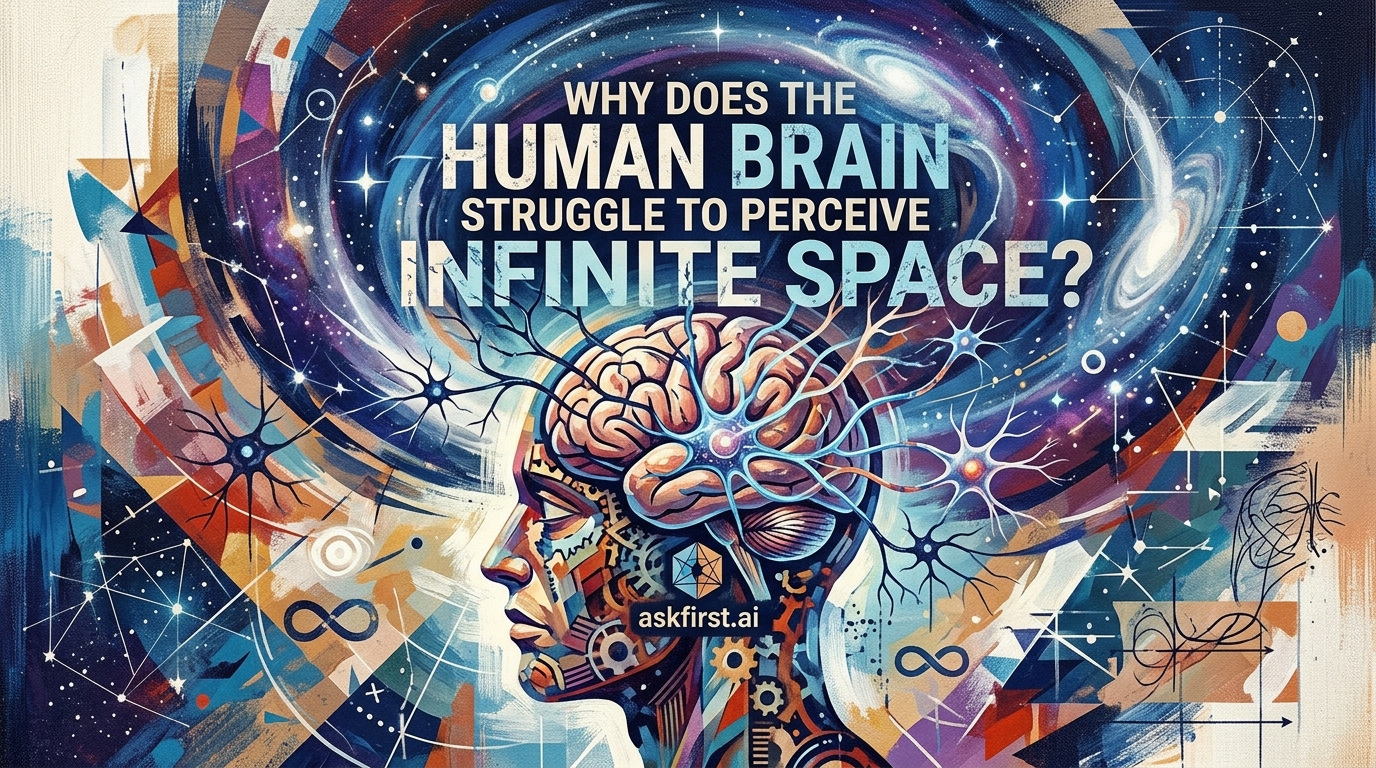
Human cognition is an evolutionary masterpiece, but it was sculpted by the pressures of terrestrial survival, not the contemplation of cosmic scales. To understand why the brain struggles to perceive infinite space, one must analyze the divergence between biological adaptation and the nature of the universe.
Evolution and the Survival Filter
The human brain evolved to navigate immediate physical environments. During the Pleistocene epoch, our ancestors required spatial reasoning to track prey, identify shelter, and manage tribal dynamics. These tasks required a keen understanding of depth, trajectory, and local geometry—usually within a range of a few kilometers. Because evolution prioritizes energy efficiency, the brain developed heuristics for immediate space that simply do not scale to interstellar or infinite distances. Attempting to perceive infinity is akin to asking a high-resolution camera to record the entire history of the world in one frame; the hardware lacks the necessary bandwidth.
The Problem with Cognitive Mapping
Our minds rely on "cognitive maps" built through sensory experience. We understand the distance of a mile because we can walk it, and we understand a city because we can navigate its streets. However, space does not offer these benchmarks. When confronted with light-years or the concept of an eternal, expanding void, the brain loses its internal anchor. Psychological research into scale sensitivity reveals that humans perceive distances logarithmically rather than linearly. We struggle to differentiate between thousands and millions when those numbers do not correlate to tangible objects in our daily experience.
Neural Limitations on Conceptualization
There is a fundamental biological disconnect between abstract symbolic thought and visceral perception. While we can use mathematics to describe infinity, the visual cortex cannot render it. According to the "embodied cognition" theory, our thoughts are shaped by our physical form. Because our bodies have boundaries, our brains are hardwired to think in terms of boundaries. An infinite space lacks a container, and without a container, the brain experiences a "cognitive overflow." This is not a failure of intelligence but a demonstration of the brain's reliance on finite, relatable models.
Overcoming the Infinite Wall
To bridge this gap, scientists and philosophers often rely on mental models or analogies. For instance, visualizing the universe as an inflating balloon helps compress the concept of expansion into a manageable physical space. Yet, even with these tools, the sense of "infinite" remains an intellectual conclusion rather than an intuitive realization. We can know that space is infinite, but we cannot feel it. The brain remains a machine designed for the horizon, forever bounded by the very biological systems that allow it to contemplate the stars.