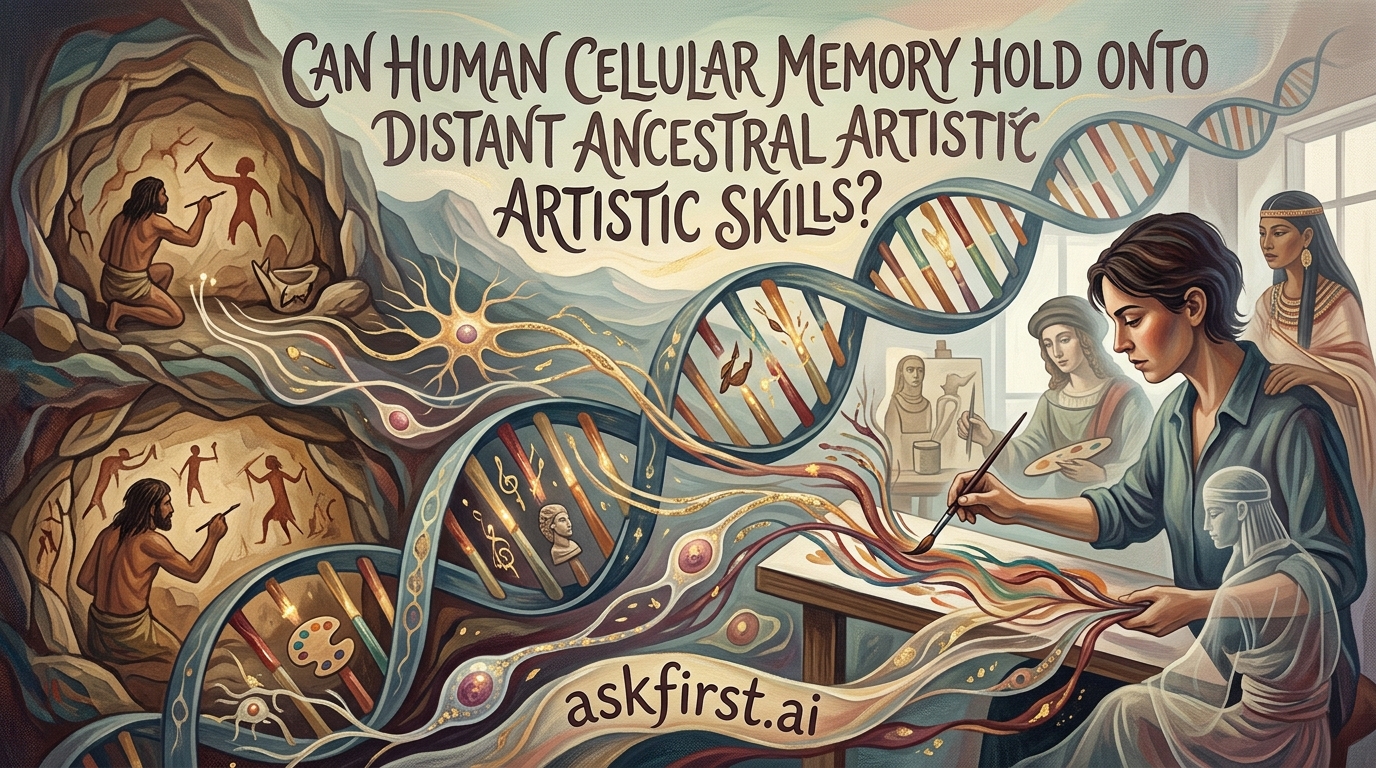
The Scientific Inquiry into Ancestral Cellular Memory and Artistic Skill
The question of whether human cellular memory can harbor "distant ancestral artistic skills" sits at the intersection of epigenetics, evolutionary biology, and neuro-phenomenology. While the concept is a frequent trope in speculative fiction and metaphysical discourse, current scientific consensus distinguishes between inherited biological traits and the transmission of complex cultural behaviors like artistic mastery.
The Biological Mechanism: Epigenetics vs. Genetic Memory
The primary mechanism by which environmental information is passed down through generations is epigenetics. Epigenetic markers—such as DNA methylation and histone modification—regulate gene expression without altering the underlying DNA sequence. Research has shown that trauma or environmental stressors can create "epigenetic imprints" that affect the behavior and physiological responses of offspring.
However, there is a fundamental distinction between the inheritance of a stress response (e.g., a heightened startle reflex) and the inheritance of a complex skill set (e.g., the ability to paint in the style of a 17th-century master). Artistic skill requires the integration of fine motor coordination, cognitive spatial mapping, and cultural context—elements that are not encoded in the nucleotide sequence of the genome.
Debunking "Genetic Memory" of Skills
The theory of "genetic memory" for learned behaviors, often associated with the work of Carl Jung (the "collective unconscious") or the discredited ideas of Lamarckian inheritance, lacks empirical evidence in modern neuroscience.
- The Plasticity of the Brain: Artistic mastery is a product of neuroplasticity. It requires thousands of hours of synaptic pruning and reinforcement. Even if an ancestor was a master sculptor, the neural pathways required for that skill must be built by the individual through practice.
- The "Blank Slate" vs. Predisposition: While we do not inherit skills, we do inherit predispositions. A person may inherit a genetic architecture that confers superior hand-eye coordination, pattern recognition, or color perception. These are "artistic traits," but they are not "artistic skills."
Practical Implications: Can You "Unlock" Ancestral Talent?
If you are interested in exploring the artistic potential you believe is rooted in your lineage, you are effectively engaging in phenotypic optimization. Since you cannot access ancestral "data," you must rely on the latent genetic potential inherited from your ancestors.
Steps to cultivate latent artistic potential:
- Identify Ancestral Archetypes: Research the crafts or trades of your ancestors. While you haven't "inherited" their skill, you may possess the biological hardware (e.g., specific bone structure or visual acuity) that made them successful.
- Engage in Deliberate Practice: Use the "10,000-hour rule" to bridge the gap between innate predisposition and mastery.
- Environmental Cues: Surround yourself with the aesthetic traditions of your culture. This is not "memory recall," but rather cultural priming, which can stimulate creative output.
Future Trends and Synthetic Biology
As we move toward 2026 and beyond, the field of optogenetics and memory encoding is evolving. While we cannot currently "download" ancestral skill, researchers are exploring how to stimulate neural circuits to accelerate learning. In the future, it may be possible to use neuro-feedback to align one's brain activity with the patterns observed in high-performing artists, effectively "emulating" the skill acquisition of the past.
Conclusion
In summary, while cellular memory in the form of epigenetic markers exists, it does not function as a hard drive for ancestral artistic expertise. You are the architect of your own skills, built upon the foundation of your genetic inheritance. You do not carry the paintings of your ancestors, but you may carry the vision that allowed them to create.