The Bio-Digital Synthesis: Architecting Systems Like Nature
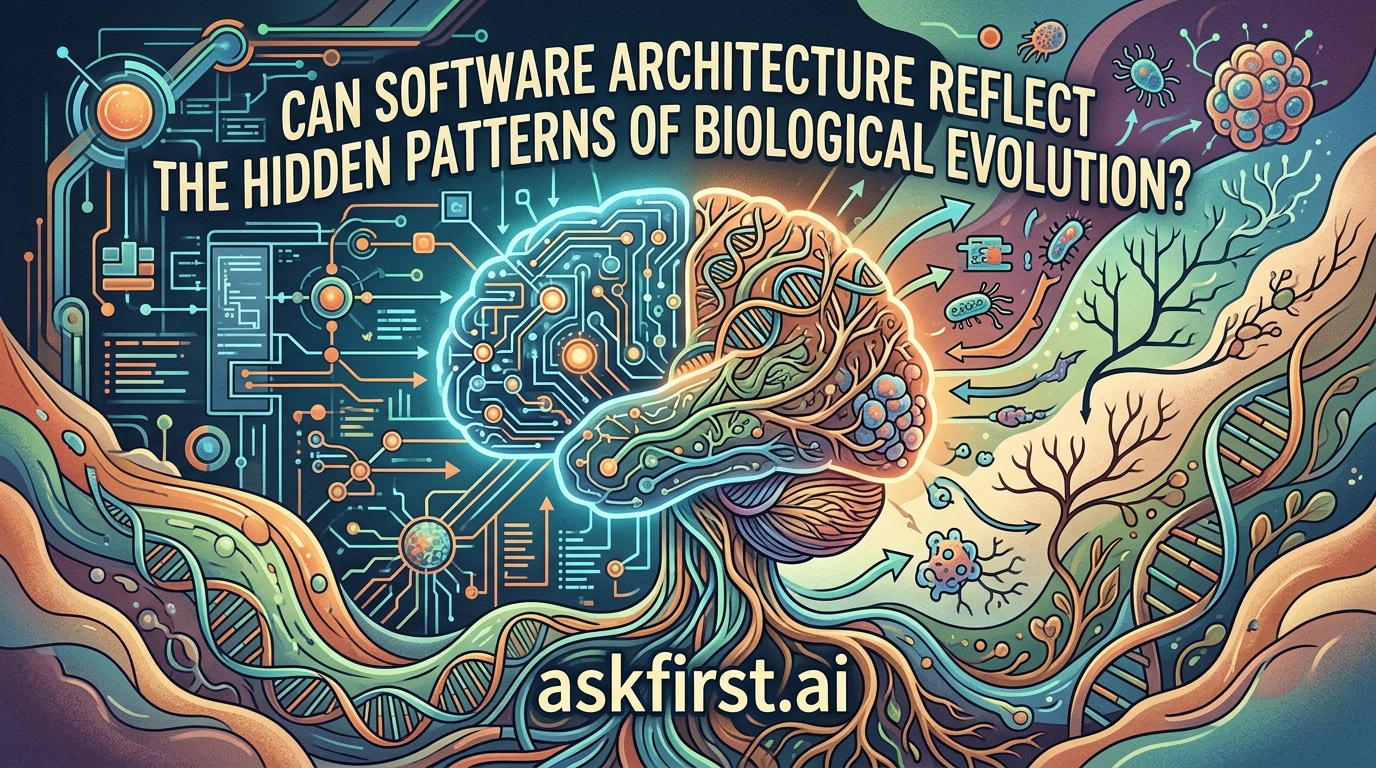
Software architecture and biological evolution share a fundamental preoccupation: the management of complexity over time. While biological organisms adapt through genetic mutation and natural selection, software systems evolve through refactoring, technical debt management, and architectural shifts. Parallels between these two domains suggest that high-performing software systems often exhibit "biological" traits such as modularity, emergent behavior, and resilience.
The Concept of Modular Design and Horizontal Gene Transfer
In biology, horizontal gene transfer allows organisms to acquire new traits from unrelated species, drastically accelerating adaptation. In software, this is mirrored by the adoption of open-source libraries, microservices, and modular APIs. Rather than building every component from scratch, modern architects "borrow" genetic material (code) from established ecosystems. This ensures that the system benefits from the collective intelligence and peer-reviewed robustness of the broader programming community, effectively creating a symbiotic software organism that survives by integrating external functionality.
Emergent Behavior and Complex Adaptive Systems
Biological systems are defined by emergent properties—the idea that the whole is greater than the sum of its parts. Similarly, distributed systems, such as microservices architectures, rely on emergent behavior. When individual services operate independently, they create complex, global outcomes that no single developer explicitly programmed. This decentralization prevents the "monolithic death trap" where a single point of failure collapses the entire system. Just as an ant colony functions without a central leader, highly scalable software relies on decoupled, self-correcting agents that maintain state through consensus protocols, ensuring system stability despite the absence of a top-down director.
Natural Selection via Technical Debt and Refactoring
Evolution acts as a harsh filter for inefficiency. In software, this filter is represented by the continuous process of refactoring. Code that fails to support business agility or becomes too brittle—much like an ill-adapted species—is eventually replaced or "deprecated" in favor of newer, more efficient architectural patterns. The "survival of the fittest" in computing manifests as the survival of the most maintainable. Systems that prioritize low coupling and high cohesion typically outlive tightly coupled, "spaghetti" architectures that cannot respond to changing environmental requirements.
Resilience and Genomic Redundancy
Biological organisms survive through redundancy; they have backup copies of vital genes and cellular repair mechanisms. Resilient software architecture mimics this through "chaos engineering," where components are intentionally subjected to failure to observe system recovery. Cloud-native architectures utilize load balancing, auto-scaling, and failover mechanisms to provide digital redundancy. By incorporating self-healing capabilities, modern systems emulate the regenerative power of organic life, ensuring that the architecture remains functional even when individual parts suffer from hardware failures or network latency. Ultimately, the future of software design lies in bridging the gap between cold, deterministic code and the dynamic, resilient principles of biological evolutionary theory.