The Genesis of Logic: Unveiling the First Executed Code
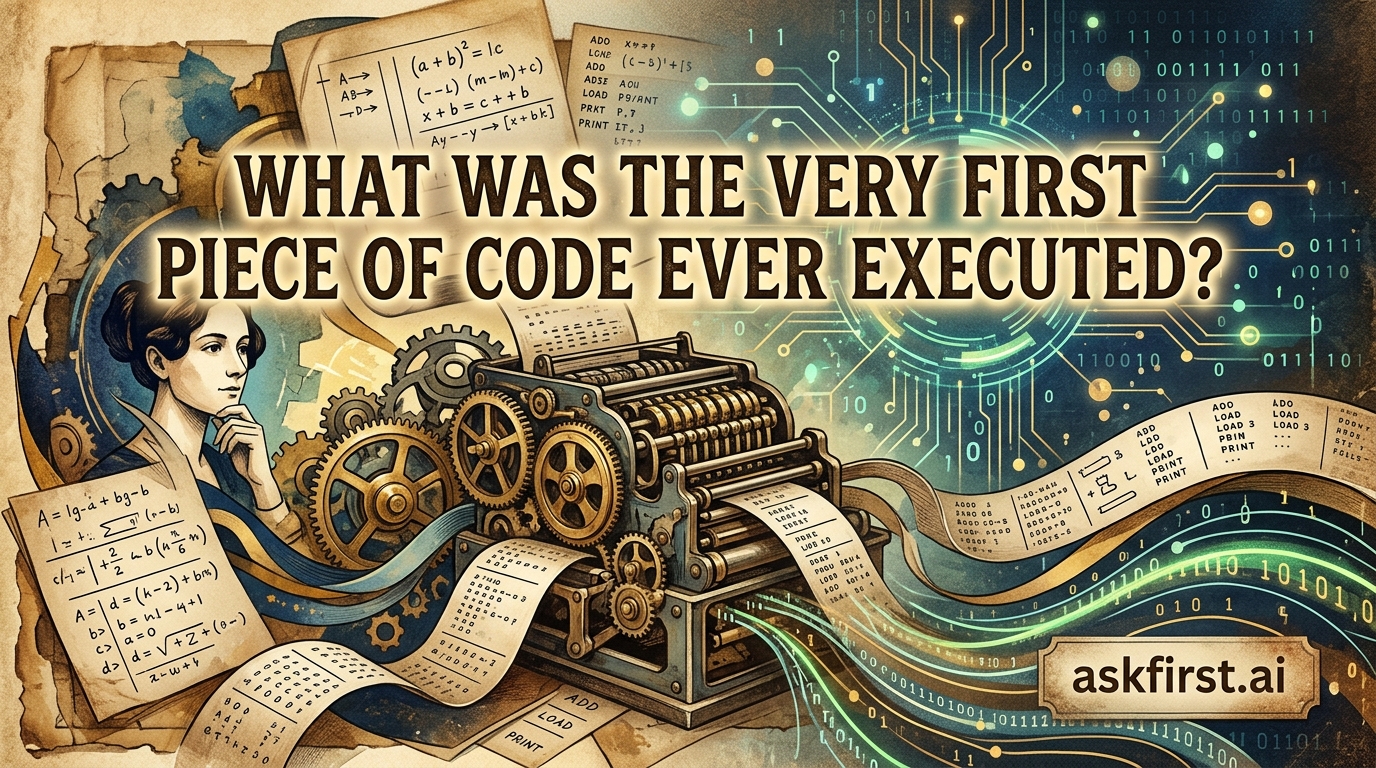
Tracing the origin of computer software requires looking beyond modern high-level languages like Python or Java. The true inception of programmable logic dates back to the mid-1940s, specifically with the development of the Manchester Baby, also known as the Small-Scale Experimental Machine (SSEM). On June 21, 1948, the team led by Frederic Williams, Tom Kilburn, and Geoff Tootill successfully ran the first stored-program software in history.
The Anatomy of the First Program
The code was not written in a modern text editor but was instead manually entered by setting switches to represent binary digits. The program itself was deceptively simple: it was designed to find the highest proper divisor of a given integer. Specifically, it performed a calculation to determine the largest factor of 2 to the power of 18 (262,144) that was not the number itself. To execute this, the engineers had to instruct the machine to perform repeated subtractions—a task that required 17 instructions and took the machine approximately 52 minutes to compute successfully.
Why This Moment Changed Everything
Before the Manchester Baby, computers were essentially static machines. If you wanted to change the calculation, you had to manually rewire the machine, physically moving cables or reconfiguring circuits. This process was tedious, prone to human error, and incredibly time-consuming. The 1948 breakthrough introduced the Stored-Program Concept. By storing both the data and the instructions in the same memory space, the computer could modify its own behavior based on the software loaded into it. This transition from 'hardware-configured' to 'software-defined' computation is the direct ancestor of every smartphone, laptop, and server running today.
Technical Limitations and Ingenuity
Because the SSEM used a Williams tube—an early form of cathode ray tube memory—for storage, the program had to be extremely compact. The memory capacity was a mere 32 words, each 32 bits long. This limitation forced the programmers to be absolute masters of efficiency. Every single bit mattered. The algorithm chosen was a deliberate stress test to verify the reliability of the memory system, as it required the machine to cycle through operations repeatedly without losing the stored data bits to decay.
The Legacy of the 1948 Trial
The success of this 52-minute computation proved that digital storage was a viable paradigm for universal computation. It effectively birthed the field of computer science as we recognize it. While the code itself seems trivial compared to modern artificial intelligence or operating systems, it demonstrated that machines could follow abstract logic to solve mathematical problems independently. Every modern line of code, from video game engines to banking security protocols, is a direct descendant of those 17 instructions executed in a laboratory in Manchester over seven decades ago.