The Logical Foundations: How Math Invented Code
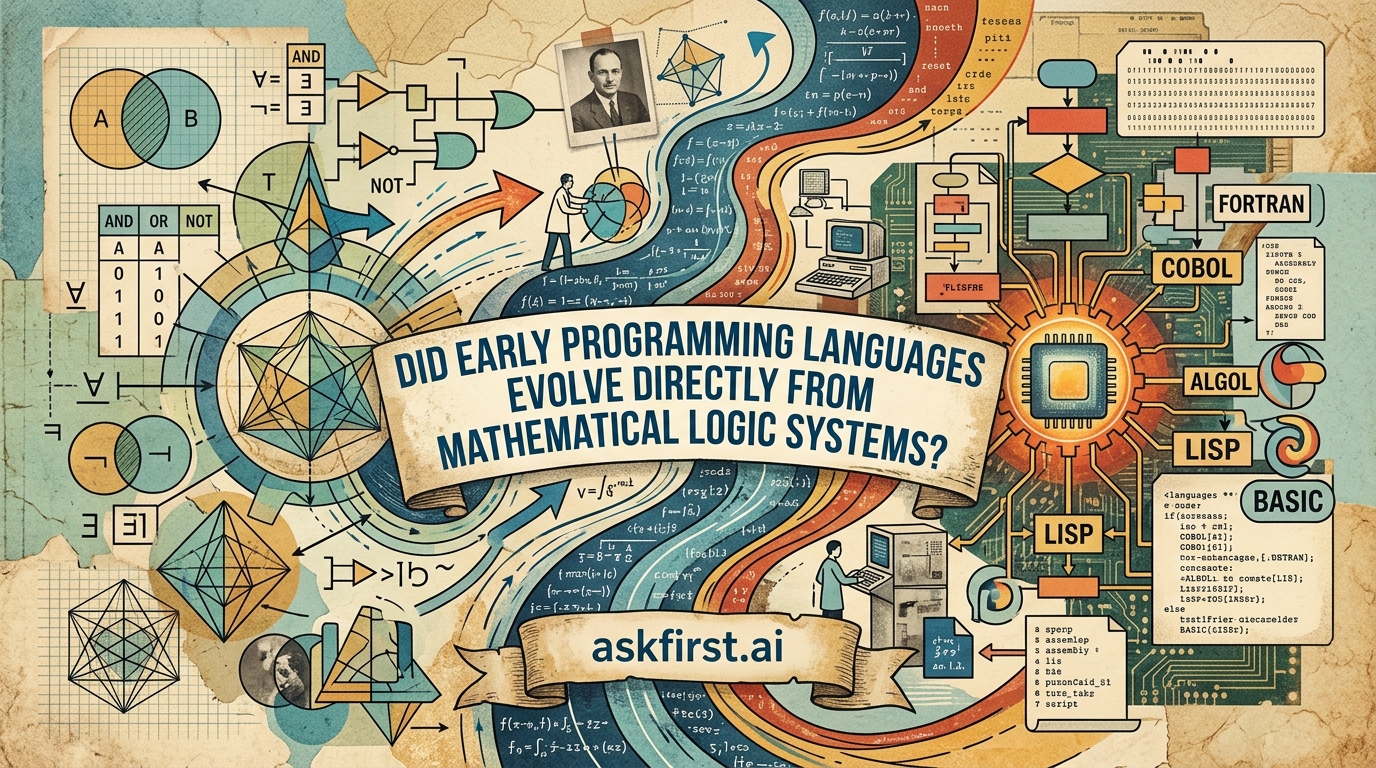
The perception that programming is a modern invention detached from abstract thought is a common misconception. In reality, the architecture of modern software is rooted firmly in the soil of mathematical logic. The short answer is yes: programming languages did not emerge in a vacuum; they evolved directly from formal logic systems designed to solve foundational paradoxes in mathematics.
The Principia Mathematica Influence
At the turn of the 20th century, mathematicians like Bertrand Russell and Alfred North Whitehead attempted to derive all of mathematics from pure logic in their seminal work, Principia Mathematica. While this project faced the existential blow of Kurt Gödel’s Incompleteness Theorems, the methodology established—defining axioms, rules of inference, and symbol manipulation—became the blueprint for computer science. When Alan Turing proposed the Turing Machine, he was essentially creating a mechanical model for logic, effectively mapping symbolic reasoning onto physical components.
The Lambda Calculus and Functional Roots
Perhaps the most direct bridge between pure logic and coding is the Lambda Calculus, developed by Alonzo Church in the 1930s. This formal system defines computation as the evaluation of mathematical functions. It is not merely a precursor; it is the fundamental ancestor of functional programming languages like Lisp, Haskell, and ML. Unlike the imperative languages that focus on state changes, functional languages remain tethered to the mathematical definition of a function, proving that code can be viewed as an executable proof.
Logic as the Syntax of Reality
Early programming pioneers, such as John McCarthy, specifically utilized the principles of recursive logic to create languages that could process symbolic information. The development of languages like Prolog in the 1970s took this further by turning logic directly into a programming paradigm. In Prolog, the programmer defines a set of facts and logical rules, and the language's inference engine solves queries based on that logical structure. This is literally programming as formal logic; the user provides the premises, and the computer finds the conclusions.
Why This Matters Today
Understanding these origins is vital for developers and theorists alike. When one writes code, they are engaging in a process of formal logic, whether they realize it or not. The safety features in modern compilers—such as type checking—are derived from formal logic systems like Hindley-Milner type inference. By grounding software in mathematical certainty rather than ad-hoc scripts, computer science ensured that systems could be verified, debugged, and scaled. The marriage of logic and electronics did not just create the computer; it created a rigorous language for describing the logic of the universe, proving that software is simply math that has learned how to run.