Harmony as Medicine: How Medieval Doctors Used Sound to Heal
In the medieval worldview, health was not merely a matter of biological function but a delicate orchestration of cosmic and bodily forces. Far from viewing medicine as purely mechanical, scholars and physicians of the Middle Ages widely subscribed to the concept of the "Music of the Spheres," a philosophical framework suggesting that the human body operated in mathematical harmony with the universe. Consequently, music was not merely an aesthetic luxury; it was a potent therapeutic tool intended to restore the equilibrium of the body.
The Philosophical Foundation
Medieval medical theory was deeply rooted in the concept of the four humors—blood, phlegm, yellow bile, and black bile. Illness was often diagnosed as an imbalance of these substances, and physicians sought methods to restore "consonance." Drawing from Pythagorean traditions, they believed that specific musical intervals and rhythms mirrored the proper proportions of a healthy human soul and body. Because sound vibrations were considered physical entities that could penetrate the skin and influence the humors, music was utilized as a systematic intervention to correct bodily discord.
Therapeutic Applications
Physicians frequently prescribed specific musical modes to treat distinct physical ailments:
- Relief of Fever: Soothing, slow-tempo melodies were believed to cool the "fiery" humors associated with inflammation.
- Digestive Harmony: Rhythmic, structured compositions were thought to assist in the proper processing of food, acting as an acoustic aid to the metabolic fire.
- Neurological Stability: Music was used to calm the "spirits" that inhabited the brain, a practice particularly noted in accounts involving high-strung patients or those exhibiting signs of melancholy.
The Role of the Physician and the Musician
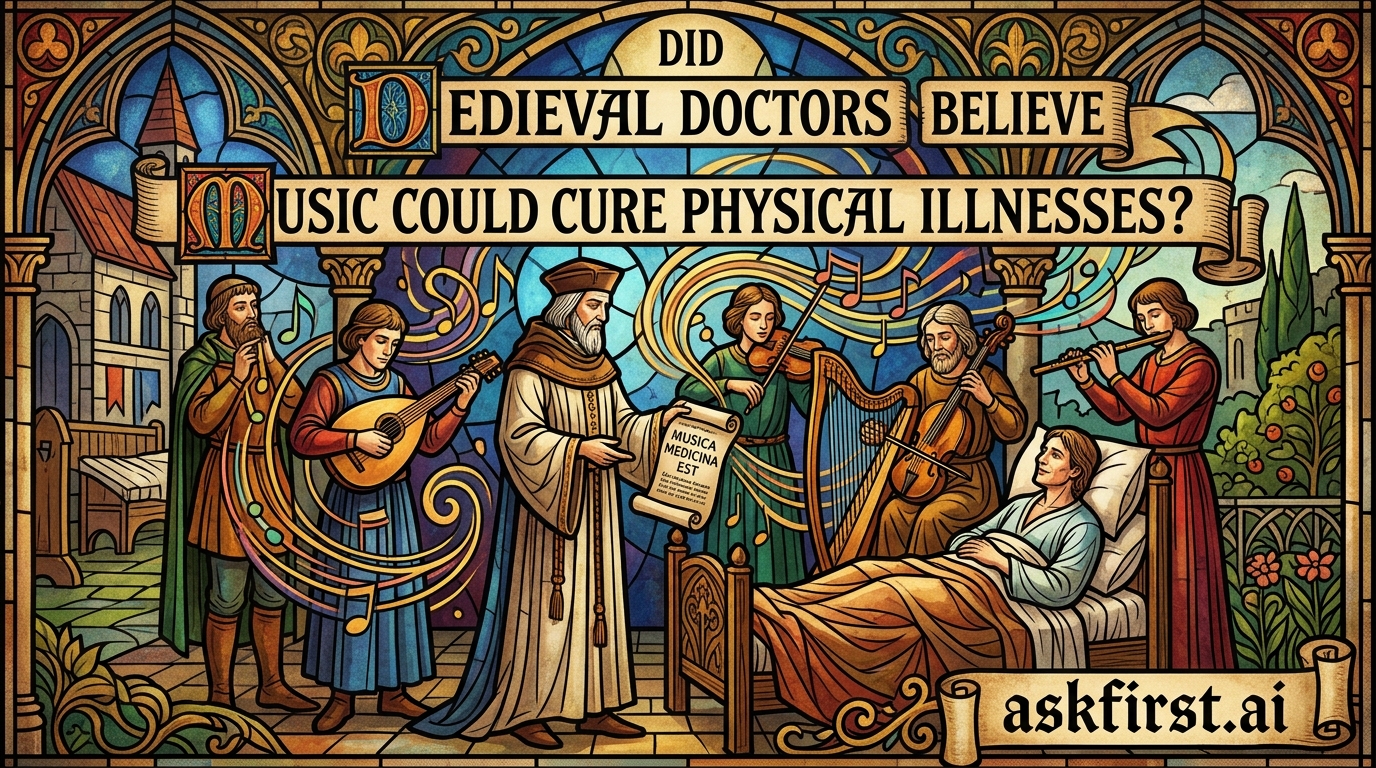
In the medieval hierarchy, the distinction between the musician and the doctor was remarkably fluid. A learned physician was expected to understand the mathematical properties of music, as music was considered part of the Quadrivium—the four liberal arts concerning number and proportion. When a patient suffered from a physical complaint, a physician might order a lutenist or harpist to perform at the bedside. The music functioned as a "sonic prescription," designed to align the internal vibrations of the patient with the healthy, harmonious order of nature. This was not considered "alternative" medicine, but rather a standard, rigorous application of physiological and physical science as it was then understood.
Conclusion: A Legacy of Sound
This historical intersection of acoustics and health reveals that our ancestors recognized the profound influence of sound on the nervous system long before the advent of modern neuroscience. By treating the body as an instrument that could fall out of tune, medieval practitioners established a holistic tradition that viewed external auditory input as a fundamental component of structural health. While their scientific understanding of germ theory was nonexistent, their intuition regarding the physiological impact of sound remains a fascination for modern researchers exploring sound therapy today.