Why Successful People Struggle in Relationships
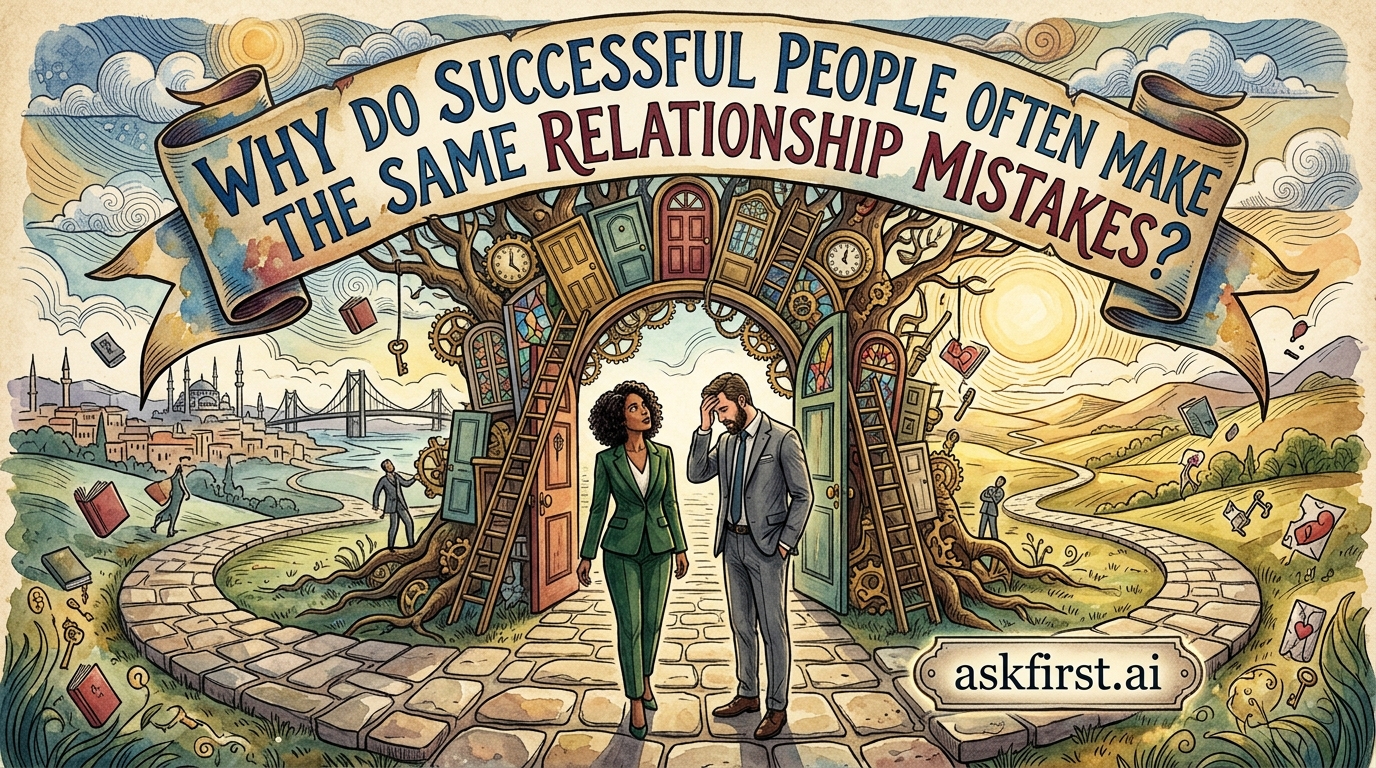
The Success-Relationship Paradox: Why High Achievers Struggle in Love
High-achieving individuals often excel in professional spheres by utilizing logical, result-oriented, and decisive strategies. However, when these same cognitive patterns are applied to the emotional, non-linear terrain of romantic relationships, they frequently lead to recurring patterns of failure. This phenomenon, often termed the 'success-relationship paradox,' arises because the traits that drive professional dominance—hyper-independence, control, and efficiency—are fundamentally antithetical to intimacy.
The Efficiency Trap
Successful people are masters of optimization. They treat problems as obstacles to be solved through clear data and decisive action. In relationships, this manifests as treating a partner like a project or a business partner. When conflicts arise, instead of engaging in vulnerable communication, an achiever may attempt to 'fix' the situation with logic or by setting performance expectations. Research into adult attachment theory suggests that this avoidant-leaning behavior stems from a preference for autonomy, as intimacy is subconsciously viewed as a risk to the control one has worked so hard to maintain.
The Myth of 'Optimal Selection'
Many high-performers fall into the trap of 'optimization selection bias.' They treat finding a partner as a search for the 'perfect candidate' that meets a rigorous checklist of professional and personal criteria. By reducing human beings to a set of data points, they overlook the messy, unpredictable nature of chemistry and emotional compatibility. This hyper-rationality prevents them from embracing the vulnerability required for deep bonding, leading them to choose partners based on prestige or functionality rather than emotional safety.
Cognitive Over-Reliance
High achievers spend their lives rewarding themselves for being right. In their careers, precision is rewarded; in romance, being 'right' is often the death knell for a healthy connection. Maintaining a 'winner's mindset' creates a power imbalance, effectively silencing the partner and preventing the development of a collaborative emotional life. Psychological studies on relational intelligence highlight that the capacity to tolerate ambiguity and demonstrate emotional humility is a stronger predictor of long-term success than cognitive intelligence or professional status.
Breaking the Cycle
To overcome these patterns, high-achieving individuals must consciously pivot their behavioral strategy:
- Embrace Vulnerability as Strength: Redefine vulnerability not as a weakness, but as an advanced tool for fostering trust and deep communication.
- Practice Active Listening: Shift from a 'solution-seeking' mode to an 'understanding-seeking' mode. Silence the urge to solve and focus entirely on the emotional experience of the partner.
- Relinquish Total Control: Allow for 'inefficiency' in the relationship. Real intimacy exists in the gaps between tasks, chores, and objectives—it lives in the unplanned moments of authentic connection.
By consciously unlearning the hyper-independence that served their careers, high achievers can finally create lasting, fulfilling partnerships that mirror the success they have built elsewhere.