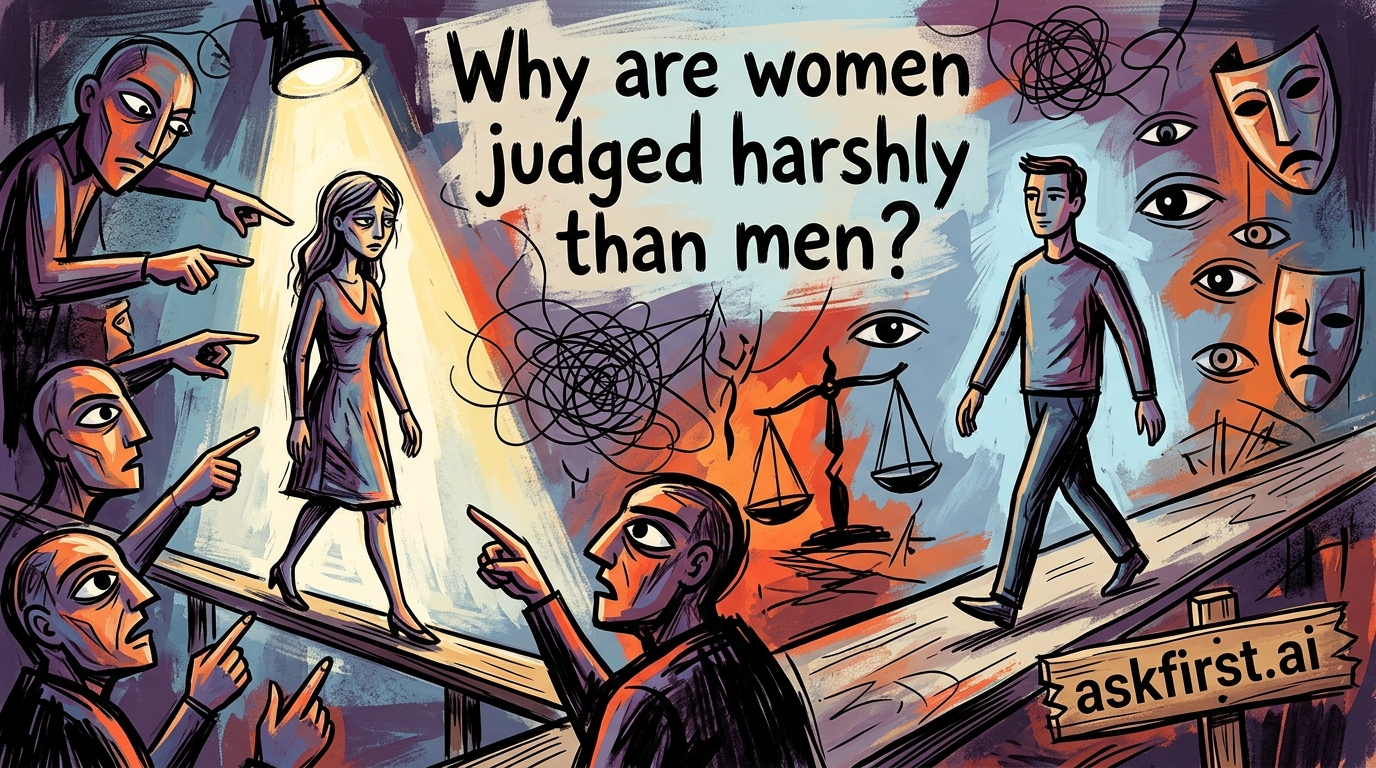
The Sociological and Psychological Foundations of Gender-Based Judgment
The phenomenon of women being judged more harshly than men—often referred to as the "double standard"—is a deeply entrenched sociological construct. This disparity is rooted in centuries of patriarchal structures, evolutionary psychology, and persistent cultural conditioning that dictates how genders "should" behave.
1. Historical and Structural Context
Historically, societies were organized around the public-private dichotomy. Men were expected to occupy the public sphere (politics, labor, warfare), while women were relegated to the private, domestic sphere (child-rearing, caretaking).
- The "Double Bind": Women entering the workforce today often face a double bind: if they are assertive, they are viewed as "abrasive" or "bossy" (violating communal expectations), but if they are warm and accommodating, they are viewed as "weak" or "unfit for leadership" (violating agentic expectations). Men, conversely, are rarely penalized for being assertive, as it aligns with traditional masculine archetypes.
2. The Role of Implicit Bias and Stereotypes
Human brains utilize heuristics to process social information, leading to the formation of gender schemas. These mental shortcuts reinforce specific expectations:
- Communal vs. Agentic Traits: Women are culturally expected to possess communal traits (nurturing, empathy, selflessness), while men are expected to possess agentic traits (competence, dominance, decisiveness). When a woman displays agentic traits, she is often judged more harshly because she is perceived as violating a fundamental social "rule."
- The "Likability Penalty": Research, such as that conducted by Sheryl Sandberg and Adam Grant, highlights the likability penalty. For men, success and likability are often positively correlated; for women, they are often inversely correlated. As a woman becomes more successful, she is frequently perceived as less likable.
3. Practical Implications and Statistics
The impact of these judgments is quantifiable across various sectors:
- Professional Performance Reviews: A study published in the Harvard Business Review analyzed thousands of performance reviews and found that women received vague feedback (e.g., "you are too abrasive"), whereas men received constructive, task-oriented feedback.
- Social and Moral Judgment: In sexual conduct, the double standard persists. Women are frequently stigmatized for sexual activity ("slut-shaming"), whereas men are often culturally rewarded or ignored for the same behavior. This is rooted in historical concerns regarding lineage and property, which prioritized female chastity.
4. Pros, Cons, and Mitigations
While the "cons" of this judgment are clear—diminished career advancement, mental health strain, and reduced agency—the "pros" are essentially non-existent, serving only to maintain outdated power dynamics.
How to mitigate these biases:
- Objective Criteria: Implementing standardized, blind hiring processes to remove gendered language.
- Awareness Training: Educating managers to recognize the "likability penalty" during performance reviews.
- Active Allyship: Encouraging men to call out gendered double standards in real-time.
5. Future Trends
As society moves toward gender parity, the "Gender Role Flexing" trend is emerging. Younger generations (Gen Z and Alpha) are increasingly deconstructing these binaries. However, as women gain more power, the "backlash effect"—a psychological resistance to shifting social hierarchies—may temporarily intensify before long-term equilibrium is achieved. Understanding that these judgments are not reflections of individual merit, but rather symptoms of systemic bias, is the first step toward dismantling them.