The Printers' Monopoly: How Copyright Actually Began
It is a widespread modern misconception that copyright laws were originally designed to protect the creative genius of individual authors. In reality, the legal foundations of intellectual property were built to serve as a tool for state censorship and commercial monopoly by the printing industry. To understand why copyright exists today, one must look back at the introduction of the printing press and the subsequent power struggles between the crown and the publishers.
The Statute of Anne: A Shift in Power
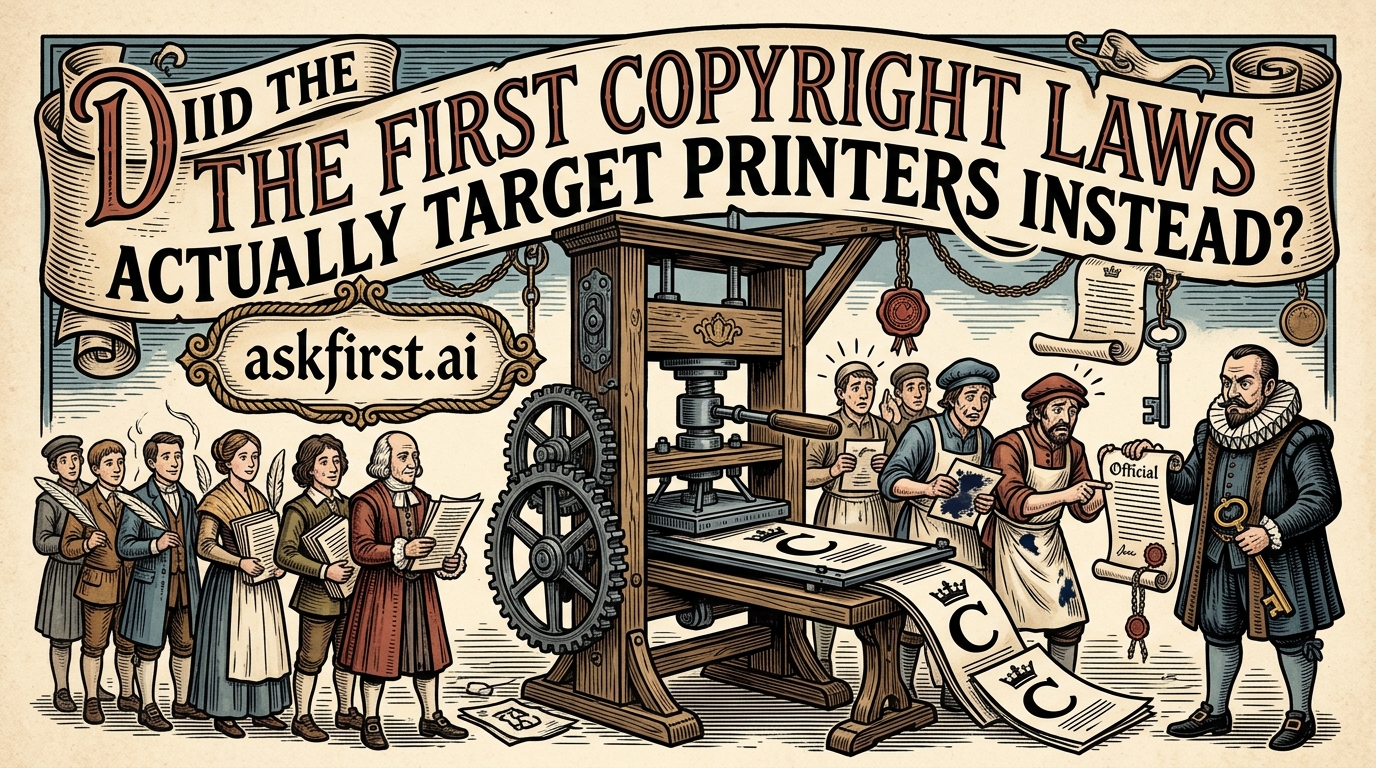
Before the 1710 Statute of Anne in Great Britain—often cited as the first copyright law—the control of books was governed by the Stationers' Company. This was a guild of printers and booksellers who held a legal monopoly granted by the monarch. The objective was never to reward the author for their intellectual effort. Instead, it was an effective mechanism for the government to suppress seditious material and religious dissent. If a printer held the exclusive right to publish, they were held accountable by the crown for the content of every page printed. If they failed to suppress heresy, they lost their printing license.
Why Printers Wanted Regulation
Printers were the primary agitators for legal protection. Without these regulations, the printing market was a chaotic, competitive environment where unauthorized copies could appear instantly. Printers realized that by framing their commercial desire for a monopoly as a matter of "copyright," they could secure exclusive rights over the literary output of others. This was not a move to benefit the struggling writer but a tactical play to ensure that no rival printing house could issue a cheaper edition of a popular title. The author was often paid a flat fee for their manuscript, and the publisher then reaped the long-term profits through these exclusive rights.
The Evolution Toward Authorship
It was only gradually that the emphasis shifted toward the author. By the late 17th and early 18th centuries, the rise of a new class of professional writers began to challenge the absolute dominance of the Stationers. The Statute of Anne finally allowed authors to own the copyright themselves, but the system remained deeply rooted in the printing trade's economic interests. The transition from a tool of censorship to a mechanism for creative property was a slow, legal metamorphosis rather than an instant transformation of intent. While the modern legal landscape heavily emphasizes individual creative rights, the historical lineage remains inextricably tied to the protection of the book trade’s commercial territory. This evolution confirms that the genesis of copyright was essentially a commercial firewall meant to manage the supply of information, long before it became the intricate system of creative rights seen in the digital age.