The Origins of Legal Personality
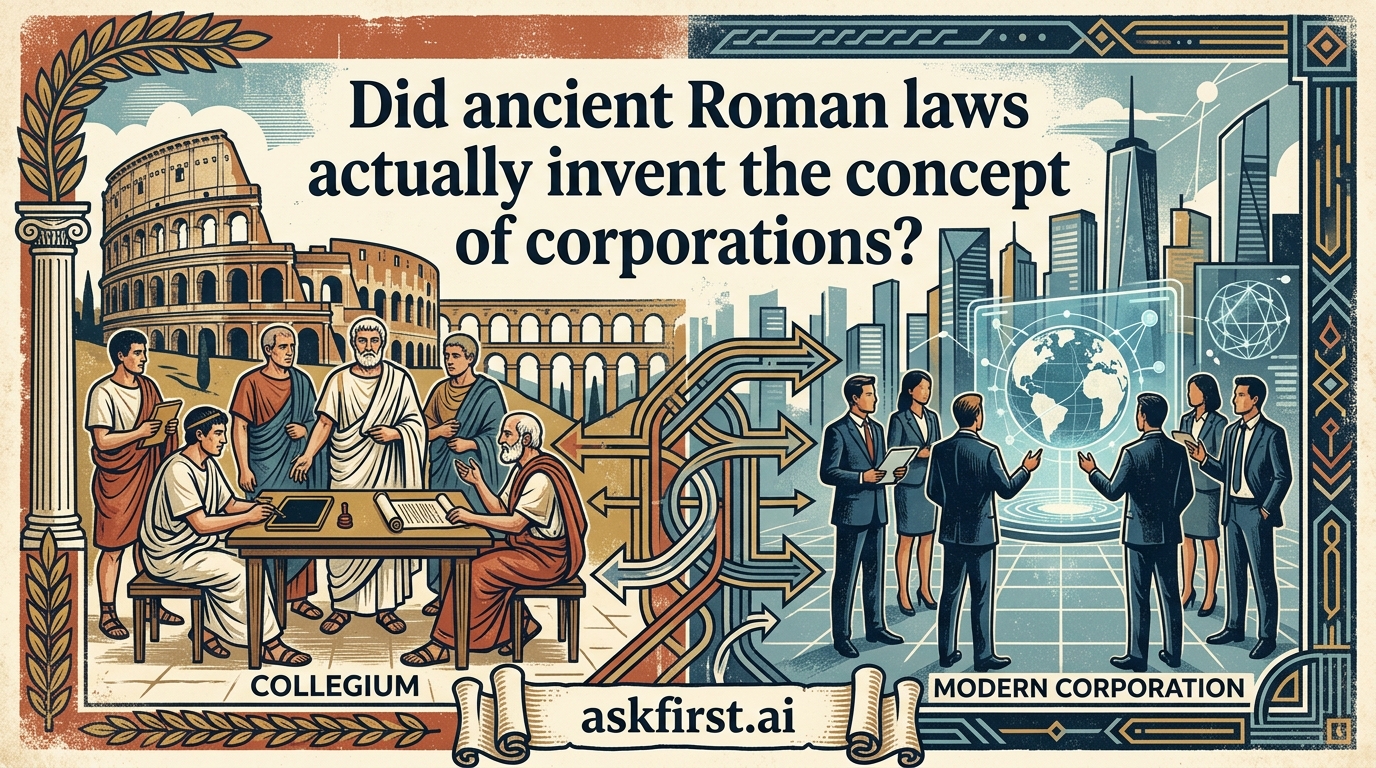
While the modern corporation is often associated with the rise of industrial capitalism, its structural DNA is firmly rooted in the jurisprudence of ancient Rome. Roman law provided the foundational concept of the universitas, a legal entity that possessed an existence separate from its individual members. This was not merely an association of people; it was an artificial person recognized by the state as a distinct entity capable of owning property, entering into contracts, and suing or being sued in court.
The Roman 'Corporatio'
The Romans developed several types of entities that mirror modern corporate features:
- Societas: While primarily a partnership, it established the principle of shared enterprise.
- Collegia: These were associations of individuals, such as guilds, professional organizations, or religious groups, that maintained an autonomous legal status.
- Publicani: During the Roman Republic, the state hired private entities known as publicani to manage tax collection and infrastructure projects. These organizations operated with a level of continuity that allowed them to function even when individual shareholders died or retired.
Why Rome Was the True Pioneer
The breakthrough in Roman law was the legal fiction of the 'corporate body.' By treating an organization as a singular entity (persona ficta), the Roman legal system ensured that the entity's life was not tied to the lifespan of its founders. This allowed for long-term investments in state infrastructure and massive commerce, which are the hallmarks of modern corporate law. This conceptual leap transformed how wealth and power were managed, creating a framework that outlived the empire itself.
From Rome to Modernity
Although the medieval church and later royal charters during the age of exploration significantly expanded these concepts, the core logic originated in Rome. The idea that a group of people could form a legal 'person' allowed for the centralization of capital and the mitigation of individual risk. Modern statutes concerning limited liability and perpetual succession find their earliest echoes in the Roman regulations that governed the collegia. Therefore, when one considers the global economy today, it is impossible to ignore the Roman legal infrastructure that birthed the very concept of a corporate entity. The Romans did not just invent the business organization; they invented the legal architecture that sustains the modern world’s economic systems.