The Cosmic Property Myth
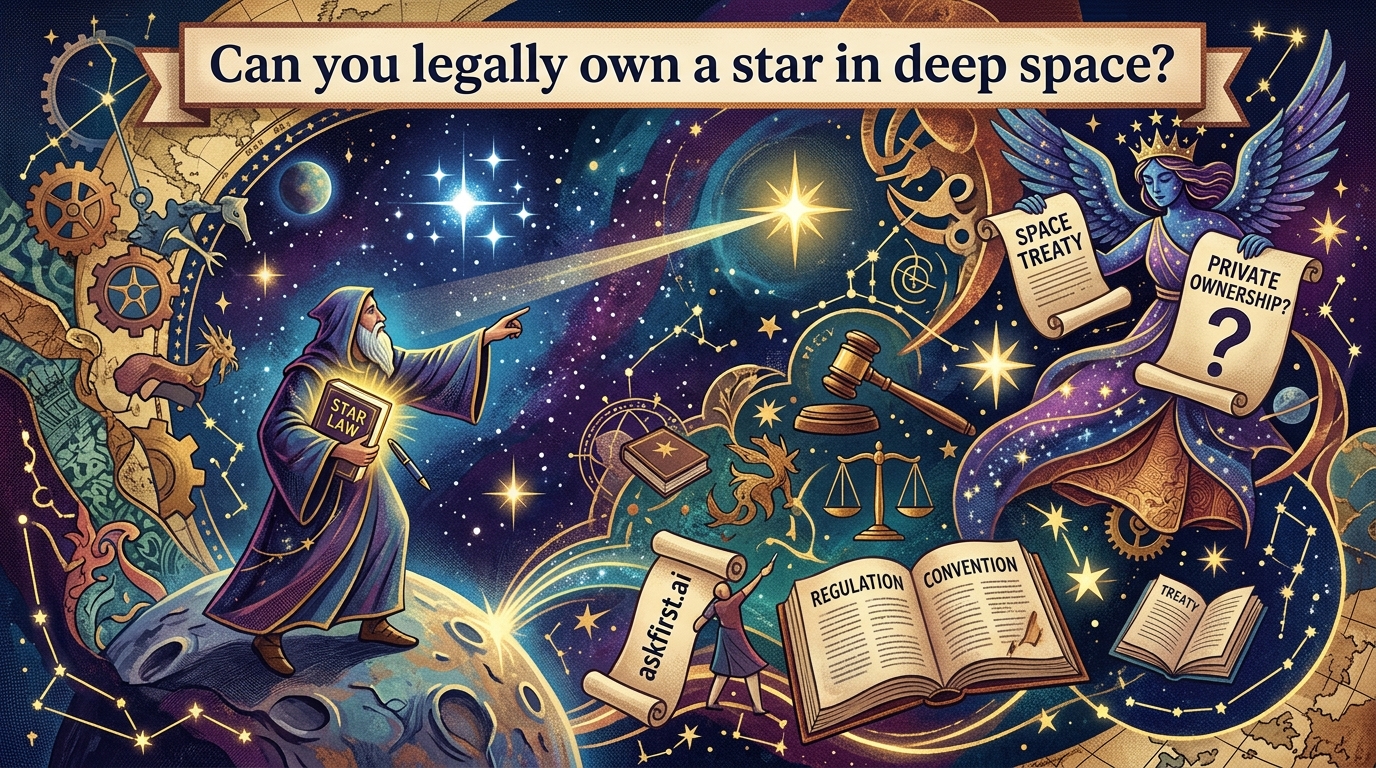
Many individuals are surprised to discover that the romantic notion of purchasing a star via commercial registries is not legally binding. Despite the popularity of companies offering to 'name a star' or assign coordinates to a buyer, these entities have no official authority recognized by the international community. Buying a star is essentially a novelty gift rather than a transfer of property rights, as no legal framework exists to support private ownership of celestial bodies.
The Outer Space Treaty of 1967
The governing document for space activities is the Outer Space Treaty (OST), which was drafted by the United Nations. This international treaty serves as the foundational law for all nations operating in space. Article II of the treaty explicitly states: 'Outer space, including the moon and other celestial bodies, is not subject to national appropriation by claim of sovereignty, by means of use or occupation, or by any other means.' This provision creates a legal barrier that prevents any country from claiming sovereignty over space, which naturally extends to the inability of countries to grant property rights to individuals or private corporations.
Why Private Ownership Remains Impossible
- International Consensus: The OST is ratified by over 100 nations, including all major space-faring powers. This broad agreement ensures that space is treated as the 'province of all mankind.'
- Non-Appropriation Principle: Because no state can claim territory, they cannot delegate title to a private citizen. If a government cannot own a star, it cannot sell or deed that star to anyone else.
- Scientific Integrity: The international astronomical community, specifically the International Astronomical Union (IAU), remains the only body responsible for designating names for celestial objects. They do not sell these naming rights, nor do they recognize names purchased from private commercial registries.
The Reality of Commercial Registries
When a company sells a 'star certificate,' they are selling a service of inclusion in a private database. While the documentation may look official, it carries no weight in astronomy, law, or international relations. Scientists will never recognize a star by a name purchased through these services, and the stellar object continues to be tracked solely by its scientific catalog designations, such as the Hipparcos or Gaia star catalogs. While these gifts can serve as sentimental tokens or commemorative gestures, they do not grant the purchaser any rights to control, visit, or profit from the star. The vast, silent depths of space remain a public commons, free from the ownership claims of any human entity.