Can You Own Your Dreams: The Legal Reality of Copyright
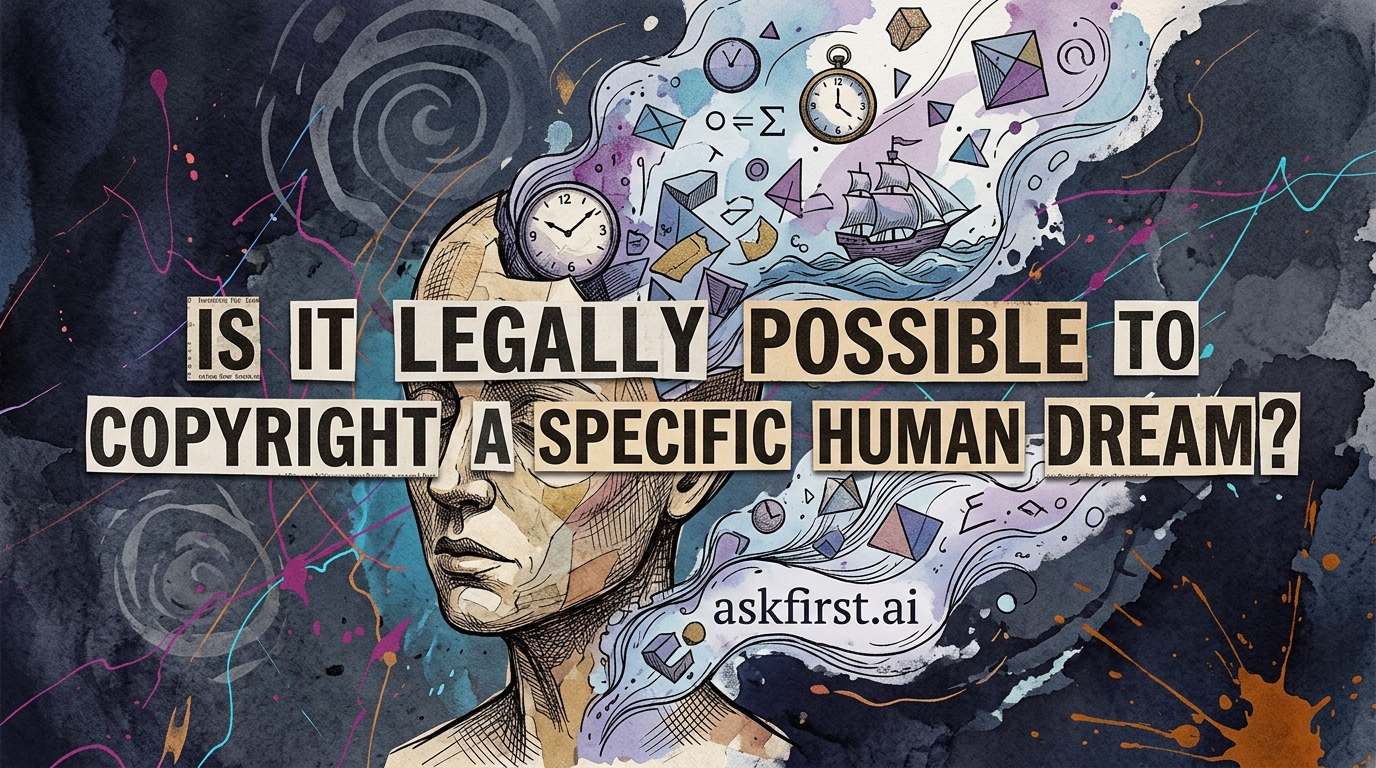
Copyright law functions as a pillar of intellectual property, designed to protect original works of authorship fixed in a tangible medium of expression. However, when it comes to the ethereal world of human dreams, the legal system faces a fundamental barrier: the requirement of fixation. Under current international intellectual property standards, such as the Berne Convention, a creative work must be captured in a perceivable form—such as a manuscript, a digital file, or a painting—to qualify for protection. Because dreams exist only within the neural architecture of the subconscious, they remain outside the domain of copyrightable expression until they are consciously recorded and externalized.
The Barrier of Fixation and Originality
The most significant obstacle is the fixation requirement. Intellectual property law does not protect ideas, concepts, or thoughts in their abstract form. If a person experiences a brilliant, cinematic dream, it remains a fleeting electrochemical event. To gain copyright status, one would have to transform that dream into a physical or digital format. Once a dream is described in writing, recorded on video, or recreated as a narrative, that specific representation of the dream becomes eligible for copyright protection. The law protects the unique expression, not the internal mental experience itself.
Furthermore, copyright requires originality. In legal terms, this means the work must originate from the author and possess at least a minimal degree of creativity. While dreams are often surreal and highly imaginative, they are inherently private. An unrecorded dream is essentially a "work in progress" that never leaves the studio of the human mind. The law cannot extend property rights to something that has not been made public or fixed in a tangible form, as this would lead to impossible scenarios regarding proof of authorship and ownership.
Future Technologies and Brain-Computer Interfaces
The intersection of neurotechnology and law presents a fascinating horizon. With the emergence of fMRI-based brain decoding and brain-computer interfaces (BCIs), scientists are beginning to visualize patterns of activity that correspond to mental imagery. If technology evolves to the point where an individual can "export" a recording of a dream directly from their neural activity to a video file, that output would likely be considered a derivative work or an original recording. At that threshold, the creator would own the copyright to the technological rendering of that dream, much like a photographer owns the rights to a captured image of a real-world scene.
Ultimately, the law distinguishes clearly between the "inspiration" (the dream) and the "fixation" (the artistic record). While humanity continues to be mesmerized by the subconscious, the legal system remains grounded in the necessity of physical manifestation for the granting of intellectual property rights.