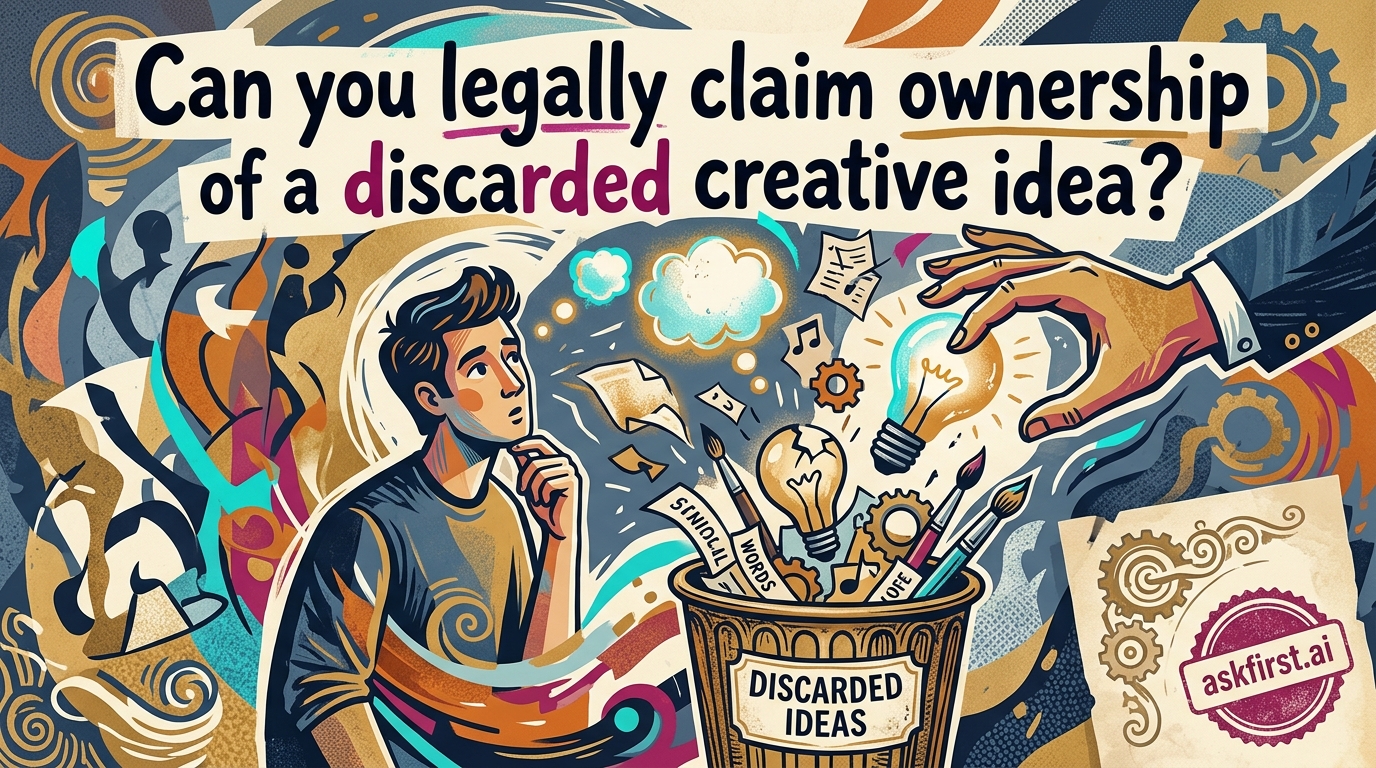
The Legal Status of Abstract Ideas
In the realm of intellectual property (IP) law, there exists a fundamental distinction between an abstract idea and a concrete expression of that idea. The short, objective answer is that you cannot legally claim ownership of a discarded creative idea merely because you conceived it. Under the "Idea-Expression Dichotomy" doctrine, which is a cornerstone of global copyright law, protection is reserved exclusively for the manifestation of thoughts, not the thoughts themselves.
The Idea-Expression Dichotomy
Legal frameworks such as the U.S. Copyright Act of 1976 explicitly state that protection does not extend to any idea, procedure, process, system, or method of operation. If an individual has a concept for a novel app, a screenplay plot, or a business model but fails to commit it to a fixed, tangible medium, the law does not recognize it as property. Even if the idea is documented, simply having it does not equate to ownership. Ownership requires the transformation of the abstract into a specific, identifiable form.
Why Ideas Remain in the Public Domain
Legislators and courts intentionally exclude ideas from copyright protection to prevent the monopolization of creativity. If authors or inventors could own basic concepts, it would stifle innovation by preventing others from building upon existing frameworks. For instance, if one person could own the "idea" of a boy wizard attending a magic school, no other writer could explore that trope. Therefore, ideas must remain free for the public to iterate upon. As noted in landmark cases like Baker v. Selden, the goal is to promote progress by ensuring that the "building blocks" of culture remain accessible.
How to Protect Creative Property
To move from an abstract concept to a legally enforceable asset, one must employ specific strategies:
- Documentation and Fixation: For copyright, the work must be fixed in a tangible medium of expression. This means writing it down, recording it, or sketching it out.
- Patent Protection: If the idea involves a technical process, machine, or manufacturing technique, a patent might be applicable. However, patents require an extremely rigorous application process, proving that the invention is novel, non-obvious, and useful.
- Trade Secret Agreements: If an idea remains proprietary and provides a competitive advantage, it can be protected through Non-Disclosure Agreements (NDAs). This does not "own" the idea in the public sense but creates a contractual obligation of confidentiality between parties.
Conclusion
While the frustration of seeing a "discarded" idea used by another is valid, the legal system remains firm: until an idea is codified into a specific, unique expression, it belongs to the collective consciousness. To own a creative work, one must stop merely thinking and start building, writing, or designing.