The Magna Carta: The Hidden Blueprint of Modern Law
When most people think of the 1215 Magna Carta, they imagine a dusty parchment signed by a reluctant King John in a muddy field at Runnymede. While this document is often mythologized as the singular fountainhead of democracy, its true legacy lies in a much more practical arena: the evolution of legal drafting and the formalization of judicial procedure. The Magna Carta did not merely suggest new laws; it fundamentally transformed the architecture of how governance and legal accountability are structured.
Shifting from Personal Will to Procedural Law
Prior to 1215, law in England was largely an extension of the monarch’s personal whim. Legal processes were often arbitrary, and decisions were subject to the shifting moods of the crown. The Magna Carta initiated a transition toward "the rule of law," which requires that laws be predictable, public, and applied through established processes rather than individual discretion. This shift forced the creation of clearer documentation for royal decrees and legal obligations.
The Roots of Due Process
The most significant contribution to the art of lawmaking is found in Clause 39, which famously states that no free man shall be seized or imprisoned except by the lawful judgment of his peers or by the law of the land. This established a precedent for Due Process, the requirement that the government must respect all legal rights owed to a person. This concept necessitated a more rigorous standard for legal writing. Statutes and decrees could no longer be vague proclamations; they had to define the boundaries of authority so that the judicial system could measure executive actions against those written standards.
Standardization and Legal Language
The Magna Carta also introduced a new level of specificity in legal documentation. By detailing exact weights and measures in Clause 35, the document signaled that laws were becoming tools for economic and social consistency. This fostered a legislative tradition where statutes were designed to be interpreted consistently across jurisdictions. Subsequent English common law evolved to favor:
- Precision: Moving away from broad royal mandates toward targeted legislation.
- Publicity: Ensuring that laws were recorded and could be referenced as evidence.
- Accountability: Establishing that the law applies to those who enforce it as much as those who obey it.
A Global Legislative Legacy
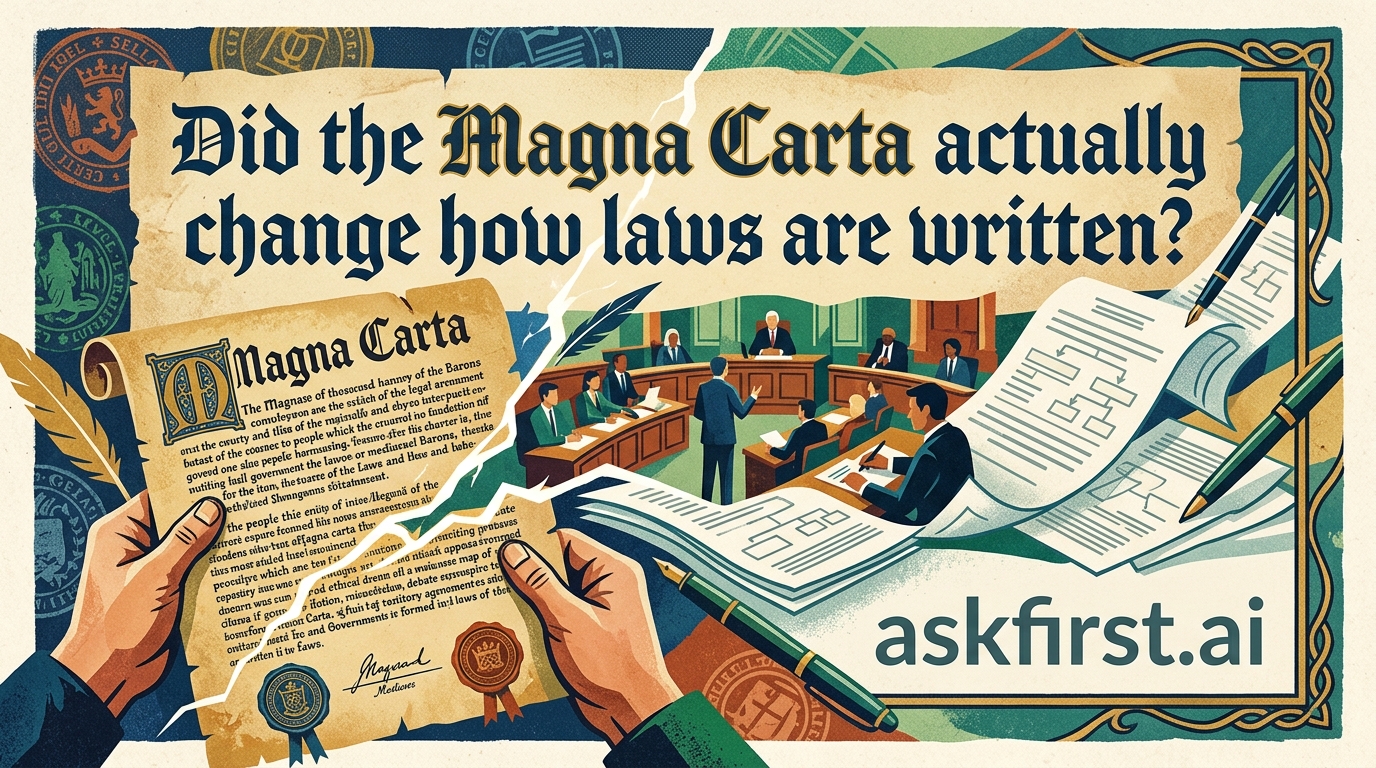
The ripple effects of this approach are visible today in every written constitution. The move from "oral tradition" and "royal proclamation" to the formal, written statute is the direct descendant of the bureaucratic revolution triggered by the Great Charter. Modern legislative drafting—which emphasizes clarity, scope, and the explicit definition of judicial remedies—owes its philosophical foundation to the realization that for law to be binding, it must first be observable and fixed in writing. By forcing the King to commit his concessions to ink, the Magna Carta created the blueprint for every modern legislative body on Earth.